
Avaya Unified Cloud Supply Chain Management Case Study
by Divya
5/22/20264 min read


This case study examines how Avaya Inc., a global leader in business collaboration and digital communications technology, transformed its operations from what corporate leadership classified as a "worst-in-class" framework into a lean digital network. Rapid, consecutive corporate acquisitions capped by the 2009 acquisition of Nortel Enterprise Solutions left Avaya with a highly unstable supply chain footprint.
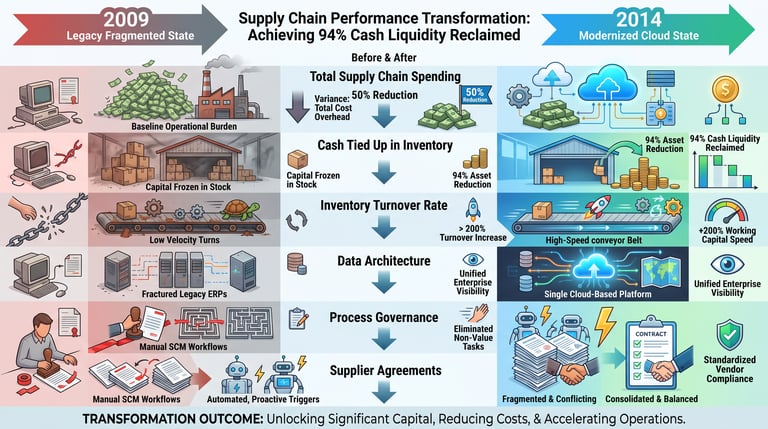
The merged organization was crippled by a severely elongated cash-to-cash cycle, conflicting vendor terms, massive inventory bloat, and manual, paper-driven processes. To reverse this margin erosion, senior management launched a multi-year transformation between 2010 and 2014. By migrating its fractured IT landscape onto a single, unified cloud-based platform and executing systemic cultural shifts, Avaya cut its total supply chain expenditures by 50%, slashed cash tied up in safety stock by 94%, and boosted inventory turns by over 200%.
Avaya’s rapid inorganic expansion strategy outpaced its operational integration. Following the multi-billion-dollar Nortel acquisition, the combined entity’s supply chain fell into systemic instability.
Core Problems Identified
Long Cash-to-Cash (C2C) Cycles: Capital remained frozen in raw material pipelines and unpaid bills due to disconnected internal cash workflows.
Supplier Term Imbalances: Due to separate legacy procurement contracts, vendors operating in the same component tiers held highly mismatched payment terms and delivery agreements.
Information Blind Spots: The IT landscape consisted of multiple isolated software platforms. None of these systems spoke to each other, preventing an enterprise-wide view of global operations.
Manual Process Friction: Demand forecasting, factory replenishment, and delivery handoffs relied heavily on manual data entry, exposing the network to human error.
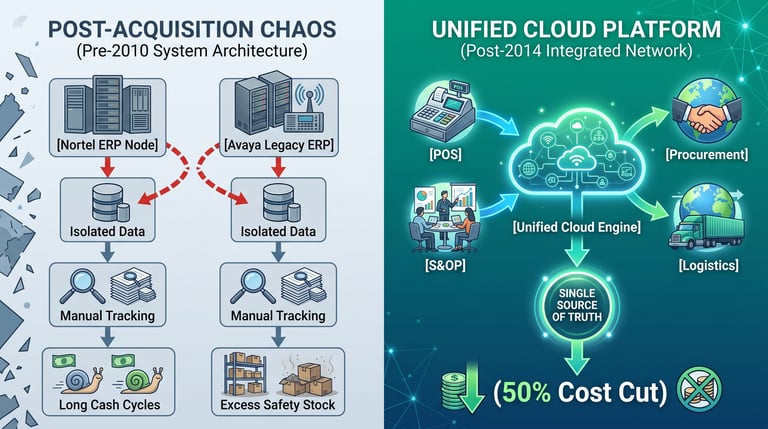
Avaya’s executive team recognized that changing out individual regional software systems would only create new data silos. Instead, they opted for an enterprise-wide approach, relying on cloud-based integration software to unify their existing systems.
Functional Scope of the Unified Cloud Platform
Avaya built a single cloud-based operations engine to link and automate seven key logistics workstreams:
Point of Sale (POS) Analysis: Siphoning real-time demand data straight from sales channels to eliminate delayed forecasting.
Procurement Analysis: Standardizing supplier metrics to identify volume purchasing discounts and clear out redundant vendors.
Supplier Communication: Setting up automated electronic portals to keep component vendors updated on assembly needs.
Supply and Demand Planning: Deploying algorithmic data engines to match global factory capacities with active market trends.
Inventory Planning: Optimizing storage levels to minimize safety stock holdings without hurting parts availability.
Inbound and Outbound Logistics: Centralizing transit data to maximize freight loads and reduce shipping delays.
The Holistic Transformation Triad
Recognizing that software alone cannot fix bad habits, Avaya backed its tech rollout with a three-part organizational change program:
Cultural Re-Alignment: Shifting employee mindsets from simply trying to speed up current tasks to actively questioning why certain steps existed and removing non-value-added tasks entirely.
Talent Investment: Training current staff on data-driven supply chain methods while bringing in specialized talent to run the new cloud platform.
Rigorous KPI Auditing: Setting up uniform Key Performance Indicators (KPIs) and continuous benchmarking loops to catch process slowdowns early.
Over a four-year turnaround period, Avaya completely reshaped its core operational and financial performance metrics.
Cash-to-Cash Cycle Optimization Mechanics
Avaya’s turnaround shows how optimizing the Cash-to-Cash (C2C) Cycle can unlock significant corporate value. The metric calculates the exact number of days cash remains tied up in day-to-day operations:
Cash-to-Cash Cycle = Days Inventory Outstanding + Days Sales Outstanding - Days Payable Outstanding
Avaya’s turnaround shows how optimizing the Cash-to-Cash (C2C) Cycle can unlock significant corporate value. The metric calculates the exact number of days cash remains tied up in day-to-day operations:
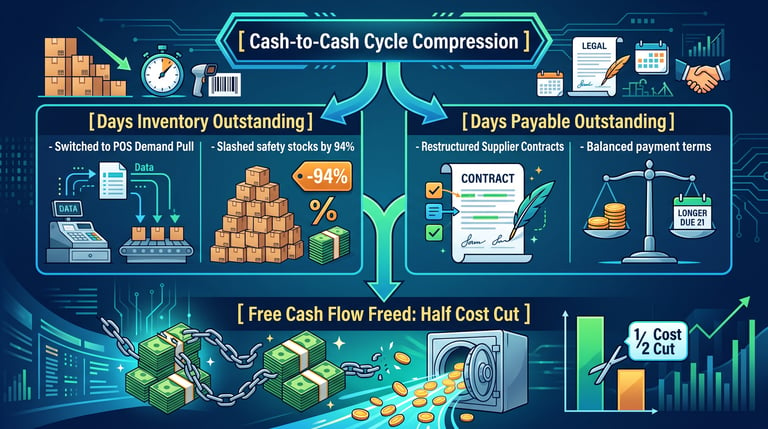
Avaya’s legacy push-based approach caused a huge spike in Days Inventory Outstanding (DIO), trapping cash in unneeded stock. By using real-time POS data and automating replenishment schedules through the cloud, Avaya drastically cut its DIO. Simultaneously, normalizing supplier agreements balanced their Days Payable Outstanding (DPO). This two-sided squeeze freed up trapped capital, allowing Avaya to reduce inventory cash commitments by 94%.
Managing Product Lifecycle Complexity in Mergers
When major technology companies merge, they frequently run into a classic operations issue: a product-process misalignment caused by software bloat.
Buying Nortel added hundreds of legacy SKUs and a fragmented mix of different IT setups to Avaya's portfolio. Instead of spending capital to replace each individual regional software platform, Avaya used an asset-light cloud integration layer. This layer sat on top of the old architecture and extracted clean operational data. This strategy avoided a costly, long-term system swap while delivering the end-to-end transparency needed to run a lean, demand-driven supply network.
Takeaways
The Avaya turnaround provides vital lessons for executive leadership:
Address Post-Merger Friction Early: Growing through acquisitions often masks underlying operational weaknesses until the business is left with high overhead costs and fragmented systems. Post-merger roadmaps must prioritize rapid data and process integration.
Use Cloud Platforms as Network Integrators: You do not always need to completely rip and replace legacy software systems to fix a fractured supply chain. A unified cloud integration platform can effectively connect disparate systems and provide an enterprise-wide view of operations.
Align Technology Changes With Culture: Technology is simply a tool. Achieving a major operational turnaround requires shifting the corporate culture from a reactive approach to a proactive mindset that focuses on eliminating waste and streamlining processes.
Contact
Questions? Reach out anytime.
© 2025 BizSphere. All rights reserved.