
California Plastic Packaging Law Litigation Triggers Massive Compliance Uncertainty For Consumer Goods Corporations
by Divya
6/19/20262 min read


Corporate legal compliance and supply chain risk took center stage as the regulatory framework surrounding California’s Extended Producer Responsibility packaging law faced intense litigation. Multiple high-stakes lawsuits were filed against CalRecycle, the state agency responsible for implementing the landmark Plastic Pollution Prevention and Packaging Producer Responsibility Act, also known as SB 54. The legal complaints accuse the agency of failing to exclude polluting recycling technologies from its approved frameworks, creating massive compliance uncertainty for over 5,700 corporate consumer goods producers operating within the state. For MBA students tracking operational risk and corporate governance, this legal battle represents a critical case study in how fragile state regulatory baselines can suddenly disrupt national manufacturing and logistics strategies.
The timing of this litigation has created immediate operational friction for executive teams, as June 2026 marked the hard statutory deadline for covered companies to register with the Circular Action Alliance or face steep daily financial penalties. This packaging law shifts the economic burden of waste management directly onto the producers, requiring them to completely overhaul their material sourcing, product design, and post-consumer recycling logistics. With thousands of brands caught in the crosshairs of this sudden legal challenge, corporate strategy teams are forced to make high-impact capital expenditure decisions while the underlying regulatory definition of compliant packaging remains a moving target in federal and state courts.
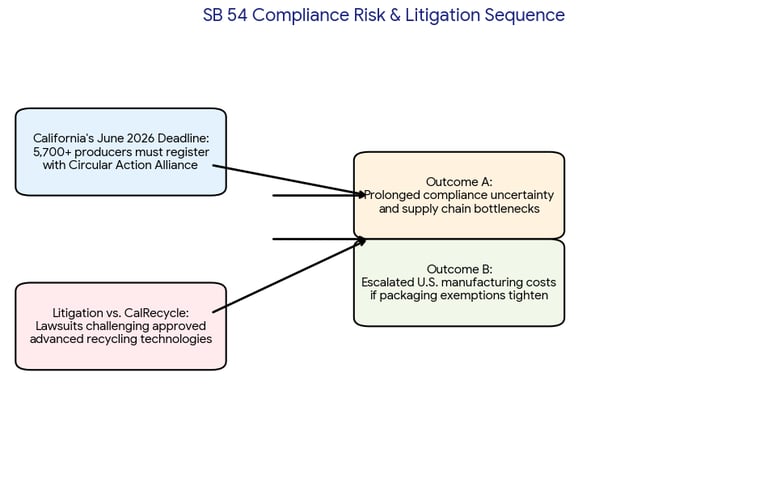
If the courts rule in favor of the plaintiffs and force CalRecycle to dramatically tighten its packaging exemptions, manufacturing compliance costs will scale up exponentially across the entire United States consumer goods sector. Because California represents the largest sub-national economy in the world, multinational corporations rarely design unique packaging pipelines solely for the California market; instead, state-level mandates effectively dictate national production standards. Operations managers and chief financial officers must now re-evaluate their Extended Producer Responsibility strategies, building advanced political risk scenarios into their procurement models to prevent sudden regulatory shifts from stranding raw material inventories and erasing product profit margins.
For graduating MBA classes entering an era defined by aggressive environmental, social, and governance oversight, this California legal battle offers an essential lesson in proactive corporate leadership. Managing a modern supply chain requires looking far beyond immediate unit economics to anticipate the legal and political vulnerabilities hidden within your operational ecosystem. As future corporate leaders, your ability to navigate the complex intersection of environmental law, state governance, and operational resilience will determine whether your organization falters under regulatory penalties or successfully leverages sustainable infrastructure to capture a permanent competitive advantage in the global market.
Contact
Questions? Reach out anytime.
© 2025 BizSphere. All rights reserved.