
Case Study: Portfolio Restructuring and Asset Divestment at Unilever PLC
by Divya
5/13/20263 min read


In the mature Fast-Moving Consumer Goods (FMCG) sector, sustained value creation relies on a delicate balance between price optimization and organic volume growth. Leading up to mid-2023, Unilever PLC increasingly diverged from this balance. Facing aggressive macroeconomic inflation and shifting consumer habits, the multinational conglomerate defended its top-line revenue metrics primarily through aggressive price hikes.
However, this strategy masked a severe underlying vulnerability: steadily declining sales volumes. When an FMCG firm relies entirely on price changes to drive nominal revenue growth, it risks alienating price-sensitive demographics, degrading brand equity, and surrendering market share to nimbler competitors like Procter & Gamble (P&G) and Nestlé.
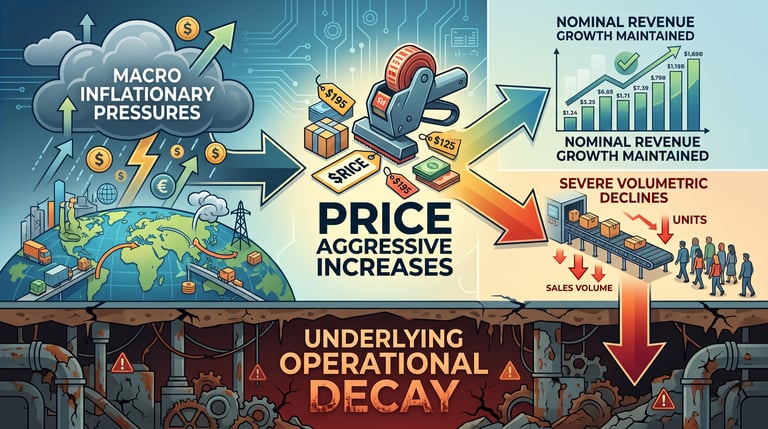
When CEO Hein Schumacher assumed leadership in July 2023, Unilever's multi-brand ecosystem was heavily bloated. Managing hundreds of localized brands distributed across highly fractured product categories created immense internal operational friction. This excessive organizational complexity diluted executive focus and scattered marketing expenditures, causing Unilever's operating margins to trail its pure-play global peers.
To address this underperformance, leadership initiated an operational and structural turnaround program designed to eliminate the "conglomerate discount" the stock market tendency to value a diversified conglomerate at less than the sum of its individual parts. The strategic playbook transitioned from broad market coverage to intensive asset focus, isolating just 30 power brands to receive the majority of corporate capital expenditure and marketing allocation.
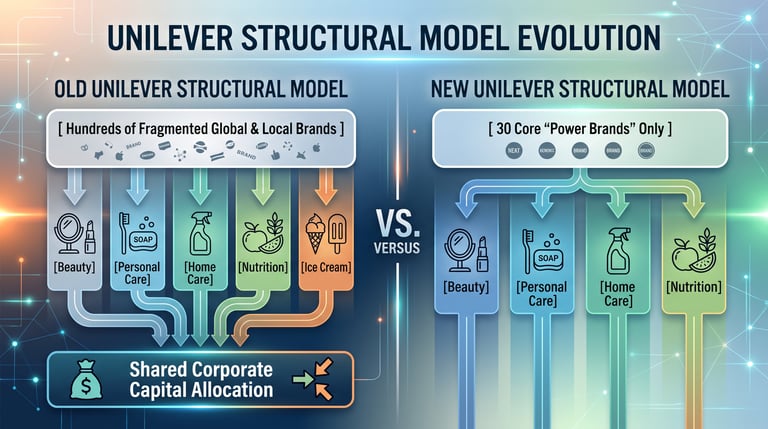
The crown jewel of this restructuring strategy was the complete carve-out and spinoff of Unilever's historic Ice Cream division. This portfolio optimization transformed Unilever's operating model:
Revenue Impact: The Ice Cream division accounted for approximately 13% of Unilever’s total global revenue in 2023. Divesting a business unit of this scale demonstrates a clear prioritization of structural margins over raw top-line volume.
Logistical Diseconomies: From an operational strategy standpoint, the ice cream business model is fundamentally incompatible with the rest of the FMCG portfolio. Ice cream requires a specialized, capital-intensive cold-chain distribution infrastructure (sub-zero manufacturing, specialized refrigerated transport, and dedicated retail freezing units). This operational reality offered minimal to zero supply chain overlap with ambient home care or liquid personal care products.
Macro Volatility: The division's extreme demand seasonality introduced predictable but highly inefficient earnings volatility into the broader corporate portfolio, distorting cash flow predictability.
A corporate turnaround cannot rely solely on structural asset sales; it requires a parallel compression of the parent company's operational cost baseline. To optimize the remaining organizational core, Unilever executed an aggressive retrenchment program aimed at streamlining institutional layers.
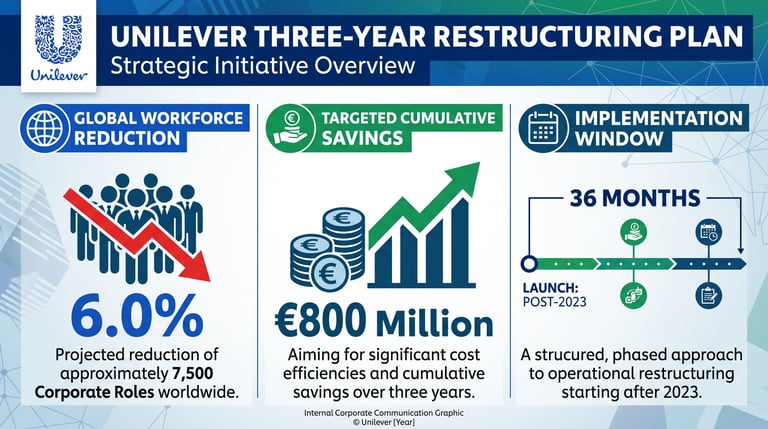
By eliminating roughly 7,500 corporate roles, the restructuring targeted administrative and regional overlaps that developed during years of decentralized expansion. This structural cost extraction was designed to unlock €800 million in cumulative savings over three years. Academically, this structural capital is not intended to sit idle on the balance sheet; it is explicitly engineered to be reinvested into the research, development, and brand-building budgets of the remaining core divisions to aggressively reverse the prior volume declines.
Following the execution of the carve-out, the streamlined Unilever asset profile stabilizes into four tightly aligned, high-margin business groups:
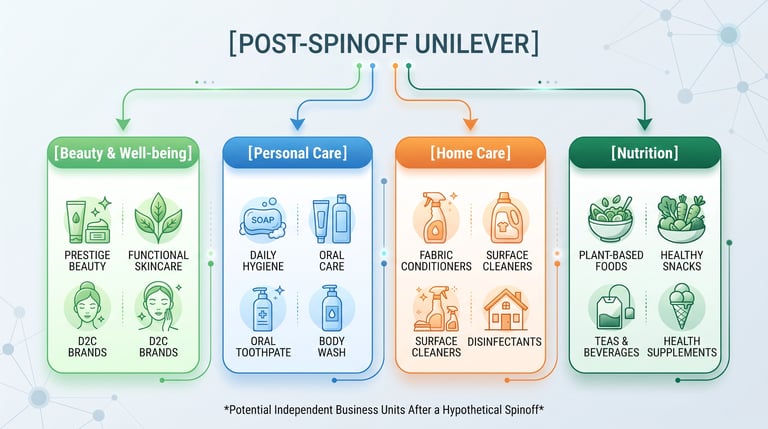
By removing the asset-heavy, capital-intensive cold chain requirements of the Ice Cream division, the newly configured enterprise operates as a more predictable, pure-play ambient consumer goods machine.
Strategic Synergy: How does a complete lack of supply chain overlap (e.g., cold-chain vs. ambient logistics) impact a conglomerate's internal capital market allocation efficiency?
The Conglomerate Discount: Did Unilever's historical reliance on price-driven revenue growth justify an activist investor's push for structural spin-offs, or could the portfolio have been optimized via internal operational fixes?
Execution Risk: What are the primary corporate governance and employee retention risks when executing a simultaneous 6% global workforce reduction alongside a major corporate carve-out?
Contact
Questions? Reach out anytime.
© 2025 BizSphere. All rights reserved.