
China Blocks Meta Acquisition of Manus AI Geopolitical Risk Corporate M&A
by Divya
4/30/20263 min read


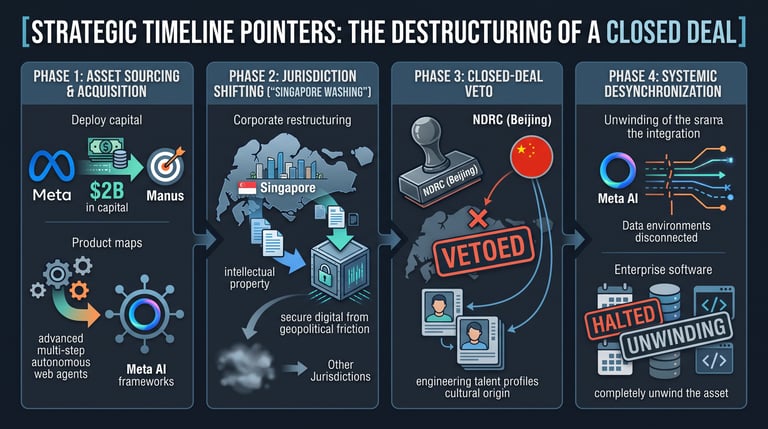
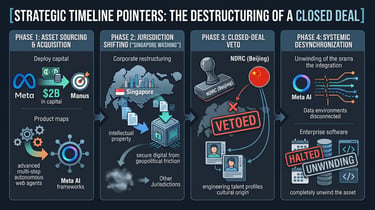
Beijing’s unprecedented intervention to force Meta to unwind its completed $2 billion acquisition of autonomous AI agent startup Manus is a stark reminder that cross-border tech transactions are now a matter of national security The Guardian Reuters. Despite Manus attempting to mitigate regulatory friction by executing a corporate restructuring to Singapore NPR, a maneuver commonly referred to as "Singapore washing"—China’s National Development and Reform Commission (NDRC) successfully asserted its jurisdiction over the deal Global Banking & Finance Instagram. For MBA students evaluating corporate development strategies, this veto represents a permanent shift in how multinational enterprises must account for geopolitical risk in the AI race CNBC Global Banking & Finance.
From a strategic Mergers and Acquisitions (M&A) perspective, this incident completely shatters traditional legal structuring frameworks Shumaker. Historically, corporate development teams assumed that shifting a startup's legal headquarters and intellectual property to a neutral, Western-friendly hub like Singapore would insulate the transaction from adversarial state oversight CNBC Global Banking & Finance. Beijing’s aggressive decision to challenge a transaction that had already closed proves that regulatory review now looks past paper domiciles Reuters Global Banking & Finance. If the underlying technology was built by Chinese engineers within the domestic infrastructure ecosystem, the state claims ultimate gatekeeping authority over its export Reuters Instagram.
This regulatory blockade deals a heavy blow to Meta's broader product roadmap Finance Yahoo. Manus had developed a highly anticipated, workforce-optimization AI capable of executing complex, multi-step web tasks completely autonomously Yahoo Finance BBC. Mark Zuckerberg intended to integrate these agentic frameworks directly into Meta AI to leapfrog competitors in the consumer software utility landscape Reuters BBC. Instead, Meta has been forced to cut off Manus' access to its data systems and instruct its teams to halt integration YouTube, illustrating how geopolitical realities can abruptly compromise technology roadmaps and destroy capital efficiency.
For global venture capital and international business strategy, the implications of this veto are profound. Early-stage funding models rely hems on the assumption that a startup can easily scale toward a lucrative exit via an acquisition by a U.S. Big Tech buyer CNBC. By cutting off this exit pathway for Chinese-rooted deep-tech firms, Beijing is signaling that it considers AI talent and capabilities as critical sovereign wealth that cannot be bought by American capital NPR Global Banking & Finance. This effectively creates a balkanized tech ecosystem where Western buyers face severe capital lockup risks if they attempt to buy innovations tied to Chinese ecosystems Instagram.
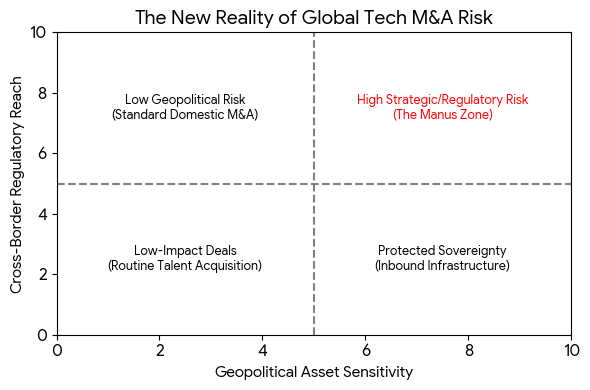
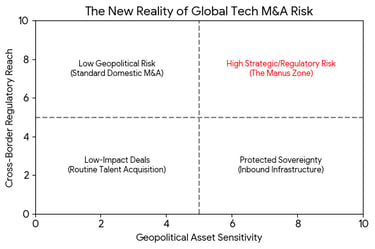
The framework illustrated above defines the new parameters of corporate development in an era of digital nationalism. Traditional M&A due diligence focused almost exclusively on the left side of this matrix, where regulatory reach was predictable and asset sensitivity was measured by anti-competitive market share. However, the Manus intervention pushes cross-border tech deals squarely into the top-right quadrant, The Manus Zone. Here, sovereign nations assert jurisdictional reach based on the cultural and infrastructural origin of a startup's engineering capital rather than its legal tax haven. For strategists, operating in this zone requires a dramatic increase in the cost of capital calculations to account for severe post-closing integration risks and potential forced divestitures Reuters.
Contact
Questions? Reach out anytime.
© 2025 BizSphere. All rights reserved.