
Courageous Accountability Moving the Needle From Diversity Metrics to Inclusive Communities
by Divya
5/14/20262 min read


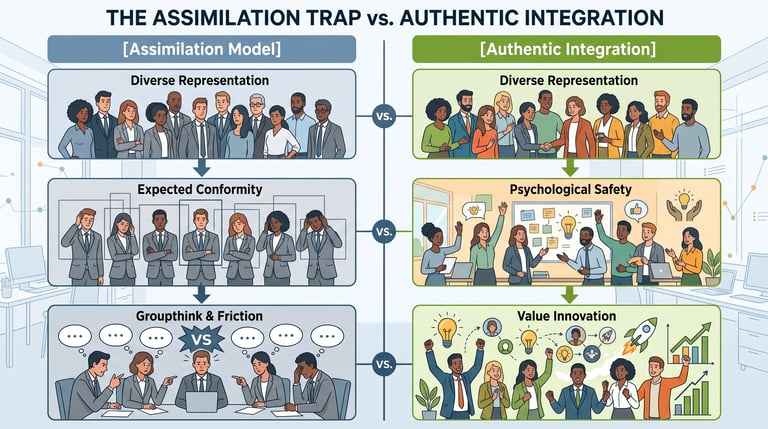
In MBA human capital and organizational behavior coursework, the traditional corporate playbook on Diversity, Equity, and Inclusion (DEI) is increasingly criticized for its superficiality. For years, organizations have treated diversity as a numbers game chasing representation metrics, checking compliance boxes, and launching performative affinity groups. Yet, macro-level workplace data reveals a stark reality: hiring a diverse workforce is entirely useless if the underlying corporate culture forces those individuals to assimilate or remain on the margins. Moving the needle toward true inclusion requires shifting our focus from passive representation to active community building, where authentic diversity is genuinely valued.
Building an inclusive corporate community demands that leadership look beyond the traditional HR dashboard and redesign the actual architecture of everyday workplace interactions. Authentic diversity thrives only when employees feel the psychological safety required to bring distinct perspectives, cultural backgrounds, and non-conformist problem-solving styles to the table without fear of professional penalty. This transition means moving away from a culture of assimilation where minority employees are subtly expected to adopt dominant communication and leadership styles and moving toward a culture of integration. In an integrated workplace, organizational norms are continuously reshaped by the unique identities of its workforce.
At the core of this structural evolution is a concept often missing from corporate strategy: courageous accountability. Accountability in DEI is frequently reduced to annual reporting or diversity spend quotas. True, impactful accountability, however, requires systemic courage from executive leadership down to front-line managers. It means having the structural courage to link executive compensation directly to inclusion benchmarks, tie team retention rates to managerial promotions, and audit internal talent pipelines for systemic bias. Without explicit, measurable consequences for exclusionary behavior, diversity initiatives remain empty public relations exercises.
So, what exactly does courage have to do with it? The answer is: everything. True inclusion disrupts comfort zones, challenges legacy power dynamics, and forces a reevaluation of what "culture fit" actually means within an organization. For future business leaders, demonstrating courage means leaning into the profound discomfort of difficult conversations, calling out subtle micro-exclusions in real-time meetings, and dismantling entrenched talent acquisition systems that favor elite, homogenous networks. It requires the courage to champion equitable systemic adjustments over comfortable corporate rhetoric, recognizing that a truly inclusive environment may initially introduce creative tension before yielding innovative breakthroughs.

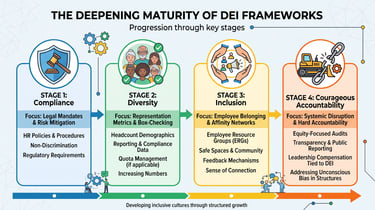
Ultimately, for the next generation of MBA leaders, the mandate is clear: inclusion is an active, continuous leadership discipline, not a passive organizational state. Transitioning from a diverse headcount to an inclusive, high-performing corporate community is impossible through safe, non-controversial policies alone. It demands a culture of courageous accountability where leaders willingly put skin in the game to protect authentic diversity. When corporate leaders match their systemic structures with personal courage, organizations finally stop merely counting heads and begin making those heads count.
Contact
Questions? Reach out anytime.
© 2025 BizSphere. All rights reserved.