
Deconstructing Corporate Greenwashing and the Strategic Rise of Greenhushing
by Divya
4/3/20264 min read


The intersection of marketing, corporate governance, and sustainable operations has given rise to deep structural challenges concerning how firms communicate their environmental performance. Academic literature defines greenwashing as the act of misleading consumers regarding the environmental practices of a company at the firm level, or the environmental benefits of a product or service at the product level [Delmas & Burbano, 2011]. For future business executives, managing this communication dynamic is a high-stakes challenge. Greenwashing is no longer just a public relations issue; it is a systemic strategic risk that actively degrades human capital, triggers employee retaliation, increases turnover, and erodes long-term corporate valuation [Robertson et al., 2023]. Understanding the drivers, typologies, and emerging counter-trends of this phenomenon is required to build a resilient, compliant enterprise.
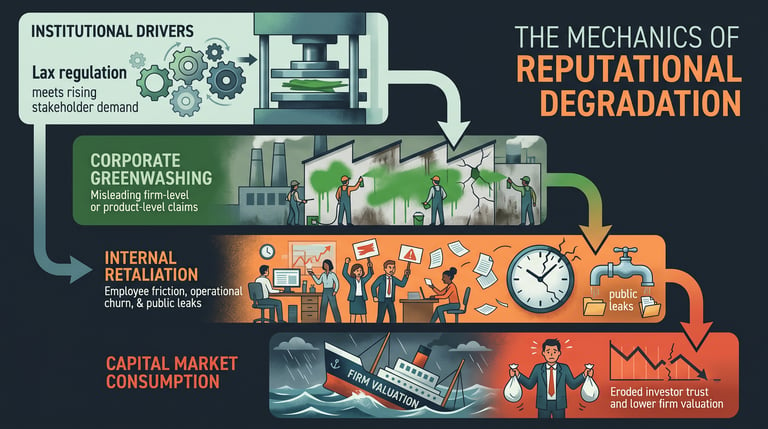
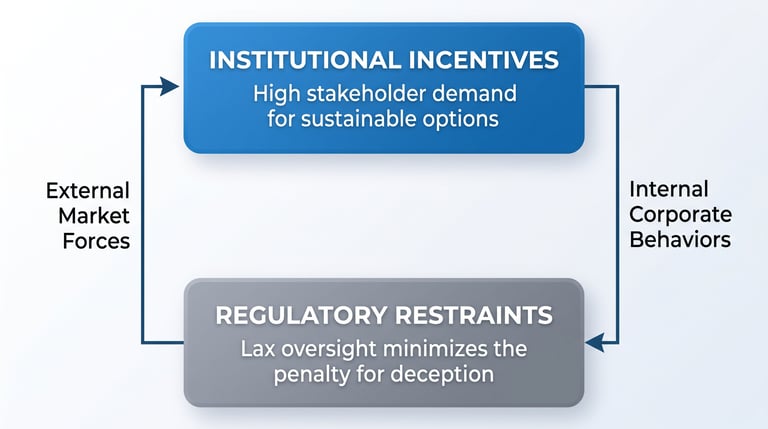
The underlying drivers of greenwashing operate at both an institutional and organizational level [Hahn, 2022]. Externally, a lax and uncertain regulatory environment significantly reduces the legal and financial risks associated with making exaggerated environmental claims [Hahn, 2022]. This weak regulatory oversight combines with an intense, rising demand from stakeholders including consumers, activist groups, and institutional investors for companies to display sustainable behavior [Hahn, 2022]. Internally, specific organizational characteristics, industrial classifications, and structural incentives influence greenwashing tendencies [Hahn, 2022]. Firms operating in highly pollutive or sensitive industries often perceive a greater opportunity to capture competitive advantages, premium product pricing, or a lower cost of capital by artificially inflating their green credentials [Hahn, 2022].
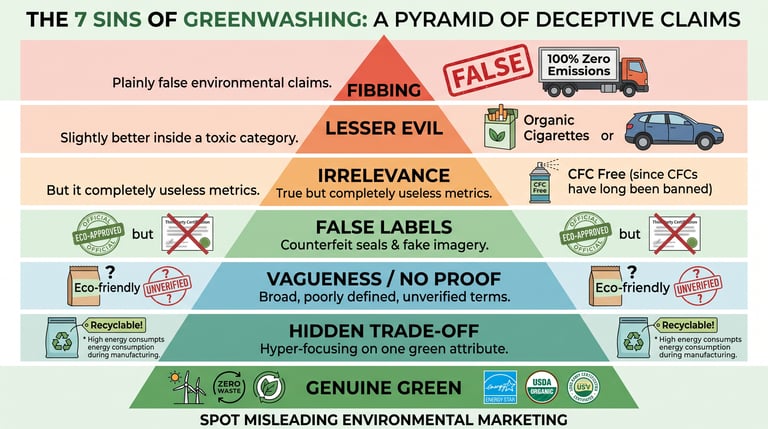
At the product level, greenwashing manifests across seven distinct typologies that distort market signals and erode consumer confidence [Hahn, 2022]. The first is the hidden trade-off, where an organization advertises an asset as sustainable based on a narrow set of attributes while completely ignoring other severe, connected environmental lifecycle costs [Hahn, 2022]. This is closely supported by the sins of no proof, where companies make unsubstantiated environmental claims without third-party validation, and vagueness, which relies on broad, poorly defined phrases like "eco-friendly" or "natural" that are prone to consumer misunderstanding [Hahn, 2022]. Organizations also engage in worshipping false labels by misleadingly using certification-like imagery or counterfeit seals [Hahn, 2022]. Furthermore, companies rely on irrelevance, making claims that are technically true but useless to the product's actual footprint, or the lesser of two evils, where a product claims to be more sustainable than a competitor's alternative even though the entire product category is inherently unsustainable [Hahn, 2022]. The final, most egregious product-level typology is fibbing, which involves making environmental assertions that are completely false [Hahn, 2022].
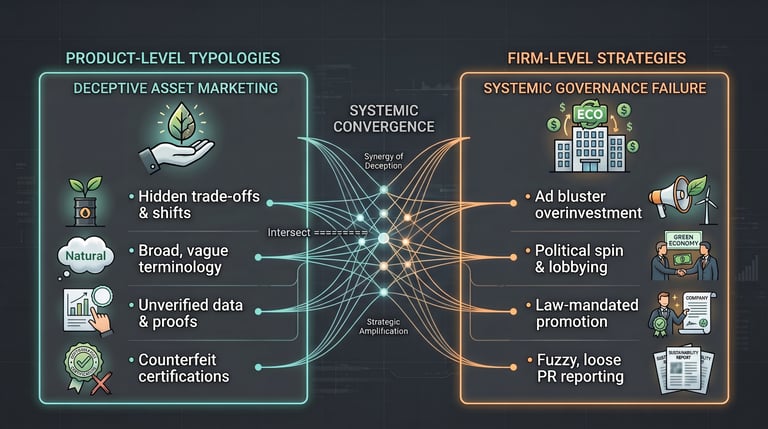
When evaluated at the enterprise level, greenwashing transitions from basic product marketing deception into systemic corporate governance failure [Hahn, 2022]. This institutional greenwashing is classified into five distinct corporate maneuvers [Hahn, 2022]. The first is dirty business, where a firm with an inherently unsustainable core operational model uses isolated sustainable products to promote its entire brand image [Hahn, 2022]. The second is ad bluster, an aggressive communication tactic where an organization deploys mass advertising to exaggerate minor environmental achievements, occasionally spending more capital on the public relations campaign than on the actual sustainability initiative itself [Hahn, 2022]. The third, political spin, represents a deep governance failure where a firm communicates public commitments to sustainability while actively funding lobbying efforts to weaken environmental laws and regulations [Hahn, 2022]. This matches the fourth maneuver, "It’s the law, stupid!", where an enterprise promotes environmental achievements that are already legally mandated by regional regulations [Hahn, 2022]. Finally, corporations utilize fuzzy reporting, exploiting unregulated or loosely structured sustainability reporting metrics as a one-way communication channel to manipulate public perception without providing verifiable data [Hahn, 2022].
Compounding this landscape is the rising counter-trend of greenhushing, where companies deliberately choose not to share the positive operational steps they are taking to reduce their carbon footprint due to fear of external backlash. Corporate executives find themselves caught in a high-stakes crossfire. If an enterprise publicly states its environmental, social, and governance (ESG) goals and reports its metrics, it faces immediate pushback from progressive stakeholders who argue the plans lack sufficient ambition or structural depth. Conversely, the exact same public disclosures draw aggressive criticism from conservative investors, politicians, and legal bodies who argue that ESG expenditures undermine fiduciary duties, hurt profit margins, or run counter to local values. This dual-sided threat has forced many risk-averse leadership teams to intentionally hide their genuine sustainability achievements, choking off the transparent sharing of best practices that could accelerate industry-wide decarbonization.
To navigate this toxic landscape of greenwashing accusations and greenhushing paralysis, modern executives must adopt a holistic lifecycle perspective that separates superficial "feel good" initiatives from deep systemic impact. Superficial actions, such as outlawing plastic straws or removing mini-shampoo bottles from hotel rooms, often generate strong initial public relations value but have virtually zero impact on the global accumulation of plastic garbage. In fact, these changes frequently shift the environmental burden elsewhere, introducing new carbon and logistical costs to manufacture, transport, install, and maintain larger bulk replacement containers.
True sustainable strategy requires evaluating the entire value chain, accounting for complex trade-offs across raw materials, recycling processes, and lifecycle logistics. For example, a toy manufacturer might discover that a program designed to recycle old plastic toys into durable building bricks actually generates higher net carbon emissions due to the energy required to process the materials and the logistics of consumers shipping heavy old items back to centralized plants. Similarly, Tesla faces deep structural questions regarding its battery supply chain, balancing the short-term capital expenditures of advancing closed-loop battery recycling and eliminating conflict minerals against the long-term benefits of reducing reliance on newly mined, high-risk rare earth metals. Ultimately, modern executive leadership requires moving past superficial, public relations-driven slogans to build verified, data-backed operational frameworks that can withstand rigorous scrutiny from both capital markets and civil society.
Contact
Questions? Reach out anytime.
© 2025 BizSphere. All rights reserved.