
Deconstructing the Red Ocean Traps Why Smart Managers Stay Stuck in Bloody Waters
by Divya
5/11/20262 min read


In competitive strategy, W. Chan Kim and Renée Mauborgne’s Blue Ocean Strategy famously challenged leaders to stop fighting over scraps in overcrowded markets ("Red Oceans") and instead create uncontested market space ("Blue Oceans"). Yet, despite analyzing the textbook case studies, many brilliant managers fall straight into Red Ocean Traps. These traps are deeply ingrained, subconscious assumptions driven by traditional marketing and corporate frameworks. To truly innovate, MBA students must learn to unlearn the default competitive playbook.
The first and most dangerous trap is the belief that customer-led innovation equals market creation. When companies ask their existing customers what they want, they receive iterative requests: faster, cheaper, or slightly better features. This binds the firm closer to the current industry standard. To escape to a Blue Ocean, strategists must look at non-customers and understand why they refuse to use the industry's products. Shifting focus from customer retention to non-customer pain points is the real driver of new demand.
Another pervasive trap is treating niche strategy and market creation as the same thing. Traditional Porterian frameworks teach us to segment markets to find premium or highly specific customer subsets. However, creating a Blue Ocean is not about hyper-segmentation; it is about desegmentation. True value innovation happens when you identify commonalities across customer groups. This allows you to build a massive, entirely new demand pool rather than carving out a smaller, specialized slice of a shrinking market.
Furthermore, managers frequently confuse technological innovation with value innovation. A breakthrough technology does not guarantee commercial success unless it is explicitly tied to utility, price, and cost positions that buyers value. Consider how Segway introduced an incredible technical feat but failed to create a viable mass market. Conversely, companies like Starbucks or Uber captured Blue Oceans by leveraging existing technology wrapped in radically superior customer utility. Technology is an enabler, not the strategy.
Finally, the ultimate operational trap is the assumption that a company must choose between differentiation and low cost. Traditional strategy dictates a strict trade-off: you either premiumize or you slash prices. Blue Ocean strategy breaks this trade-off through a mechanism called Value Innovation. By simultaneously pursuing differentiation and low cost, a firm eliminates factors the industry takes for granted while raising value metrics well above the industry standard.
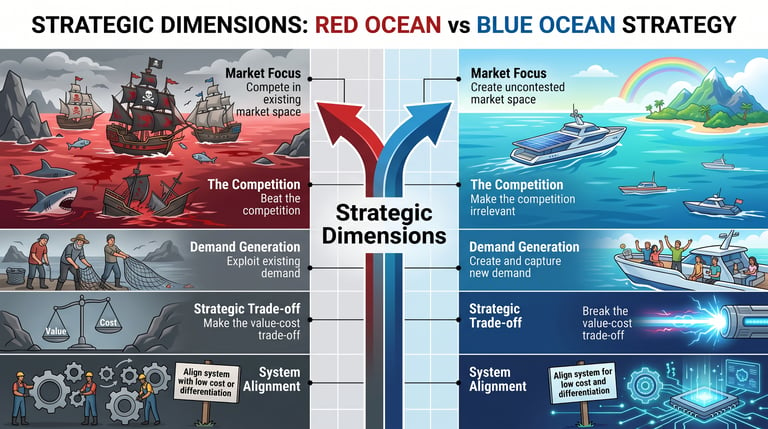
To successfully steer a company away from bloody competition, MBA students must shift their mindset from "fighting the enemy" to "making the enemy irrelevant." Escaping Red Ocean Traps requires looking beyond existing customer data, resisting the urge to over-segment, and refusing to accept traditional cost-value trade-offs. True strategic leadership isn't about playing the game better than everyone else—it is about rewriting the rules of the game entirely.
Contact
Questions? Reach out anytime.
© 2025 BizSphere. All rights reserved.