
Digital Transformation of a Legacy Bank Modernizing a Century Old Institution for Gen Z
by Divya
6/24/20262 min read


The core challenge centered on executing a multi-layered organizational transformation: completely overhauling rigid legacy IT infrastructure while simultaneously shifting deeply entrenched employee mindsets toward an agile corporate culture. Decades of operating in silos had left the bank with fragmented data systems, manual back-office approvals, and a risk-averse workforce accustomed to slow, bureaucratic product deployment cycles. To compete effectively with fintechs, the bank needed to build a seamless, real-time mobile banking experience. However, achieving technical agility was impossible without first dismantled the cultural resistance of a workforce wary of automated workflows and rapid operational changes.
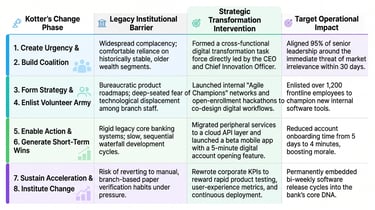
To systematically drive this massive institutional pivot, management deployed Kotter’s 8-Step Change Model to govern the organizational transformation.
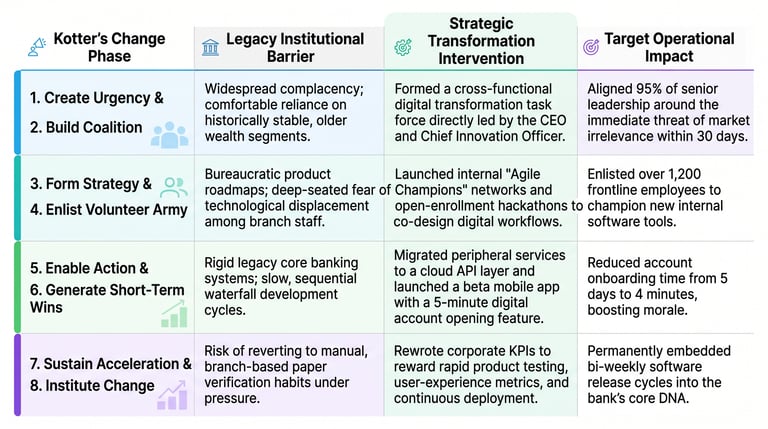
Simultaneously, the digital product team utilized the Value Proposition Canvas to fundamentally redesign the bank’s mobile features specifically for the digital-native Gen Z demographic. By mapping out the precise customer profile—isolating the daily jobs, pains, and gains of younger banking users—the team successfully aligned the bank's new product offerings with modern expectations. The canvas revealed that Gen Z consumers viewed traditional physical branch banking as a major friction point, demanding instead immediate, automated financial wellness tools, transparent fee structures, and frictionless peer-to-peer payment integrations.
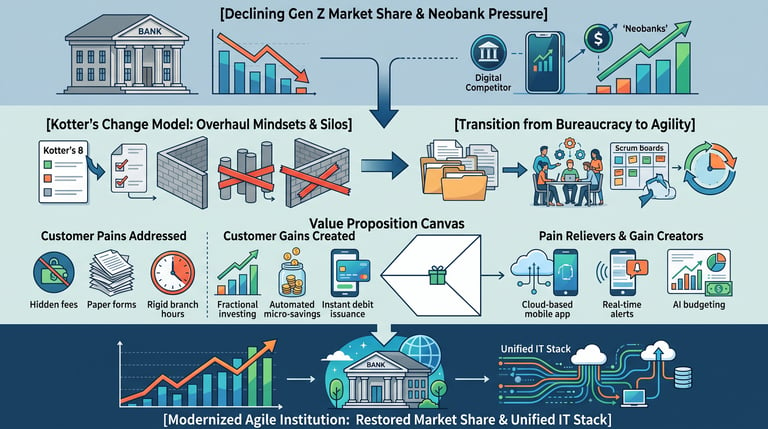
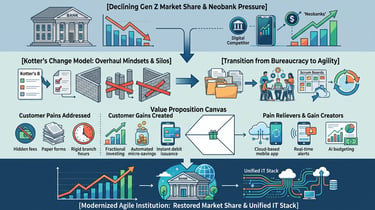
Within twenty-four months of initiating this dual-framework strategy, the heritage bank successfully reversed its market decline and established a benchmark for legacy financial modernization. The institution secured a 34% increase in new account acquisitions among users aged 18 to 26, completely reclaiming its lost market share in that vital demographic segment. Furthermore, the cultural and structural pivot to an agile operating model reduced the bank's operational cost-to-income ratio by 18%, driven by the automation of back-office verification tasks. By blending structured organizational change management with hyper-focused, customer-centric product design, the bank successfully preserved its century-old trust while matching the velocity and appeal of a modern fintech platform.
The retail banking sector is undergoing a profound structural shift as traditional financial institutions face aggressive competition from cloud-native neobanks and agile fintech startups. A prominent, 100-year-old retail bank recently experienced this disruptive pressure firsthand, observing a steady erosion of its younger customer segments alongside a sharp decline in new account openings among Gen Z consumers. For an institution anchored by century-old operating traditions, deep-seated regional branch networks, and aging infrastructure, this demographic shift threatened its long-term market relevance. The executive committee recognized that survival required an immediate, comprehensive digital overhaul to transition from a legacy institution into a modern financial ecosystem.
Contact
Questions? Reach out anytime.
© 2025 BizSphere. All rights reserved.