
ESG Transformation - How a Fast Fashion Giant Survived the Sustainability Crisis
by Divya
6/22/20262 min read


The primary operational hurdle centered on executing a comprehensive transition to a sustainable supply chain without passing the financial burden onto a highly price-sensitive consumer base. In the fast-fashion sector, thin margins leave little room for error, and any sharp increase in retail prices risks driving core customers to lower-cost competitors. The strategic imperative required a structural re-engineering of the value chain. Management needed to discover internal cost offsets, eliminate production waste, and restructure vendor partnerships to absorb the premium expenses associated with ethical sourcing, fair labor practices, and carbon reduction initiatives.
To systematically address these multidimensional pressures, the corporate strategy team utilized the Triple Bottom Line (TBL) framework, evaluating organizational health across the distinct pillars of People, Planet, and Profit.
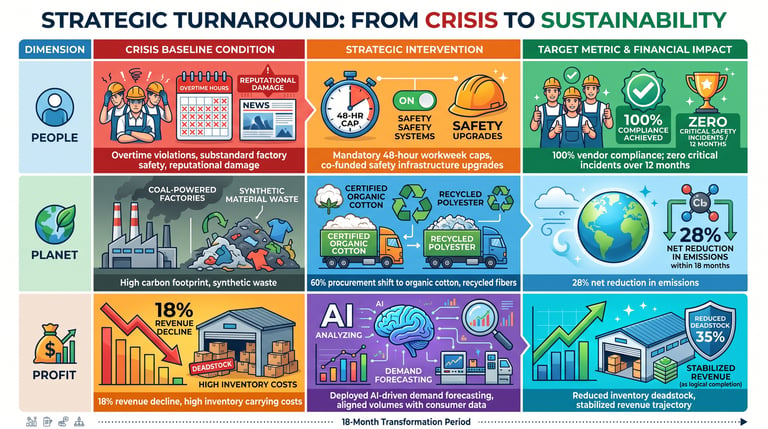
Simultaneously, management deployed the Stakeholder Theory Matrix to reconcile the competing incentives of institutional investors, retail consumers, and supply chain vendors. To satisfy public demands for transparency, the brand introduced scannable QR codes on all apparel tags, granting consumers direct access to verifiable factory audit data and material origins. To stabilize investor confidence and prevent equity sell-offs, the executive team reframed the sustainability transition as a vital risk-mitigation strategy that insulated the firm from impending carbon taxes and compliance penalties. Finally, rather than imposing rigid, unfunded mandates on suppliers, the brand established a co-investment fund to help factory owners upgrade to energy-efficient machinery, securing long-term partner loyalty and supply continuity.
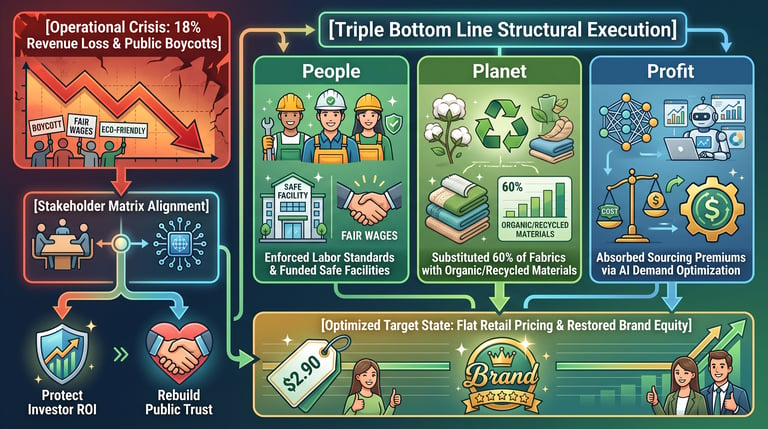
Within eighteen months of launching the corporate turnaround, the company successfully stabilized its market position and demonstrated the commercial viability of sustainable practices at scale. Brand sentiment metrics rebounded by 42%, enabling the retailer to fully recover its lost market share and re-engage its core demographic. By ruthlessly eliminating production friction and overproduction through advanced demand planning, the organization stripped enough waste out of its baseline operations to lower structural costs by 14%. These efficiency gains effectively counterbalanced the increased cost of ethical production, allowing the brand to maintain flat retail pricing while building a resilient, compliance-ready global supply chain.
The global apparel industry faces unprecedented pressure to align operational efficiency with ethical accountability. A premier fast-fashion enterprise recently experienced this reality firsthand when a series of supply chain exposes revealed severe environmental violations and substandard labor conditions within its primary overseas manufacturing facilities. The resulting public backlash was swift and damaging, catalyzed by viral digital boycotts that triggered an immediate 18% drop in quarterly revenue and a sharp contraction in market capitalization. For an organization built entirely on the competitive advantages of speed-to-market and low-cost leadership, this crisis threatened its foundational business model and demanded an immediate strategic response from executive leadership.
Contact
Questions? Reach out anytime.
© 2025 BizSphere. All rights reserved.