
Federal Reserve Interest Rate Decision Valuation Impact Strategy
by Divya
4/29/20262 min read


The Federal Reserve has officially kept its benchmark interest rate steady in the 3.50% to 3.75% target range Nuveen Trading Economics. In a decision that aligned perfectly with market expectations, the Federal Open Market Committee (FOMC) chose stability over intervention Trading Economics. This marks a continuation of the central bank's cautious approach to managing a complex macroeconomic landscape defined by resilient consumer demand, localized supply shocks, and evolving structural inflation Federal Reserve.
For MBA students mapping out corporate strategy, this rate pause is a critical case study in managing capital budgeting and structural economic pivots. For the past few years, corporate finance models have operated under the assumption that the high-rate environment would eventually give way to aggressive monetary easing. Instead, this meeting cements a fundamental truth: the "higher-for-longer" interest rate regime is no longer a temporary anomaly, but the baseline economic reality for corporate forecasting and valuation modeling RSM.
This policy holding pattern directly intersects with core corporate finance frameworks, specifically the Cost of Capital and Weighted Average Cost of Capital (WACC). With benchmark rates firmly anchored above 3.50% Nuveen, the hurdle rate for evaluating new corporate projects remains elevated. Future executives can no longer rely on cheap debt to inflate project Net Present Value (NPV). Companies are forced to ruthlessly prioritize high-margin initiatives, optimize working capital management, and abandon speculative projects that only made sense during the decade of zero-interest-rate policy (ZIRP).
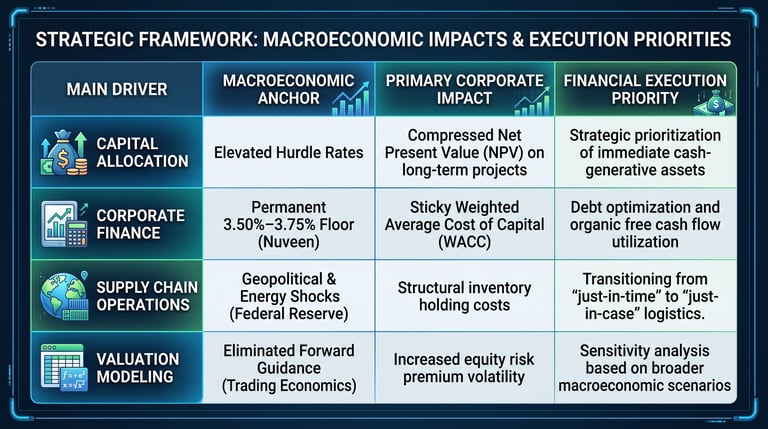
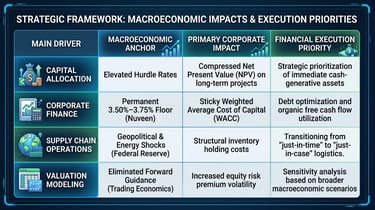
Furthermore, the operational realities underlying the Fed's caution provide a live lesson in supply chain management and international economics. The central bank highlighted that while domestic economic activity is expanding at a "solid pace," inflation remains sticky due to persistent energy supply shocks emanating from geopolitical friction Federal Reserve Forbes. This structural inflation cannot be cured by interest rates alone, highlighting a massive strategic shifts for global operations leaders: supply chain resilience must be prioritized over absolute cost minimization, as localized shocks now have a direct line to corporate borrowing costs.
Equally compelling for students of strategic leadership is a profound institutional shift taking place under the Fed's new leadership Trading Economics. The central bank is actively moving away from traditional "forward guidance," intentionally choosing not to map out future policy trajectories for Wall Street Trading Economics. This pivot drastically increases the macroeconomic uncertainty premium. For corporate strategy teams, it means that standard predictive forecasting is dead; leadership teams must now build dynamic, scenario-based financial models that can pivot instantly if the underlying macroeconomic data swings Investing.com.
Ultimately, the takeaway from this Fed meeting is that agility beats anticipation every single time. The era of predictable, coddled market environments has been replaced by a brutal landscape where capital discipline is paramount. As future managers look across the corporate ecosystem, the organizations that thrive will not be those hoping for a sudden drop in interest rates, but those that adapt their unit economics, supply chains, and balance sheets to comfortably run at a 3.50%+ benchmark floor Nuveen Forbes.
Contact
Questions? Reach out anytime.
© 2025 BizSphere. All rights reserved.