
Global Data Center Resource Consumption Reaches Sovereign Nation Scale
by Divya
6/17/20262 min read


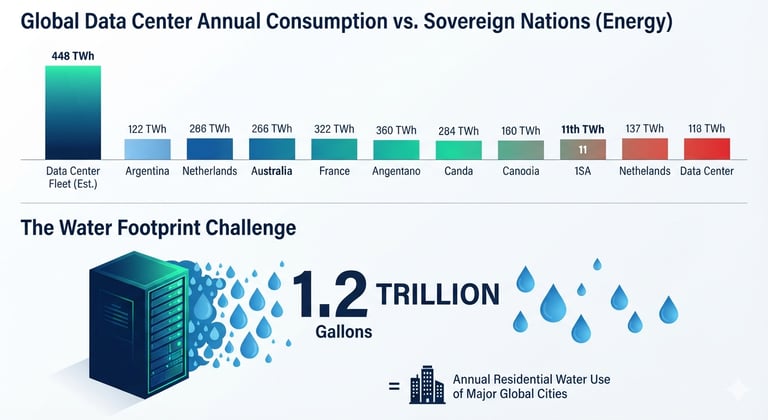
Global data centers now consume an astonishing 448 trillion watt-hours of electricity and 1.2 trillion gallons of water annually, elevating digital infrastructure into a primary macroeconomic sustainability challenge. If the global network of data centers were aggregated into a single sovereign nation, its massive resource footprint would rank as the 11th largest energy consumer on Earth. Furthermore, the environmental externalities of this computing power are equally profound, generating annual greenhouse gas emissions equivalent to the entire country of Argentina. For MBA students analyzing corporate strategy, this resource crunch represents a critical operational bottleneck where the exponential growth curves of artificial intelligence and cloud computing directly collide with physical grid capacities and planetary boundaries.
From an operations management perspective, the sheer volume of resource inputs required to sustain modern digital infrastructure reveals a deep structural vulnerability in tech supply chains. The dual demand for massive electricity to power high-density graphics processing units and billions of gallons of ambient water to cool those same server architectures creates severe local inflation and regulatory risks. Technology conglomerates can no longer treat utility access as a passive operational cost; instead, securing dedicated, carbon-neutral power grids and implementing closed-loop, water-free cooling systems have become core competitive advantages that dictate where future capital expenditures can be deployed.
For finance and corporate sustainability professionals, this sovereign-scale consumption profile alters the risk-return calculus for tech sector equities and infrastructure bonds. As municipal governments and regional grid operators impose stricter regulatory caps on power allocation and water rights to protect local communities, hyperscale data center operators face escalating compliance costs and stranded asset risks. MBA candidates evaluating long-term business strategy must look beyond standard enterprise software margins and closely audit how companies manage their scope one, two, and three emissions profiles. The firms that successfully decouple computing output from linear resource consumption will ultimately mitigate geopolitical scrutiny, avoid carbon penalties, and capture the next wave of institutional ESG capital.
Contact
Questions? Reach out anytime.
© 2025 BizSphere. All rights reserved.