
Harvard Business School Case Study Blueprint: The Digital Optimization Crisis at Vanguard Retail Corp.
by Divya
5/6/20264 min read


Protocol I: The Catalyst for Structural Pivot
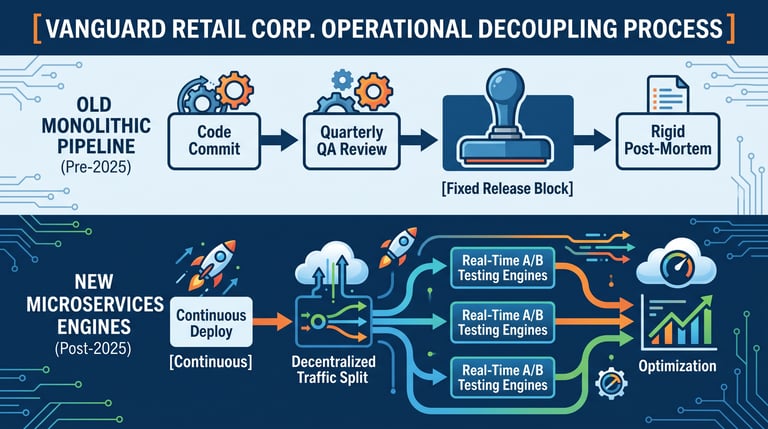
In October 2025, Vanguard Retail Corp., a multi-billion-dollar omni-channel consumer retailer, finalized a legacy infrastructure modernization program designed to transition its monolithic e-commerce stack into a distributed microservices platform. Led by Chief Product Officer (CPO) Elena Vance, the product engineering division was handed an aggressive mandate by the board of directors: leverage the new digital stack to increase checkout conversion rates by 120 basis points within four fiscal quarters. Seeking to cultivate a cultural infrastructure modeled after Silicon Valley’s highest-velocity tech companies, Vance instituted a platform-wide data mandate. Product squads were authorized to run continuous, decentralized A/B testing directly within production environments, decoupling feature rollouts from fixed, seasonal deployment cycles.
Protocol II: The Collision of Data Frameworks
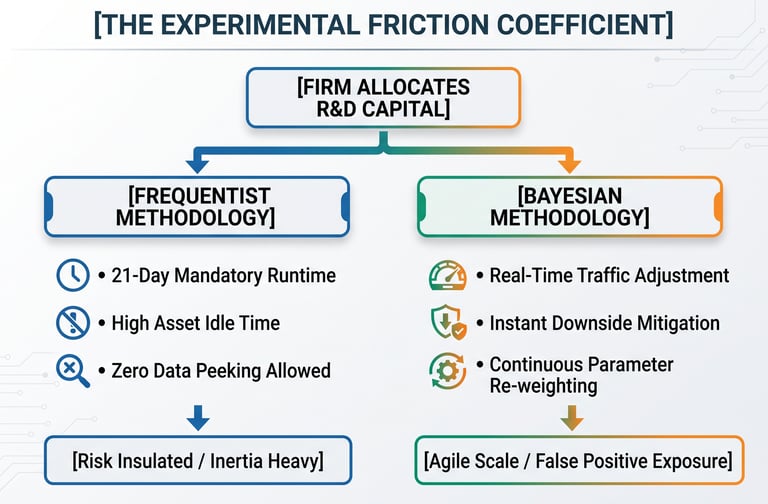
The aggressive operational mandate quickly exposed a profound methodological schism between Vanguard’s Data Science Infrastructure team, led by Dr. Marcus Sterling, and the Consumer Experience (CX) Acquisition squad, directed by VP of Growth Chloe Tan. Dr. Sterling’s data group mandated a strict frequentist experimental protocol across the entire cloud platform. Under this framework, any interface adjustment, promotional engine tweak, or algorithmic recommendation update required a fixed-sample Null-Hypothesis Statistical Testing (NHST) design. The protocol strictly forbade data "peeking," requiring tests to collect up to three weeks of continuous customer traffic to isolate confounding variables, eliminate Type I errors, and achieve a statistically significant p < 0.05 threshold before any deployment change could occur.
Protocol III: The Friction of Velocity and Control
While Dr. Sterling’s frequentist approach successfully protected Vanguard's core purchasing engine from unstable code deployments, it quickly ran into severe operational friction with Chloe Tan’s high-velocity expansion roadmap. The CX Acquisition squad argued that waiting twenty-one days to validate minor variations such as a simplified single-click cart layout or an updated promotional badge created a debilitating institutional drag coefficient. Tan's growth squad frequently witnessed highly promising early performance indicators within the first 48 hours of a test. Under frequentist rules, however, they were legally forced to keep underperforming variants live for weeks to satisfy sample size parameters. This structural lag cost Vanguard millions of dollars in unrealized marginal sales and allowed agile, direct-to-consumer competitors to rapidly win market share.
Protocol IV: The Quantitative Catastrophe
The tension reached a boiling point in Q1 2026 during a high-stakes redesign of Vanguard's mobile subscription loyalty portal. Bypassing Dr. Sterling’s rigid infrastructure gates to capitalize on a massive spring promotional cycle, Tan’s growth squad deployed a flexible, real-time Bayesian optimization engine. The engine was designed to analyze early consumer click-stream behaviors and dynamically re-weight web traffic toward the highest-converting variants. Within 72 hours, the Bayesian engine identified an interface variant that appeared to boost subscription sign-ups by an astonishing 18%. Encouraged by this strong performance indicator, the growth squad immediately diverted 100% of Vanguard's mobile traffic to the new layout.
Fourteen days later, financial reconciliations revealed a catastrophic operational failure. While mobile subscriber sign-ups had indeed risen, the new layout contained an un-tracked cross-device script error that broke the automatic renewal billing mechanism for desktop and tablet users. The early Bayesian engine had mistaken a rapid, localized spike in mobile sign-ups for overall systemic success, completely failing to account for a massive Type I error that silently wiped out millions in recurring backend service revenue.
Protocol V: Strategic Analysis of Experimental Failure Modes
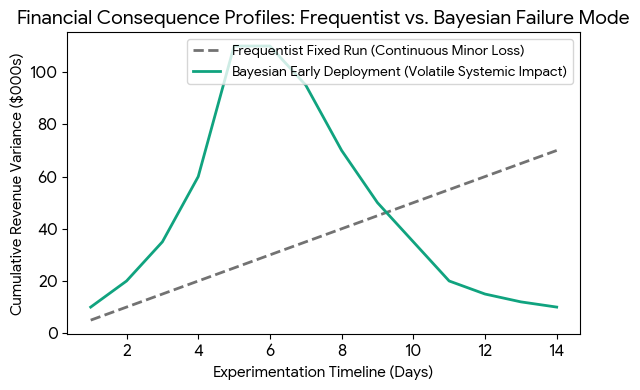
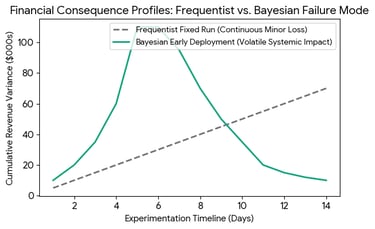
The graph above highlights the stark financial consequence profiles generated when statistical experimentation engines are poorly aligned with corporate risk governance. The frequentist path (dashed line) represents a slow, predictable cash burn; by locking experimental parameters into an inflexible 21-day runtime, the organization absorbs a fixed operational cost while waiting for mathematical certainty. Conversely, the catastrophic Bayesian failure mode (solid green line) illustrates the danger of premature deployment optimization. Because the system lacked rigid structural barriers against false positives, an early, un-vetted data spike triggered a massive deployment action. This amplified a hidden engineering defect into a severe, multi-day systemic revenue drain before remediation protocols could be successfully implemented.
Protocol VI: The Case Discussion Roadmap
As Vanguard Retail Corp. approaches its emergency board meeting at the end of Q2 2026, CPO Elena Vance must resolve this methodological impasse to preserve her transformation agenda. The data science teams are demanding a total return to centralized frequentist oversight, which would effectively paralyze product iteration speed. Meanwhile, the growth squads argue that returning to rigid pipelines will permanently damage Vanguard's competitiveness. The central problem confronting business leadership is no longer technical, but architectural: How does an enterprise engineer a hybrid governance structure that successfully synthesizes frequentist statistical guardrails for high-risk assets with agile, Bayesian-driven optimization engines for high-velocity user interfaces?
Contact
Questions? Reach out anytime.
© 2025 BizSphere. All rights reserved.