
How to Leverage Your Global Identity as a Competitive Diversity Advantage
by Divya
6/10/20263 min read


Many international students view their background through a lens of deficit. When surrounded by domestic peers who possess local networks, native language fluency, and familiarity with regional corporate norms, it is easy to assume you are starting at a distinct disadvantage.
This assumption is a strategic mistake. Modern corporate strategies prioritize global integration, meaning the exact traits international students downplay cross-cultural fluency, multilingual capabilities, and firsthand knowledge of international markets are in high demand by multinational organizations.
Shifting your perspective from "assimilation" to "differentiation" allows you to systematically package your global identity as an elite corporate asset.
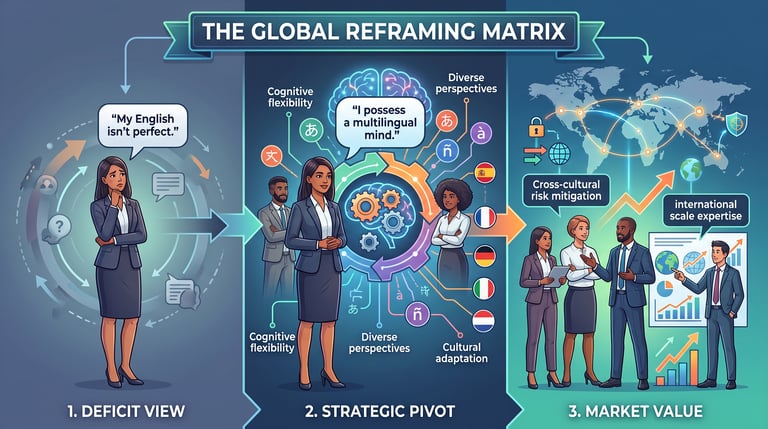

1. The Language Reframe: Moving Beyond Fluency to Cognitive Flex
A common source of imposter syndrome is the pursuit of accentless English. However, global firms do not hire for perfect pronunciation; they hire for cognitive flexibility.
Speaking multiple languages changes how your brain processes data and solves complex problems. When framing your language capabilities to recruiters, move beyond a bullet point list of languages spoken on your resume. Instead, frame your bilingual or multilingual capability as an operational skill:
Nuance Translation: Frame your skills around the ability to read between the lines during international negotiations, recognizing cultural subtexts that mono-lingual executives routinely miss.
Audience Adaptability: Highlight your experience tailoring complex corporate messages to varied cultural audiences, ensuring global strategic initiatives do not fail due to tone-deaf localization.
Cognitive Endurance: Managing complex, cross-border operations requires switching contexts seamlessly. Multi-lingual individuals maintain a higher cognitive stamina when navigating ambiguous global environments.
2. Converting Local Knowledge into Strategic Market Intelligence
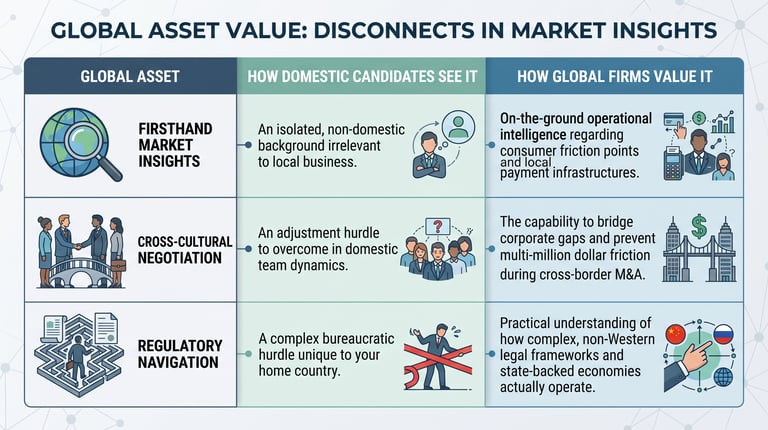
Domestic candidates understand the domestic consumer profile well. However, when an organization looks to scale, launch products abroad, or secure global supply chains, local knowledge becomes a hyper-specialized tool.
You possess native, lived understanding of economic ecosystems, regulatory environments, and consumer behaviors that Western consulting firms charge millions of dollars to research.
3. The Interview Strategy: Owning the Global Perspective
When interviewing for elite corporate functions, do not wait for the interviewer to ask how you will adapt to their local culture. Proactively demonstrate how your global perspective de-risks their international operations.
Structuring Your Behavioral Answers
When utilizing the behavioral interview format, deliberately embed global operational complexities into your context and resolution steps. Instead of a generic teamwork story, highlight a scenario where you bridged an ideological or operational divide between regional stakeholders.
Actionable Interview Response Scripts
When discussed as part of a general introduction:
"While I am fully adapted to domestic business frameworks, my primary competitive edge lies in my cross-border mobility. I understand how corporate strategy translates across diverse regulatory landscapes, allowing me to serve as a functional bridge for teams scaling operations globally."
When pitching for a strategy or market expansion role:
"Many expansion strategies stumble because firms project local consumer behavior onto international markets. My background allows me to stress-test your market entry models against localized consumer habits and logistical realities before capital is deployed."
4. Actively Positioning Your Identity on Professional Channels
True professional differentiation requires outward-facing ownership of your global identity. Do not scrub your international experiences or previous foreign employers from your public profile to look more "local."
Optimize Professional Summaries: Update platform profiles like LinkedIn to highlight cross-border operations. Use strategic phrasing such as "Specializing in cross-border strategy, emerging market positioning, and multicultural team leadership."
Author Local Insights: Write and share short analytical posts regarding business developments within your home country or region. Position yourself as a direct, reliable bridge of information between your target domestic industry and global markets.
Target Global Organizations: Prioritize firms with active international footprints. Organizations operating across multiple continents intuitively understand the high logistical cost of cultural misunderstandings, making them far more receptive to your global skill set.
Your global identity is not a gap to be bridged; it is a premium competency. By explicitly linking your cross-cultural capabilities to strategic corporate outcomes like risk mitigation, expansion precision, and cross-border efficiency you transform your international identity into an undeniable competitive advantage.
Contact
Questions? Reach out anytime.
© 2025 BizSphere. All rights reserved.