
How to Market When Third-Party Cookies Vanish Forever
by Divya
3/25/20263 min read


For over a decade, digital marketing relied on a silent tracking engine: the third-party cookie. By placing invisible trackers on consumer web browsers, brands could follow users across the internet, building creepy, highly invasive profiles of their browsing habits, purchase histories, and political leanings.
Then came the regulatory and technical hammer. Driven by Europe’s GDPR, California's CCPA, and sweeping privacy overhauls by Apple (App Tracking Transparency) and Google (the phasing out of third-party tracking tokens), the traditional programmatic ad ecosystem collapsed.
Today, buying a list of targeted consumer leads or tracking a customer from an external site back to your shop is practically impossible.
This deep-dive case study explores the survival framework for modern brands: the transition to Zero-Party Data (0PD), a strategy where consumers willingly, intentionally, and proactively hand over their personal data to brands they trust.
1. The Data Hierarchy: Understanding Zero-Party Data
To build a compliant, high-conversion marketing funnel, you must understand the four distinct tiers of data collection. Modern marketing strategy shifts capital away from the toxic outer rings to focus exclusively on the core.
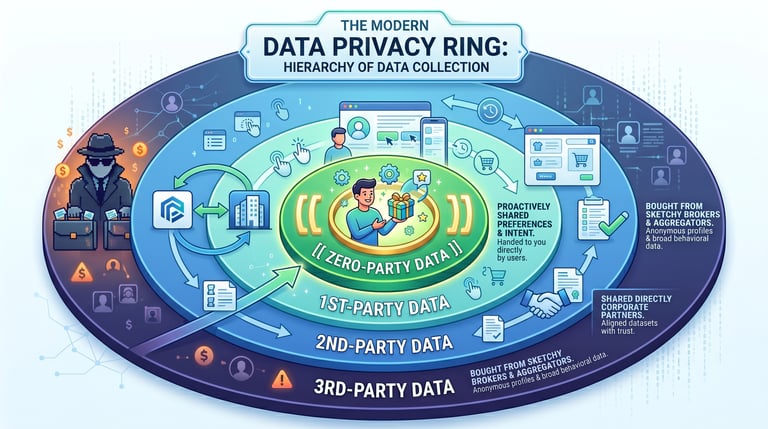
First-Party Data (Implicit): Data your website collects passively about user behavior (e.g., “User clicked on three pairs of running shoes and spent 4 minutes on the checkout page.”).
Zero-Party Data (Explicit): Data the consumer intentionally states (e.g., “I am a marathon runner, I wear a size 10, I prefer trail running, and my budget is $150.”).
2. The Value Exchange: Getting Users to Opt-In
Consumers will no longer fill out long, boring registration forms just to join a spammy email newsletter list. To capture high-value zero-party data, brands must build an authentic Value Exchange Framework.
If you want a consumer's personal data, you must provide immediate, tangible value in return:
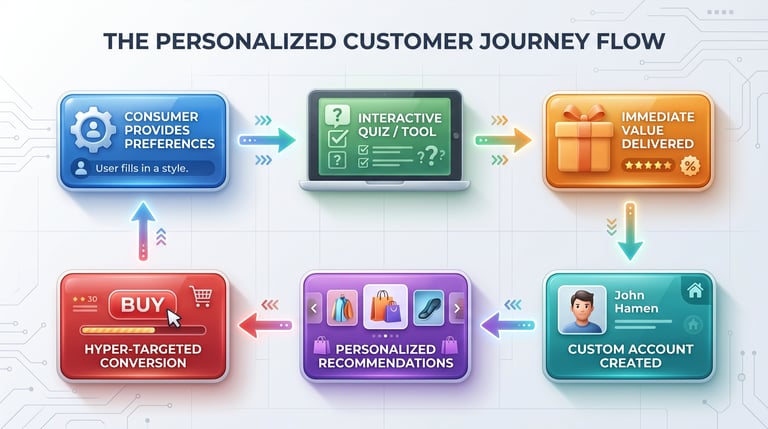
High-Converting Zero-Party Data Capture Mechanics
The Interactive Product Finder Quiz: Brands like Sephora and Hims & Hers guide users through a 60-second diagnostic questionnaire to find the exact product match for their skin or health type. The user gladly answers deeply personal questions because it guarantees a flawless product recommendation.
Progressive Profiling Checkouts: Instead of asking for 20 data points upfront, ask one contextual question during micro-interactions (e.g., a simple one-click poll in an order confirmation email: "Is this purchase a gift, or for yourself?").
Gamified Preference Centers: Give users a highly visual slider dashboard inside their account settings where they can physically dial in their content preferences, product sizes, and styling aesthetics.
3. Visualizing Personalization ROI
The shift to zero-party data isn't just a legal compliance requirement; it is an incredible financial catalyst. When you stop guessing customer preferences via third-party cookies and start using explicit, declared data, your conversion metrics skyrocket.
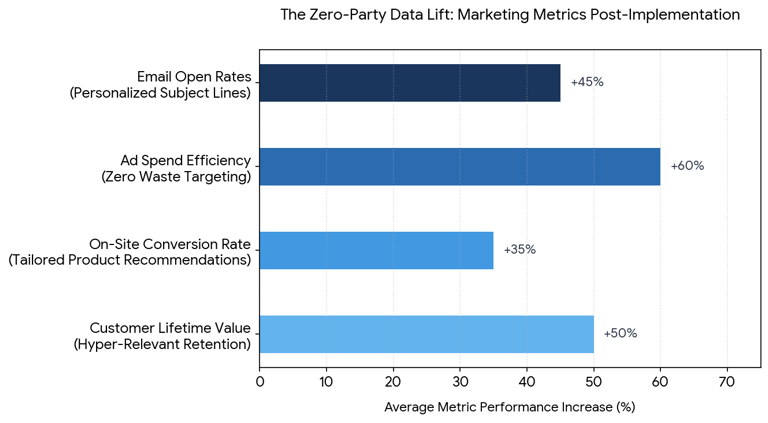
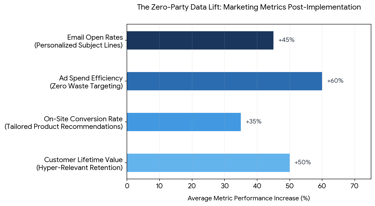
As demonstrated by the data, utilizing declared user intent eliminates wasted advertising spend. By showing consumers exactly what they asked for, brands unlock a 60% boost in ad spend efficiency and dramatically lengthen Customer Lifetime Value (LTV).
4. Operational Playbook: Building the 0PD Infrastructure
Transitioning to a zero-party data model requires a tight integration between your marketing technology (MarTech) stack and your customer experience workflows.
Deploy a Customer Data Platform (CDP): Traditional CRMs aren't nimble enough. Implement a CDP (like Segment or Klaviyo) that aggregates real-time quiz answers, preference center selections, and email survey responses into a single, unified customer identity profile.
Enforce Strict Data Transparency: Trust is the primary currency of zero-party data. State explicitly why you are asking a question. For example: "We ask for your birthday so we can send you a 20% discount code during your birth month."
Automate Hyper-Segmentation Loops: Never capture data you don't intend to use. If a user states in a quiz that they are a "Beginner," their automated email onboarding sequence must immediately branch away from intermediate or advanced product selections.
Key Takeaways for CMOs
Stop Renting Audiences, Own Them: Relying on Meta or Google algorithm matching means renting an audience. Capturing zero-party data means building a permanent, proprietary company asset that algorithm updates cannot destroy.
Make Personalization Collaborative: Stop trying to secretly track your users. Ask them openly what they want, show them the value they get for sharing, and craft custom experiences based on their direct answers.
Audit Your Form Friction: Review every fields-form on your site. If a question doesn't directly enhance the user's experience or segment your marketing loop, delete it immediately to lower checkout friction.
Contact
Questions? Reach out anytime.
© 2025 BizSphere. All rights reserved.