
Macroeconomic Signals for Career Strategy Timing Job Transitions via Global Economic Indicators
by Divya
6/5/20262 min read


Navigating a professional trajectory in a highly integrated global economy requires far more than localized industry awareness; it demands a systematic comprehension of how central bank policies transmit directly to corporate headcount allocations. When global inflationary pressures build, central banks increase policy interest rates, elevating commercial borrowing costs and forcing enterprise leadership to transition capital allocation from high-growth R&D to liquidity preservation. This tightening cycle triggers an immediate causal sequence: corporate credit lines contract, enterprise capital expenditure shrinks, and local human resource divisions execute hiring freezes or structural redundancies. Conversely, expansionary rate-cutting cycles lower capital costs, motivating enterprises to aggressively scale operations and recruit specialized professionals, demonstrating that local labor demand is a lagging reflection of macro monetary policy.


To systematically exploit these cycles rather than fall victim to them, strategic professionals must continuously monitor a specific dashboard of macroeconomic metrics before initiating a career transition. By tracking the intersection of central bank policy rates, labor market reports, manufacturing indices, and sovereign debt spreads, individuals can objectively calculate whether the macro environment favors a high-leverage career leap or an immediate stand-still strategy. The evaluation matrix below outlines the exact quantitative thresholds and tactical career adjustments required to navigate these shifting economic regimes:
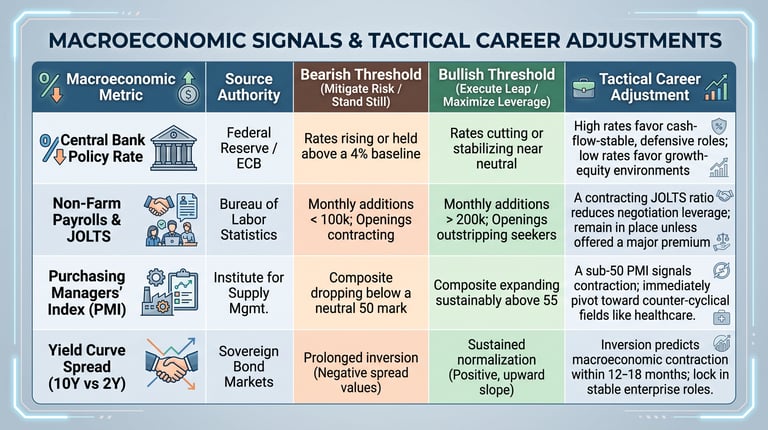
Ultimately, successful market timing requires a disciplined, three-step execution protocol performed every quarter: first, audit central bank rate paths to avoid leaving cash-flow-positive firms for unbacked startups during steep hiking cycles; second, cross-reference the Purchasing Managers' Index against sector-specific data to identify resilient industries outperforming broader market friction; and third, check the JOLTS ratio to validate your leverage, executing aggressive, high-compensation transitions when the ratio sits safely above 1.5, while optimizing for absolute institutional stability when it drops toward 1.0. By shifting from reactive job-hunting to data-driven macroeconomic diagnostics, you insulate your personal balance sheet from systemic downturns and ensure you capture maximum financial and equity rewards during global expansionary surges.
Contact
Questions? Reach out anytime.
© 2025 BizSphere. All rights reserved.