
Marketing Mix Modeling Attribution Budget Allocation Privacy Strategy
by Divya
5/8/20263 min read


The structural collapse of consumer data tracking infrastructure has forced a fundamental transformation in how modern enterprises manage multi-million dollar advertising budgets. For years, digital marketing strategies relied heavily on micro-targeting cookies and mobile device identifiers to measure ad performance. However, with the rapid implementation of stringent consumer privacy regulations like GDPR and CCPA, alongside platform-level tracking crackdowns, corporate marketing departments are facing a major measurement crisis. To protect brand equity and avoid capital misallocation, future business executives must pivot from invasive tracking mechanisms back to macro-level statistical frameworks that optimize customer acquisition without violating consumer privacy.
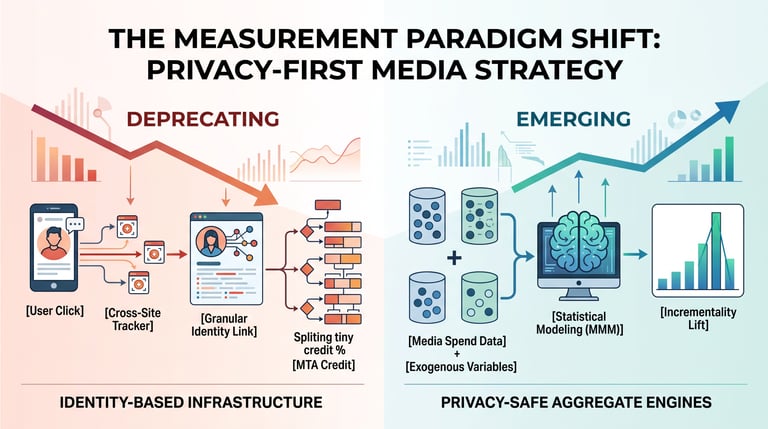
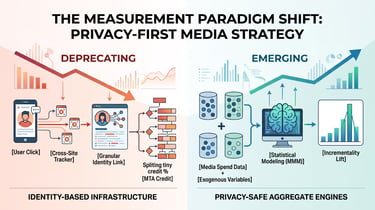
This strategic pivot has reignited a fierce debate over corporate budget evaluation: Marketing Mix Modeling (MMM) versus Multi-Touch Attribution (MTA). Multi-Touch Attribution operates at a granular, bottom-up level, attempting to track individual digital touchpoints along a consumer’s journey and assign financial credit to the specific ad that triggered a conversion. While MTA provides immediate tactical feedback for micro-optimizations, it suffers from a glaring structural vulnerability: it is entirely dependent on user identity data. In a privacy-first world where consumers routinely opt out of tracking, attribution models are increasingly blinded by data gaps, resulting in fragmented metrics that often overvalue cheap, late-stage digital ads while ignoring long-term brand equity builders.
To build a resilient data infrastructure, top-tier global enterprises are aggressively reinvesting in top-down Marketing Mix Modeling. MMM is an econometric, aggregate-level statistical approach that leverages historical time-series data to isolate the true incremental lift of both digital and traditional marketing channels. Because MMM utilizes broad financial and media execution data rather than tracking individual consumer behavior, it is inherently privacy-safe and immune to platform-level tracking blockades. This aggregate methodology allows Chief Marketing Officers (CMOs) to accurately evaluate the returns on offline, non-trackable channels like linear television, radio, and out-of-home billboards, aligning broad corporate finance metrics directly with operational marketing execution.
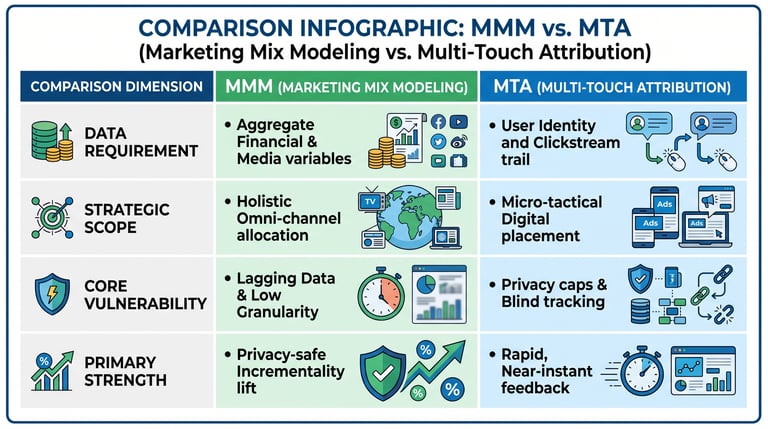
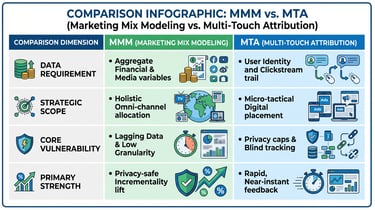
From a corporate governance perspective, managing these competing methodologies requires a deep understanding of organizational bias and data collection constraints. Attribution systems are inherently biased toward immediate, short-term performance channels like paid search, creating a dangerous feedback loop that can tempt a company to starve its top-of-funnel brand building to chase short-term, inefficient conversions. Marketing Mix Modeling corrects this structural bias by factoring in long-term brand decay curves, baselines sales metrics, and exogenous market shocks like macroeconomic downturns or competitor pricing shifts. This holistic approach ensures that long-term strategic investments are evaluated on their true, macro-level economic contributions.
Ultimately, achieving a sustainable competitive advantage in corporate growth requires the engineering of a unified, hybrid measurement system. Forward-thinking marketing organizations do not rely on MMM or Attribution in a vacuum; they deploy a modern unified approach. They leverage macro-level MMM as the foundational framework for annual asset allocation and multi-million dollar capital budgeting across offline and online ecosystems. Simultaneously, they use privacy-compliant, localized attribution models to guide day-to-day tactical asset allocation within individual digital platforms, utilizing continuous, structured data science experiments to validate model assumptions in real-time.
Contact
Questions? Reach out anytime.
© 2025 BizSphere. All rights reserved.