
Mastering the 4 T’s Framework in Corporate Governance
by Divya
4/8/20264 min read


In modern enterprise management, risk is an unavoidable reality of business growth. For future corporate executives, risk management is not a defensive compliance exercise; it is a core strategic framework used to evaluate corporate threats, allocate capital, and protect business value. When a firm identifies an operational, financial, or strategic threat, it must filter that risk through a formal decision matrix known as The 4 T’s of Risk Management: Tolerate, Treat, Transfer, and Terminate. Mastering this corporate framework allows executive boards to balance risk against potential rewards, insulate their supply chains, and build highly resilient business models.


1. Mapping the Corporate Risk Frontier: Impact vs. Likelihood
This risk matrix helps management assign each threat to the correct quadrant, ensuring corporate resources are deployed efficiently rather than wasted on minor issues.
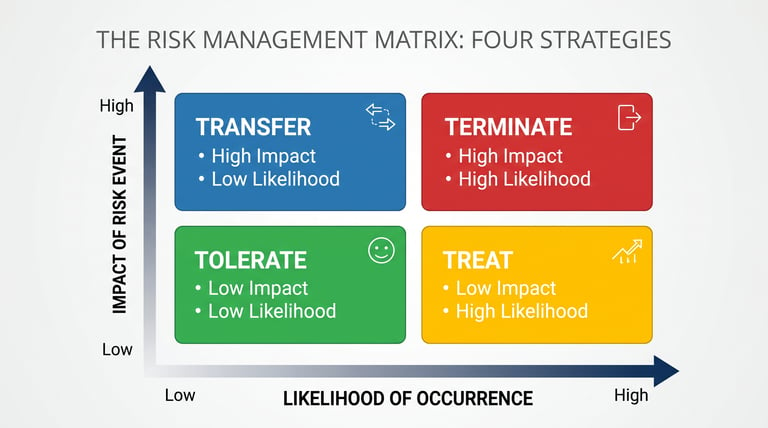
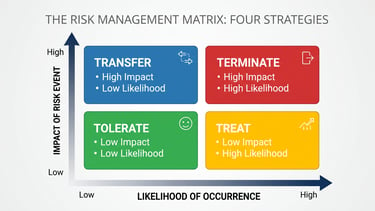
The Interdependent Corporate Response Loop - A major challenge for corporate governance is that risks are rarely isolated. Taking action in one business unit can create unexpected vulnerabilities in another part of the organization.
2. Deconstructing the 4 T’s: Strategic Options for Leadership
When a risk passes through the evaluation matrix, corporate leadership deploys one of the four core strategies to protect the firm's assets.
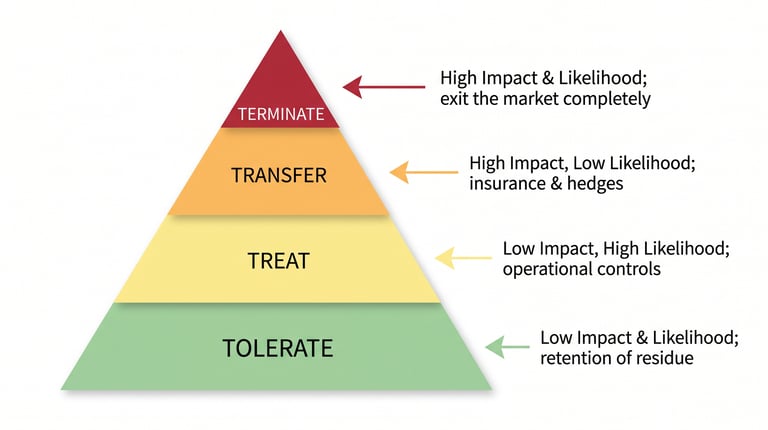
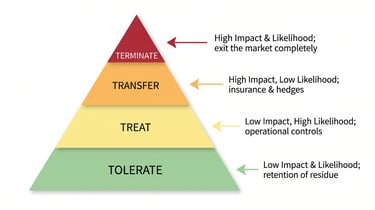
Tolerate: Informed Capital Retention - Tolerating a risk means the firm acknowledges the threat but chooses to absorb any potential losses without taking special action. This strategy is reserved for low-impact, low-likelihood events, or situations where the cost of fixing the risk outweighs the maximum financial damage the event could cause.
The Strategic Logic: Executives avoid over-engineering their corporate defenses. Spending massive amounts of capital to eliminate a minor, routine threat erodes operational efficiency and drains funds that could be better spent on growth initiatives.
Treat: Operational Risk Mitigation - Treating a risk involves implementing internal controls, upgrading infrastructure, and refining processes to lower the likelihood of an event or minimize its impact. This is the most common operational response to high-frequency, low-severity threats.
The Strategic Logic: The enterprise actively builds out its inner defenses. A classic example is a corporation upgrading its cyber security infrastructure, implementing zero-trust authentication, and running routine penetration tests to shield sensitive customer data from hackers.
Transfer: Financial Volatility Reallocation - Transferring a risk involves passing the financial liability of a threat to an external party while continuing the underlying business activity. This strategy is ideal for low-probability, high-impact events that could cause catastrophic financial damage if left unmanaged.
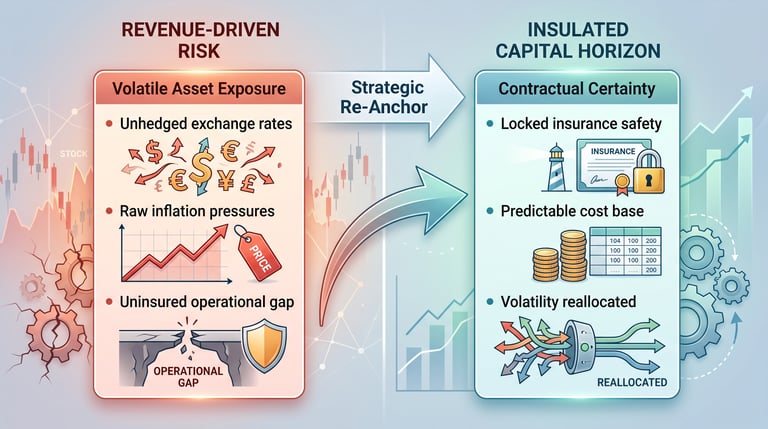
The Strategic Logic: Management reallocates risk to stabilize the company's financial horizon. This is achieved by purchasing enterprise insurance policies to cover physical assets, or utilizing financial derivatives such as foreign exchange forward contracts to lock in costs and protect the firm's supply chain from volatile commodity markets.
Terminate: Structural Risk Avoidance - Terminating a risk means the firm exits the risky activity completely. This strategy is used when a threat carries both high impact and high likelihood, or when the cost of treating and transferring the risk is so high that the business line is no longer profitable.
The Strategic Logic: The board enforces strict risk boundaries. If a multinational firm determines that expanding into a specific foreign market exposes it to unmanageable regulatory sanctions, severe currency collapse, or human rights violations within the local supply chain, the firm chooses to divest from that market entirely to protect its global brand equity and corporate solvency.
3. The Executive Dashboard: Implementing Resilient Governance
To successfully integrate the 4 T’s framework into corporate governance, future executives must establish clear risk management cultures that move past simple checklists:
Defining Corporate Risk Appetite: The board of directors must explicitly define the firm’s risk tolerance, setting hard boundaries on how much volatility the enterprise can safely absorb before it must treat or transfer a threat.
Continuous Horizon Scanning: Risk profiles are not static. A risk that can be safely tolerated today can rapidly transform into a threat that must be terminated due to sudden shifts in technology, geopolitics, or international law.
Cost-Benefit Calibration: Management must balance the cost of risk mitigation against the financial value of the asset they are trying to protect, ensuring that every dollar spent on risk controls delivers a real return in structural stability.
Ultimately, executive leadership is not about eliminating all corporate risk; it is about choosing exactly which risks to take. By using the 4 T's framework to filter threats, future business leaders can confidently navigate complex markets, insulate their balance sheets, and turn risk management into a source of competitive advantage.
Contact
Questions? Reach out anytime.
© 2025 BizSphere. All rights reserved.