
Microsoft OpenAI Partnership Revision Multicloud Enterprise Tech Strategy
by Divya
5/4/20263 min read


The formal revision of the Microsoft-OpenAI partnership is a watershed moment for corporate governance and strategic alliances, demonstrating the natural expiration date of asymmetric joint ventures. When Microsoft poured billions into OpenAI, it secured an enviable monopoly over the hottest enterprise tech commodity on earth Forbse. However, as OpenAI’s valuation and operational costs scaled, the constraints of a single-provider cloud relationship became a strategic chokehold. By renegotiating the deal to end cloud exclusivity, Sam Altman has effectively declared OpenAI's independence, proving that in high-growth tech sectors, operational agility and access to unconstrained compute will eventually override early-stage debt obligations to a single anchor investor TechCrunch VentureBeat.
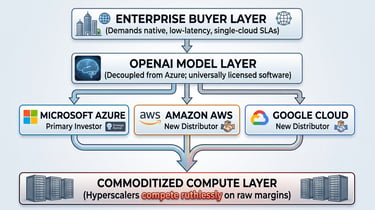
From a B2B distribution perspective, this structural shift completely reallocates market power back to enterprise software buyers. Previously, fortune 500 companies heavily locked into the Amazon Web Services (AWS) or Google Cloud ecosystems faced immense frictional costs if they wanted to build native applications using OpenAI’s frontier models VentureBeat. Now, OpenAI can be distributed natively across AWS Bedrock and Google Cloud Vertex AI TechCrunch. This optimization of the enterprise supply chain removes multi-cloud integration friction, dramatically expanding OpenAI’s total addressable market (TAM) while turning the major cloud hyperscalers into commoditized distribution pipelines competing on margins and compute efficiency.
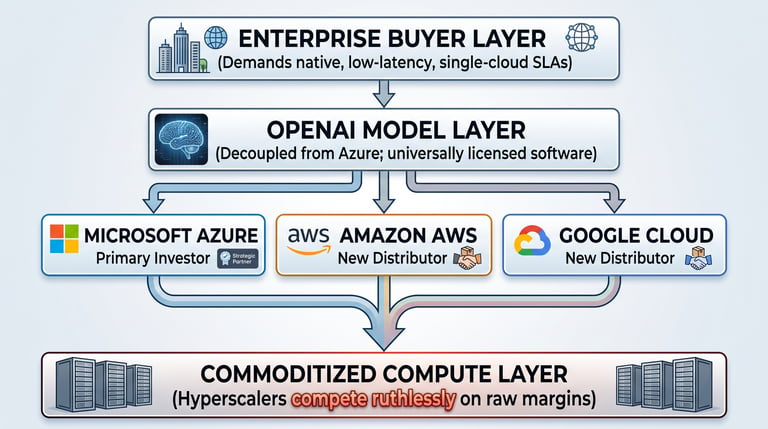
For Microsoft, this contract overhaul represents a massive exercise in risk mitigation and financial repositioning Forbse. While losing exclusive commercial rights sounds like a defeat, it significantly reduces Redmond’s exposure to intense antitrust scrutiny from global regulators who were actively investigating the monolithic tie-up. Furthermore, Microsoft remains OpenAI's largest financial stakeholder. By allowing OpenAI to leverage AWS and Google infrastructure, Microsoft shifts the immense capital expenditure burden of hosting OpenAI’s next-generation training runs onto its rivals' balance sheets, preserving its own margins while still capturing massive equity upside from OpenAI's commercial expansion Forbse.
For students of corporate strategy, the ultimate takeaway from the revised deal is a masterclass in "co-opetition" the art of cooperating and competing with the same firm simultaneously. Microsoft and OpenAI are now locked in a complex, multi-layered relationship: they are close commercial partners via Azure, direct software competitors in the enterprise AI assistant workspace, and OpenAI is now an official partner of Microsoft's fiercest cloud rivals TechCrunch VentureBeat. This is the new baseline for digital platform strategy. Modern business leaders cannot rely on rigid, permanent alliances; they must design flexible corporate structures that can constantly adapt to changing infrastructure costs and market dynamics.
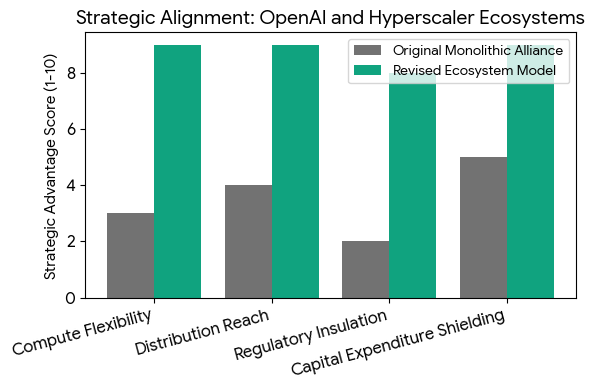
Strategic Analysis of the Alliance Optimization
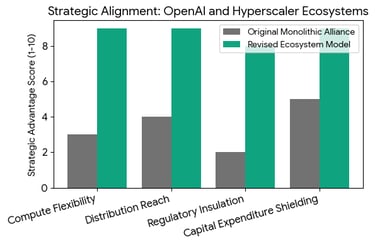
The chart above visualizes the structural optimization achieved through the contract renegotiation. Under the original monolithic alliance, OpenAI was severely constrained in its core distribution reach and compute flexibility, operating with a dangerously high regulatory risk profile. The revised ecosystem framework introduces a massive upgrade across all key strategic metrics. By spreading workloads across multiple providers, OpenAI achieves maximum infrastructure autonomy, while simultaneously maximizing its enterprise distribution footprint. Crucially, the move acts as a regulatory insulation shield, transforming what looked like an anti-competitive merger-in-all-but-name into a standard, open-market multi-vendor licensing model.
Contact
Questions? Reach out anytime.
© 2025 BizSphere. All rights reserved.