
Navigating the MBA Capstone - Strategic Selection Frameworks to Accelerate Your Career Trajectory
by Divya
5/27/20264 min read


The Master of Business Administration (MBA) capstone project is the ultimate test of your graduate education. It is not just a final academic requirement or a lengthy report designed to sit on a library shelf. Instead, your capstone is a major professional transition tool. It offers a rare opportunity to bridge the gap between academic business theory and real-world executive execution. When chosen strategically, your capstone serves as a centerpiece for your professional portfolio. It can act as a proof of concept for a new business venture, or provide a launchpad to break into a new industry.
This comprehensive guide breaks down the strategic selection process. It offers high-impact project ideas and provides a framework to ensure your final project aligns with your long-term career goals.
The Strategic Value of an MBA Capstone
Many students make the mistake of picking a capstone topic based solely on convenience, such as choosing the easiest or fastest option available. This approach wastes a valuable opportunity.
In a competitive job market, employers look for practical problem-solving skills rather than just academic credentials. Your capstone project serves as tangible proof that you can handle complex, ambiguous business problems and deliver measurable financial results.


By treated your capstone like an executive engagement, you build a powerful asset for your resume. This project gives you a compelling story to share during executive interviews, helping you answer behavioral questions with concrete, real-world examples.
The Capstone Selection Matrix
To maximize the return on investment (ROI) of your academic efforts, your capstone project should align with your specific career goals. Use this Strategic Selection Matrix to evaluate potential paths based on your post-MBA objectives.
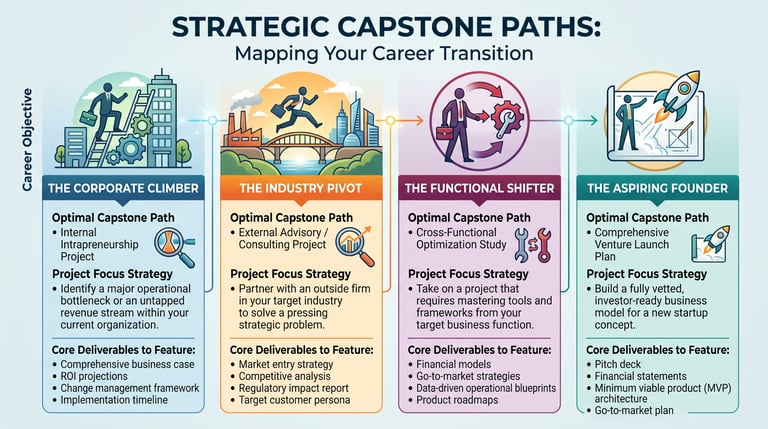
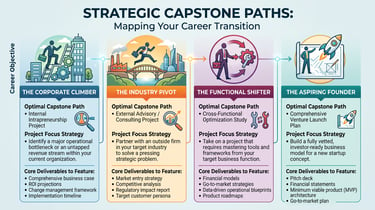
High-Impact Capstone Frameworks and Ideas
If you need inspiration for your project, consider these four proven, high-yield capstone frameworks that corporate executives value highly.
1. The Market Entry and Expansion Strategy
This framework focuses on analyzing whether a business should launch a new product line or expand into a new geographic market.
Core Challenge: Analyze market demand, evaluate competitor reactions, map out supply chain logistics, and project long-term financial performance.
Example Project Idea: Develop a comprehensive market entry strategy for a European electric vehicle component manufacturer looking to build a presence in the North American commercial fleet market.
2. The Operational Turnaround and Efficiency Blueprint
Core Challenge: Audit workflow processes, identify bottlenecks, evaluate technology options, and build a clear change management plan.
Example Project Idea: Re-engineer the fulfillment operations of a mid-sized e-commerce business by introducing automation tools, with the goal of reducing order cycle times by 25%.
3. The Digital Transformation and Data Analytics Strategy
This framework explores how a traditional business can use modern technology, cloud computing, or artificial intelligence to improve customer experiences and optimize operations.
Core Challenge: Evaluate data privacy risks, assess technology integration costs, define key performance indicators (KPIs), and design data workflows.
Example Project Idea: Design an AI-driven predictive maintenance strategy for a regional manufacturing company to reduce equipment downtime and optimize spare parts inventory.
4. The Sustainable Business and ESG Integration Plan
This framework helps organizations align their core operations with Environmental, Social, and Governance (ESG) standards without sacrificing financial performance.
Core Challenge: Measure carbon footprint impacts, audit supply chain sustainability, calculate green investment paybacks, and manage stakeholder relationships.
Example Project Idea: Create a sustainable sourcing strategy for a multi-unit consumer packaged goods (CPG) brand to transition to circular packaging models by 2030.
Step-by-Step Selection Workflow
To select and validate your capstone project topic, follow this structured, five-step workflow during your planning phase:
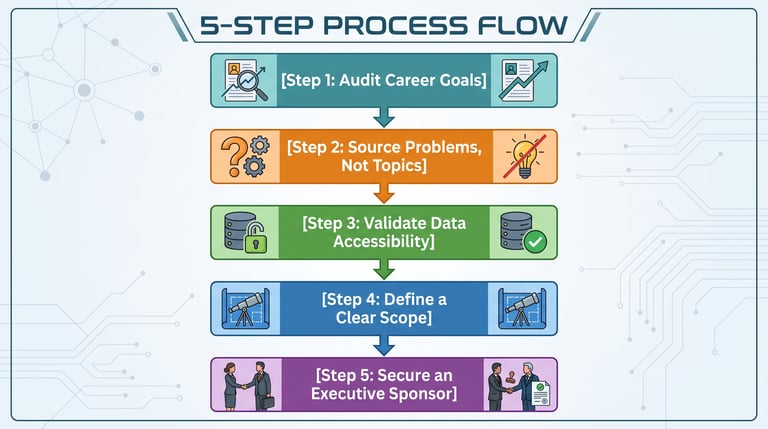
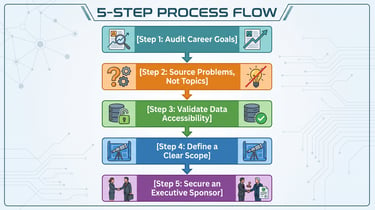
Step 1: Audit Career Goals: Clearly define where you want to be 24 months after graduation. Your project choice should support that vision.
Step 2: Source Problems, Not Topics: Do not just pick a broad topic like "Artificial Intelligence in Banking." Instead, look for a specific, unresolved problem, such as "High customer churn rates in digital-only retail banking apps."
Step 3: Validate Data Accessibility: Ensure you can actually access the data needed for your project. A brilliant project idea will stall if the target company refuses to share its financial or operational metrics.
Step 4: Define a Clear Scope: Keep your project manageable. It is better to deliver an exceptionally detailed solution for a specific problem than a superficial, generic overview of a massive global issue.
Step 5: Secure an Executive Sponsor: If you are working on an external project, find an executive champion within that organization. They can grant you access to information and provide invaluable real-world feedback.
Actionable Capstone Validation Checklist
Before finalizing your capstone proposal, use this checklist to ensure your project is viable and strategically sound:
Confirm career alignment: Can you explain in two sentences during a job interview how this project qualifies you for the role?
Verify data access: Do you have written permission to access the internal datasets, financial reports, or customer metrics required for your analysis?
Assess resource requirements: Do you have the necessary analytics tools, software access, and research methodologies ready to execute the project?
Establish measurable KPIs: Does your project include clear metrics for success, such as cost reductions, revenue growth, or efficiency gains?
Evaluate scope limits: Can you realistically complete the core research, data analysis, and final presentation within your academic term?
Review academic guidelines: Does your proposed project fully satisfy your university’s rubrics and evaluation criteria?
Contact
Questions? Reach out anytime.
© 2025 BizSphere. All rights reserved.