
Pricing Strategy for a New SaaS Platform Balancing Profitability with Rapid Market Penetration
by Divya
6/25/20262 min read


The core challenge centered on balancing near-term operational profitability with rapid, widespread user acquisition in an increasingly crowded enterprise software landscape. On one hand, setting a high premium price tag would immediately cover the substantial graphics processing unit and machine learning infrastructure costs required to run the AI engine. On the other hand, a steep financial barrier would deter mid-market enterprises and agile startups, severely restricting the platform's initial user acquisition velocity and limiting the data ingestion loops necessary to train the core algorithms. The executive team needed to engineer a pricing mechanism that captured the platform's high premium value while keeping entry barriers low enough to fuel explosive user network effects.
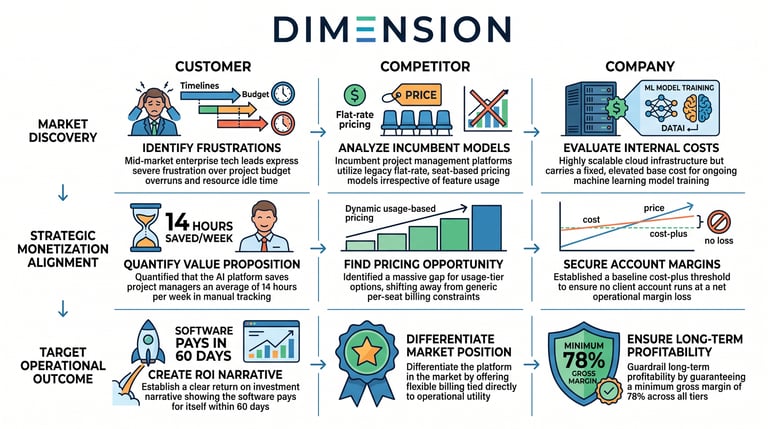
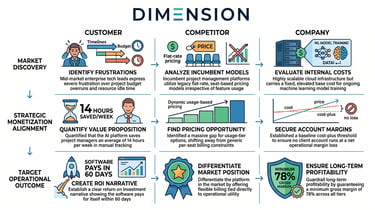
To systematically identify the optimal pricing structure, the product marketing team deployed The 3 C’s Model, analyzing the interplay between the Customer, Competitor, and Company.
Simultaneously, the finance team operationalized a Value-Based Pricing Framework to transition the conversation away from software manufacturing costs and toward customer-perceived utility. Instead of tracking employee seat counts, the platform's monetization tiers were structured around the volume of AI-driven optimization reports generated and total project scale handled. This allowed the company to introduce a highly attractive, low-cost entry tier for smaller firms, while embedding automatic, high-margin revenue expansions for enterprise clients who derived disproportionately greater economic value from the platform's advanced forecasting modules.
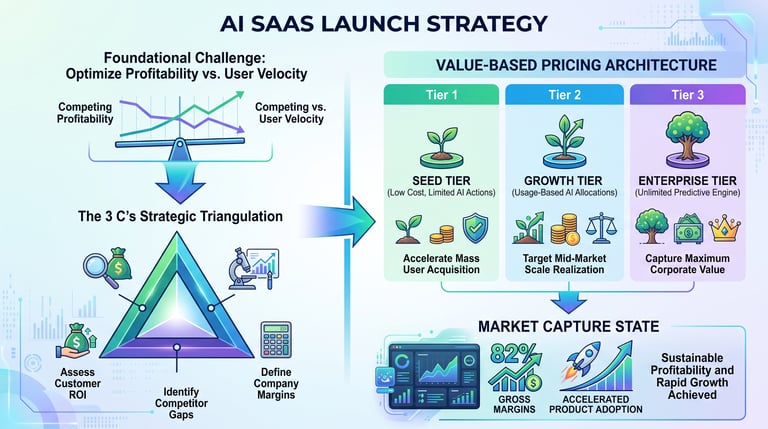
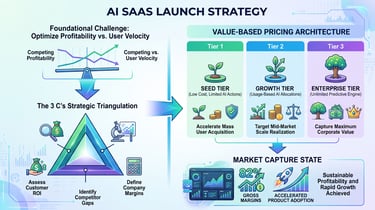
Within twelve months of launching this structured pricing strategy, the SaaS platform successfully navigated its market entry, demonstrating that pricing model design is a powerful driver of customer acquisition. The company achieved a 156% year-over-year increase in its active user base, securing a commanding initial market share in the mid-market tech sector without sacrificing unit economics. By tying its revenue expansion directly to usage-based value metrics rather than rigid seat limitations, the enterprise expanded its average contract value by 38% post-onboarding. This balanced monetization matrix delivered a predictable, sustainable revenue stream that safely covered computing overhead while funding continuous product innovation.
The business-to-business software market is experiencing a massive influx of automation utilities, making initial monetization design a critical determinant of a product's commercial survival. A pioneering software company recently faced this high-stakes decision upon launching a proprietary, artificial intelligence-powered project management platform. The application possessed advanced predictive analytics capable of optimizing team resource allocation and forecasting project bottlenecks in real time. Despite strong positive feedback during its beta testing phase, corporate leadership faced a foundational dilemma regarding how to structure its commercial licensing models to capture the maximum market value.
Contact
Questions? Reach out anytime.
© 2025 BizSphere. All rights reserved.