
Starbucks Global Supply Chain Turnaround and Cost Management Case Study
by Divya
5/20/20263 min read


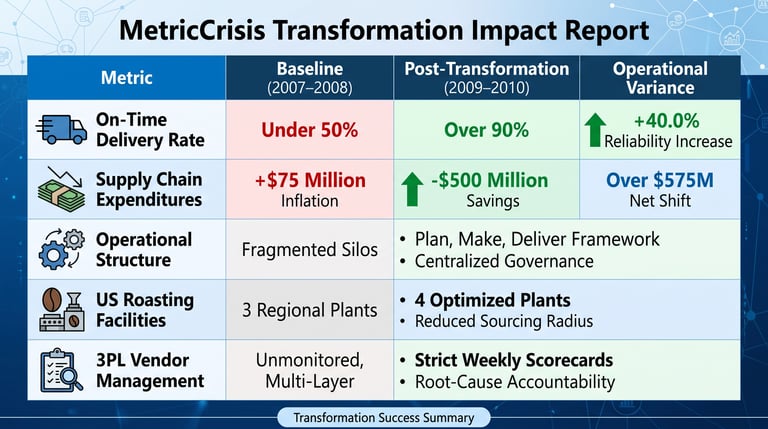
This case study analyzes how Starbucks Coffee Company resolved a severe operational crisis between 2007 and 2008. Rapid global scaling without centralized operational design led to a fragmented, high-cost network. While retail sales dipped due to the global economic recession, Starbucks' supply chain expenses unexpectedly spiked by over $75 million, while on-time store deliveries plunged below 50%.
To survive, corporate leadership launched a massive restructuring program aimed at reducing the overall cost-to-serve. By consolidating its siloed logistics divisions into a unified "Plan, Make, and Deliver" framework, eliminating underperforming third-party logistics (3PL) contracts, and establishing a rigorous weekly metrics scorecard, Starbucks successfully slashed more than $500 million in operational costs over a two-year horizon.
By 2008, Starbucks expanded its retail footprint to roughly 16,700 international locations. However, the supply chain had evolved organically rather than through intentional strategic design. This rapid growth created an overly complex, uncoordinated distribution system.
Core Problems Identified
The $75 Million Cost Paradox: As macroeconomic sales declined, operational inefficiencies caused supply chain spending to increase by $75 million.
Severe Service Degradation: Fewer than 50% of routine deliveries arrived on time at retail locations, causing frequent inventory stockouts and hurting store labor efficiency.
3PL Spending Inflation: The company over-outsourced its warehousing, regional transport, and distribution functions. This created fragmented 3PL layers with conflicting incentives and unmonitored baseline fees.
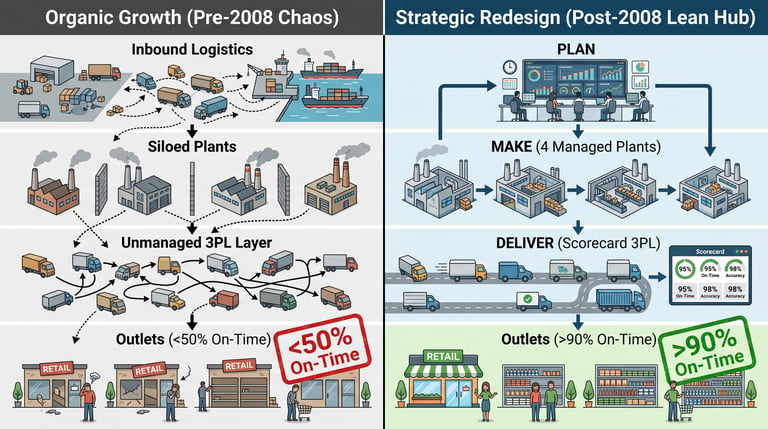
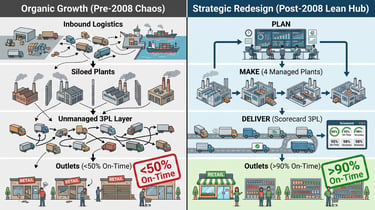
Starbucks addressed these systematic failures by executing a three-pronged turnaround strategy to reorganize the network, reduce the cost-to-serve, and build future capabilities.
The Plan, Make, and Deliver Paradigm
Management collapsed all disjointed functional silos into three macro-groups:
Plan: Centralized demand forecasting, production scheduling, and replenishment planning.
Make: In-house coffee roasting and processing operations. Starbucks opened its fourth major domestic roasting facility to optimize internal production and reduce regional transport distances.
Deliver: Outbound logistics, regional cross-docking, and final-mile storefront deliveries.
Vendor Rationalization and Performance Management
The remaining 3PL providers were held to strict Service Level Agreements (SLAs). Performance was tracked using a weekly scorecard system that measured critical metrics, including on-time delivery rates, temperature control accuracy, and order fill percentages.
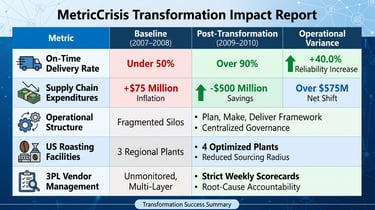
The operational transformation shifted Starbucks from a reactive, decentralized network to a highly synchronized corporate machine.
Cost-to-Serve Optimization Model
Before the reorganization, Starbucks did not accurately track its CTS per retail store. Fragmented 3PL layers drove up warehousing and last-mile freight costs independently.
By grouping operations into "Plan, Make, and Deliver," Starbucks calculated the exact cost of serving each store. This visibility allowed them to eliminate routing redundancies and optimize delivery drops.
Total Quality Management and the Deming Cycle
The transformation relies heavily on the Plan-Do-Check-Act (PDCA) loop of continuous improvement:


By embedding the "Check" phase directly into weekly operations via vendor scorecards, Starbucks created a self-correcting logistics engine. This structure prevented minor service errors from compounding into systemic delivery failures.
Takeaways
To help your audience engage with this content, I can draft a series of MBA classroom discussion questions or create a social media summary optimized for LinkedIn. Let me know how you would like to proceed!
Explore More Business Articles
Contact
Questions? Reach out anytime.
© 2025 BizSphere. All rights reserved.