
Statistical Experimentation Frameworks Conversion Rate Optimization Scale Strategy
by Divya
5/5/20263 min read


In the hyper-scaled digital economy, experimentation is no longer merely a tool for product optimization; it is a core competency that dictates capital allocation and corporate survival. For product-led growth (PLG) enterprises, executing seamless feature rollouts without disrupting the user experience requires a sophisticated orchestration of statistical engineering and strategic risk management. As organizations attempt to scale their experimentation pipelines, corporate strategy teams face a fundamental operational trade-off. They must balance the scientific rigor of their statistical frameworks against the institutional demand for velocity, agility, and rapid time-to-market.
At the center of this operational challenge sits the choice between two distinct mathematical paradigms: frequentist and Bayesian experimental frameworks. The traditional frequentist approach, built upon null-hypothesis statistical testing (NHST), p-values, and fixed sample sizes, serves as the historical bedrock of corporate data science. From a governance perspective, frequentist methodologies provide a rigid, binary decision framework that minimizes Type I errors (false positives) the corporate equivalent of rolling out a feature that inadvertently degrades the user experience or cannibalizes revenue. However, this scientific insurance policy carries a steep operational tax: it requires strict adherence to pre-determined sample sizes and forbids "peeking" at the data before completion, structurally slowing down product development cycles.
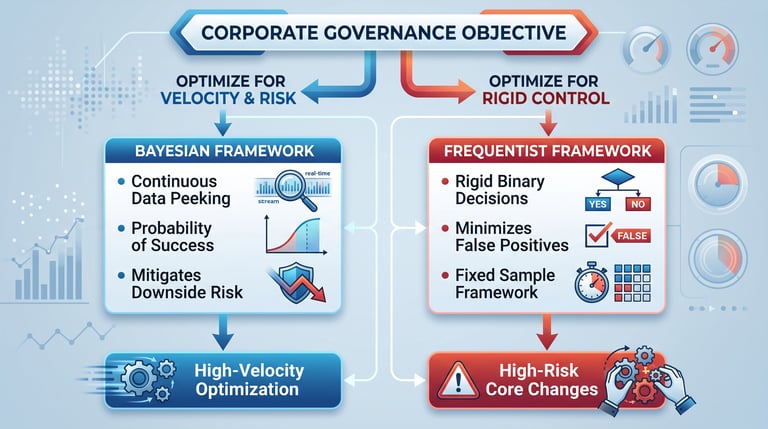
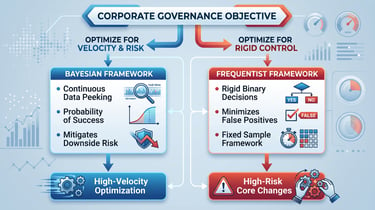
Conversely, the Bayesian experimental framework offers a more dynamic, business-centric approach to data-driven decision-making. Rather than treating parameters as fixed constants, Bayesian statistics calculates a continuously updating probability distribution based on incoming customer data and prior historical insights. For an executive managing a portfolio of digital products, the practical benefits of Bayesian experimentation are profound. It allows product teams to continuously "peek" at results in real-time, compute the exact probability of an alternative variant outperforming the baseline, and directly calculate the financial risk of deploying a suboptimal feature. This dramatically compresses experimental cycle times, unlocking rapid product iteration.
Choosing between these frameworks is a strategic decision that depends heavily on an organization's position in the product lifecycle and its appetite for risk. For mature enterprise software platforms where a 1% decline in conversion metrics can translate into millions of dollars in lost revenue, the risk-averse frequentist methodology remains highly defensible. It serves as an institutional gatekeeper against reckless feature rollouts. However, for high-growth startups or consumer-facing digital platforms looking to achieve rapid scale, the agility of the Bayesian framework is a critical competitive advantage. It allows teams to quickly kill underperforming variants and reallocate traffic to winning initiatives, optimizing customer lifetime value (LTV) in real-time.
Ultimately, the technical selection of a statistical framework must match the organization's overarching data governance strategy and platform architecture. True experimentation scale cannot be achieved by relying on a single methodology in a vacuum. Leading technology enterprises are increasingly deploying hybrid, multi-layered experimentation engines. They reserve rigorous frequentist protocols for high-stakes, core-infrastructure changes, while leveraging flexible Bayesian multi-armed bandit algorithms to dynamically optimize high-velocity UI/UX enhancements and personalization features without degrading the baseline customer experience.
Strategic Analysis of the Experimentation Frontier
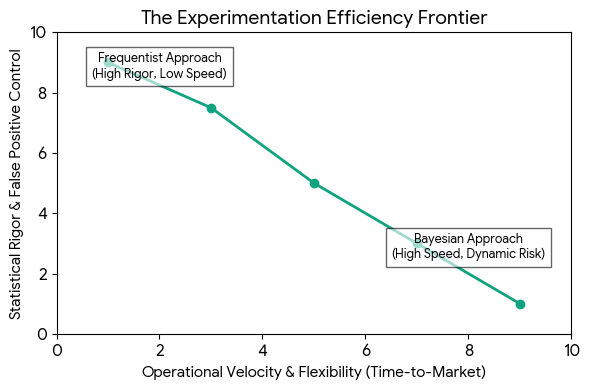
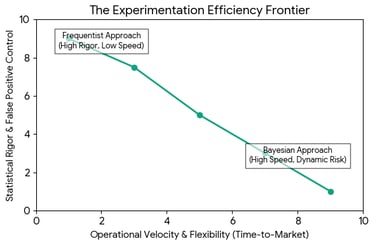
The efficient frontier curve illustrated above visualizes the structural trade-off between statistical control and operational velocity in corporate data systems. Moving upward along the curve toward the frequentist pole maximizes corporate insulation against false positives, but it introduces an institutional drag coefficient that delays product deployment. Shifting downward toward the Bayesian pole flattens organizational bottlenecks, trading rigid hypothesis thresholds for real-time risk calculations. For future operations executives, the strategic imperative is to design an organization capable of operating on this frontier allocating experimental methodologies dynamically based on the financial symmetry of the feature rollout's underlying risk profile.
Contact
Questions? Reach out anytime.
© 2025 BizSphere. All rights reserved.