
Strategic Frameworks for Mobile App Architecture and Product Analytics
by Divya
3/31/20265 min read


For future business executives, managing a mobile product is not an engineering challenge; it is a complex exercise in platform economics, user psychology, and precise data instrumentation. With the global mobile ecosystem effectively consolidated into an absolute duopoly, strategic product decisions made at the architectural phase dictate a firm's long-term financial margin, market reach, and user retention. Moving a business into the mobile space requires a deep understanding of the structural trade-offs between app delivery models and the optimization of data funnels to drive conversion.
The global mobile landscape operates under a strict, unprecedented duopoly. Google’s Android and Apple’s iOS together command 99.47% of the global mobile operating system market share, leaving a mere 0.53% for all other competing operating systems combined.


This absolute consolidation fundamentally alters corporate strategy for product distribution. Unlike the desktop market, where software can be distributed freely across open web channels the mobile space forces enterprises to comply entirely with the rules, review guidelines, and revenue splits (often up to 30%) established by Apple and Google. Because mobile operating systems act as the primary software platform managing hardware, touch interfaces, and multitasking, an enterprise's digital product must be explicitly tailored to function flawlessly within these two distinct runtime environments.
This absolute consolidation fundamentally alters corporate strategy for product distribution. Unlike the desktop market, where software can be distributed freely across open web channels, the mobile space forces enterprises to comply entirely with the rules, review guidelines, and revenue splits (often up to 30%) established by Apple and Google. Because mobile operating systems act as the primary software platform managing hardware, touch interfaces, and multitasking, an enterprise's digital product must be explicitly tailored to function flawlessly within these two distinct runtime environments.
A critical decision for any mobile product manager is selecting the deployment architecture. This decision permanently locks in upfront capital allocation, ongoing operational expenses, and the baseline user experience. Product teams must balance two conflicting forces: Platform Affinity (how easily the app runs across different operating systems) and Access to Device Capabilities (how deeply the app integrates with a phone's hardware, like GPS, cameras, and biometric sensors).
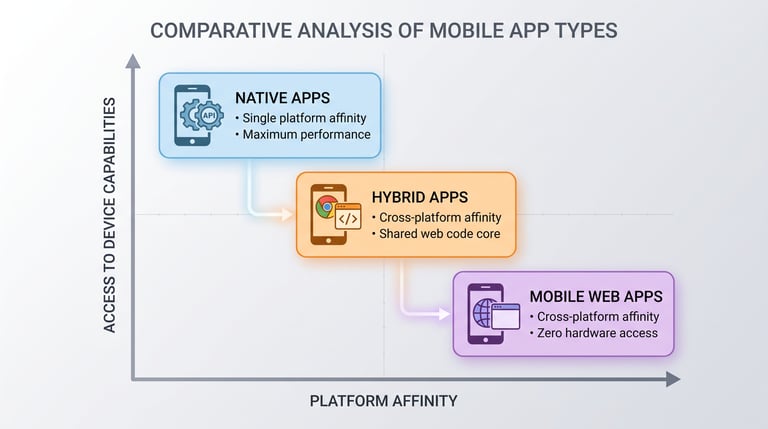
Native Applications: Maximizing Performance and Hardware Control
Native apps are developed using platform-specific Software Development Kits (SDKs), Swift or Objective-C for iOS, and Kotlin or Java for Android.
Strategic Advantages: They offer the fastest graphics processing performance, seamless fluid animations, and complete, uninhibited access to all native device APIs (on-device machine learning, low-level Bluetooth, complex camera controls). Distribution occurs strictly through official app stores, boosting user trust and discoverability.
Strategic Disadvantages: High resource intensity. Because codebases are entirely platform-specific, an enterprise must maintain two separate development teams. A single feature must be designed, written, and debugged twice, effectively doubling engineering costs and slowing down time-to-market.
Hybrid Applications: Balancing Cost and Cross-Platform Agility
Hybrid apps leverage a compromised framework where a single codebase is written using standard web technologies (HTML5, CSS3, and JavaScript) but wrapped inside a native container. This allows the app to run locally on the device, work offline, and access native hardware APIs. Major global products including Uber, Instagram, and Gmail successfully deploy hybrid architectures to maintain agility.
Strategic Advantages: Exceptional market agility. A single team writes one codebase that deploys simultaneously to both the Apple App Store and Google Play Store. This significantly lowers upfront engineering CapEx and streamlines post-launch product iterations.
Strategic Disadvantages: High-performance features, advanced rendering, or complex background processing can introduce performance bottlenecks, making the app feel less responsive than a purely native alternative.
Mobile Web Applications: Zero Friction but Restricted Capabilities
Mobile web apps are optimized, responsive websites running entirely on a remote web server and viewed via mobile browsers.
Strategic Advantages: Absolute platform affinity with zero friction. Updates are completely centralized on the company's servers, bypassing app store review cycles entirely. Users do not need to download or install an application, minimizing acquisition hurdles.
Strategic Disadvantages: They are completely cut off from the device’s underlying hardware capabilities and push notification frameworks, limiting long-term user engagement and restricting the application to basic content consumption.
3. The Mobile Analytics Framework: From Noise to Actionable Signals
Once an application is launched, the primary business objective shifts from development to optimization. Unlike traditional web analytics that track basic page views, mobile product management relies heavily on Event-Driven Architecture. Every tap, swipe, background state, and purchase is captured as an event tied to specific user properties.
Executives must look past vanity metrics (such as total historical downloads) to diagnose the genuine health of their mobile business by answering six core operational questions:
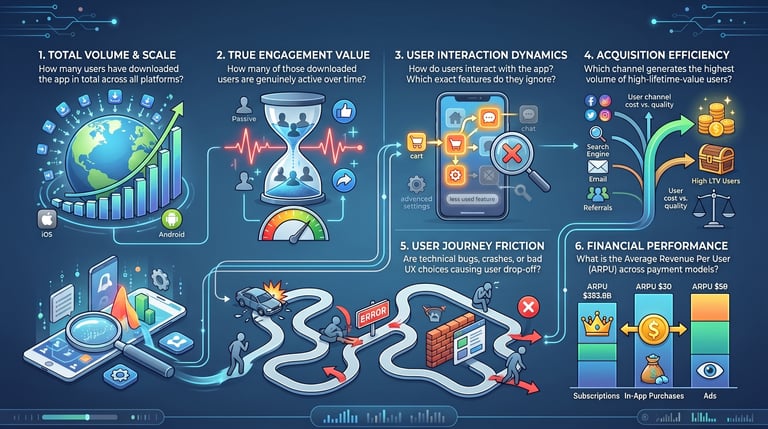

4. The Executive Dashboard: Categorizing Key Performance Indicators
To extract clear insights from raw data streams, a mobile product leader structures their analytics dashboard into six functional pillars. This data categorization allows teams to filter performance trends by platform, date, audience segment, and device model to locate precise friction points:
Active Users: Monitoring real-time users alongside Daily Active Users (DAU) and Monthly Active Users (MAU) to measure the product's ultimate user stickiness.
Conversions & Engagement: Tracking specific conversion funnels to pinpoint exactly where users abandon checkout paths, sign-up forms, or onboarding flows.
Revenue Metrics: Analyzing absolute financial yield, Average Revenue Per User (ARPU), and Average Revenue Per Paid User (ARPPU) across distinct cohort timelines.
Adoption & Acquisition: Mapping the adoption rates of new app version releases while attributing user acquisition to specific digital ad campaigns.
Retention Dynamics: Utilizing cohort analysis to track groups of users who downloaded the app at the exact same time, measuring how long they stay before churning.
Audience Demographics: Evaluating geographical, device-specific, and demographic traits to optimize targeted marketing efforts and regional feature rollouts.
5. Strategic Conversion Architecture: Optimizing the Funnel
Every distinct mobile product requires its own customized set of conversion points. A gaming app might focus heavily on microtransactions, an enterprise SaaS app on monthly subscription renewals, and a brand awareness app on daily time-spent-in-app.
To maximize the economic return on mobile investments, product managers must apply a systematic optimization framework:
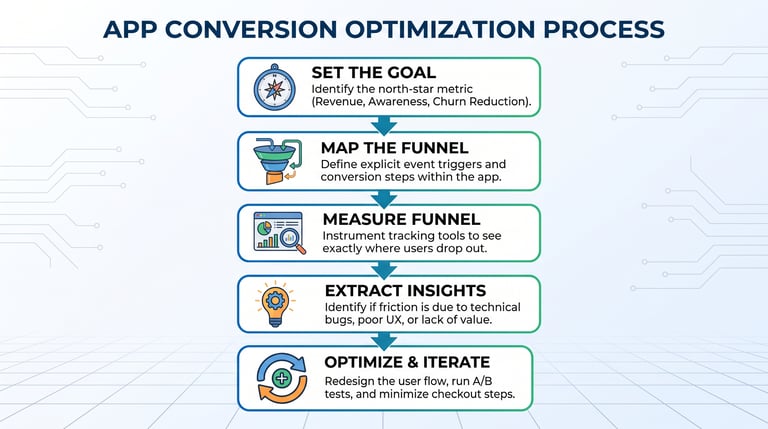
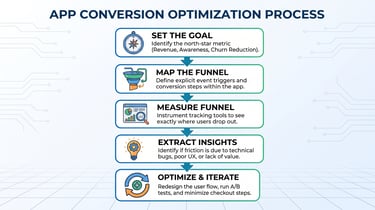
By applying this structured feedback loop, management can shift from guesswork to precise, data-backed iterations. Eliminating a single step in a registration funnel or resolving a UI lag on a specific device model can directly cause exponential growth in customer lifetime value and long-term product profitability.
Contact
Questions? Reach out anytime.
© 2025 BizSphere. All rights reserved.