
The Psychological Playbook of Strategic Leadership
by Divya
3/24/20263 min read


In stable economic environments, leadership often resembles management. It is about optimizing existing processes, maintaining cultural alignment, and executing predictable strategic goals.
But when an organization hits a major inflection point such as a post-acquisition integration, an abrupt business pivot due to technological disruption, or a severe corporate turnaround traditional management paradigms fall completely apart.
These high-stakes moments require what Harvard Kennedy School professor Ronald Heifetz coined Adaptive Leadership. Unlike technical leadership, which solves problems using existing expertise, adaptive leadership requires guiding an organization through systemic change where the problems are ambiguous and the answers do not yet exist.
This comprehensive guide breaks down the behavioral economics of leadership anxiety, explores the structural execution of corporate restructuring, and outlines an advanced blueprint for steering teams through systemic change.
1. The Core Framework: Technical Challenges vs. Adaptive Challenges
The single most frequent mistake senior executives make during organizational transitions is treating an adaptive challenge as if it were a technical challenge.
Technical Challenges: These problems are easy to define. They have clear, known solutions, and can be solved by bringing in external experts or implementing a new software system.
Adaptive Challenges: These problems are ambiguous, systemic, and deeply personal. They require people to change their values, habits, and ways of working. They cannot be solved by an executive directive; they require collective learning.
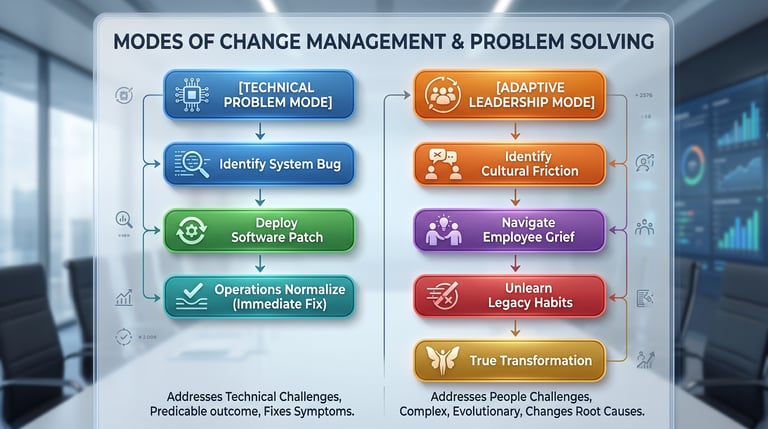
When an executive team attempts to solve a deep cultural or structural crisis by simply rewriting a policy manual or buying a new software platform, they are hiding behind a technical mask to avoid the uncomfortable, messy human work of adaptive change.
2. Managing the Heat: The Adaptive Leadership Operating Zone
True corporate transformation cannot happen without tension. Change forces people to step away from their comfort zones, which triggers a massive wave of organizational anxiety.
An adaptive leader's primary job is not to eliminate this pressure, but to regulate it. Leadership scholars visualize this dynamic through a governance framework known as the Operating Zone of Adaptive Pressure.
If the tension is kept too low (below the green threshold), the organization remains stagnant in its legacy comfort zone, and no meaningful evolution occurs. If the stress spikes too high (above the black line), the team enters a frantic panic zone, resulting in systemic burnout, high turnover, and functional paralysis.
An exceptional leader intentionally drives stress high enough to break old patterns, but actively actively intervenes to stabilize the system before the collective limit of tolerance is breached.
3. The Psychological Barrier: Overcoming Loss and Regulating Grief
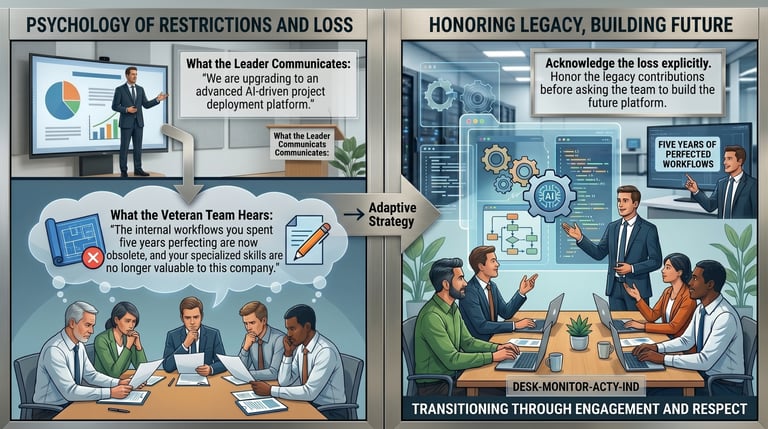
The secret that seasoned executive coaches teach MBA candidates is that people do not resist change; they resist loss.
When an organization pivots to a new business model, employees aren't necessarily angry at the new strategy. They are grieving the loss of their hard-earned status, their familiar routines, and their mastery over legacy tools.
4. Operational Playbook: Getting on the Balcony
To successfully navigate a high-stakes corporate transition, an adaptive leader must master the mental skill of moving between the balcony and the dance floor.
The Dance Floor: This is where operational execution happens. It is replying to urgent emails, putting out daily corporate fires, and analyzing immediate performance metrics. When you are on the dance floor, you cannot see structural systemic patterns because you are caught up in the action.
The Balcony: This is the place of absolute detachment. By stepping back onto the balcony, an executive can observe the macro dynamics of the organization. You can see which teams are fracturing, identify where political resistance is forming, and notice if the company is pushing past its behavioral limit of tolerance.
Tactical Leadership Guardrails
Give the Work Back to the People: Do not make the mistake of playing the omniscient hero. Instead of trying to fix every structural issue yourself, frame the core problems clearly and empower your frontline managers to design the solutions.
Protect the Voices of Dissent: During a massive structural pivot, standard management instincts tell you to suppress dissenters to keep the peace. Adaptive leaders do the opposite. They protect whisteblowers, rebels, and critics because those voices often hold the exact diagnostic data showing where your strategy is failing.
Contact
Questions? Reach out anytime.
© 2025 BizSphere. All rights reserved.