
The Seven Hundred Sixty Five Million Dollar Offshore Wind Cancellation Signals Macroeconomic Energy Pivot
by Divya
6/18/20263 min read


A massive 765 million dollar lease cancellation agreement between the United States Department of the Interior and a major power infrastructure company has upended the domestic clean energy pipeline. Under the strict terms of this high-stakes regulatory settlement, the federal government will reclaim four prime offshore wind leases. In an ironic strategic twist, the infrastructure conglomerate is legally bound to redirect the entire 765 million dollar payout exclusively into developing domestic oil and natural gas projects. For MBA students tracking corporate energy transitions, this sudden reversal serves as a stark case study in how rapidly shifting political mandates can instantly transform long-term green capital expenditure into fossil-fuel expansion capital.
From a corporate risk management perspective, this settlement highlights the severe sovereign and regulatory risks inherent in public-private infrastructure partnerships. This development marks the second multi-million dollar federal wind lease cancellation in June 2026 alone, signaling an aggressive macroeconomic pivot by federal authorities away from renewable infrastructure. By forcing the infrastructure firm to reallocate capital into carbon-heavy projects, the government has disrupted the long-term ESG portfolios of major institutional investors. MBA candidates analyzing this case must evaluate how corporate strategy teams can hedge against such volatile regulatory reversals when projects require multi-decade asset lifecycles to achieve profitability.
The financial settlement has ignited an immediate legal backlash, exposing deep cracks in multi-level government coordination and regional economic planning. A powerful coalition of state attorneys general has filed a comprehensive federal lawsuit against the Department of the Interior, arguing that these abrupt federal reversals inflict severe damage on local economic development and state-level environmental mandates. Coastal states had already aligned their regional supply chains, port infrastructure investments, and job training programs around these anticipated offshore wind grids. This litigation underscores a critical lesson for future business leaders: corporate strategy is never executed in a political vacuum, and legal battles between federal and state authorities can instantly paralyze multi-billion dollar industrial markets.
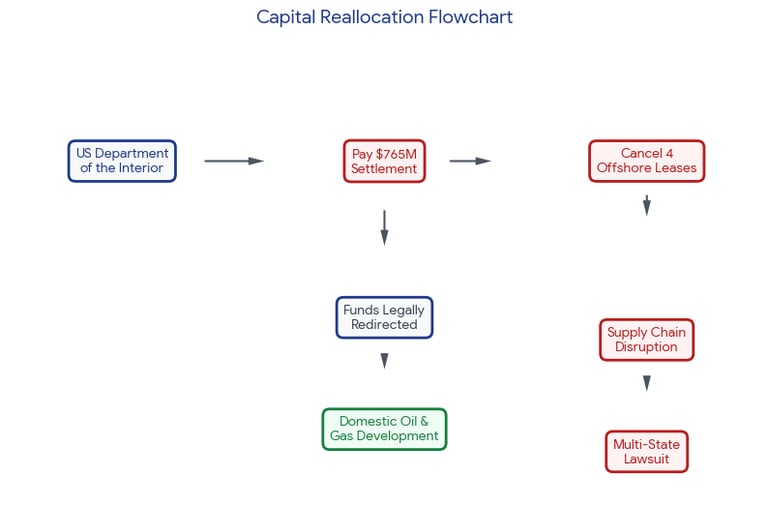
For students of strategic corporate finance, this 765 million dollar retreat offers a masterclass in calculating the true cost of asset strandedness and regulatory liability. When long-term capital projects are upended by policy shifts, corporations face massive contractual penalties, supply chain unwinding costs, and reputational damage among green-bonds underwriters. This case demonstrates that the global energy transition will not follow a linear path; instead, it is a volatile, cyclical arena where regulatory agility is just as critical to a firm's survival as technological innovation or capital efficiency. Corporations that fail to build robust political risk scenarios into their valuation models risk seeing their sustainable infrastructure portfolios dissolved by a single administrative pen stroke.
For graduating MBA classes entering this highly volatile global economy, this case study serves as a definitive roadmap for the leadership challenges that lie ahead. The traditional playbook of forecasting corporate strategy based on stable, linear policy metrics is officially obsolete. As future executives, chief financial officers, and sustainability directors, your value to an organization will not be measured by your ability to manage predictable markets, but by your agility in navigating systemic disruption and political crosswinds. True leadership in the modern era requires the strategic foresight to build optionality into your capital structures and the resilience to turn a multi-million dollar regulatory roadblock into a masterclass in corporate adaptation.
Contact
Questions? Reach out anytime.
© 2025 BizSphere. All rights reserved.