
The SPI Model and Cloud Use Cases
by Divya
3/30/20264 min read
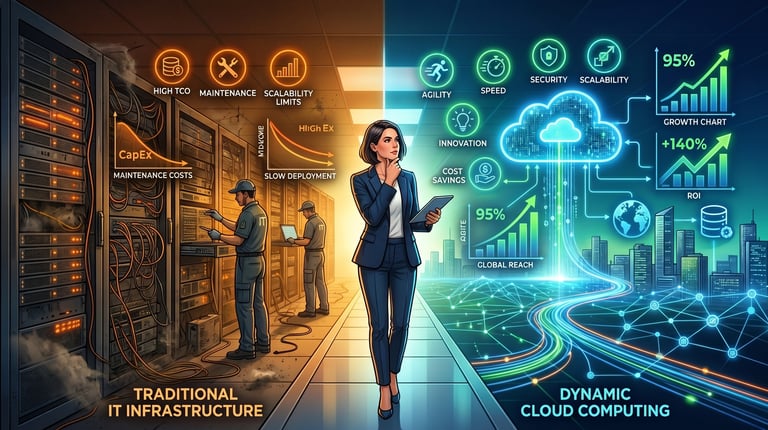
The transformation of cloud computing from a technical efficiency tool into a core driver of corporate strategy and operational scalability has fundamentally changed how future executives must approach business design. For modern leaders, the cloud is less about managing IT infrastructure and more about leveraging economic elasticity to mitigate risk, optimize capital allocation, and unlock data-driven business models. Understanding this shift requires looking past the technology itself to examine the structural, financial, and strategic frameworks that define the modern cloud ecosystem.
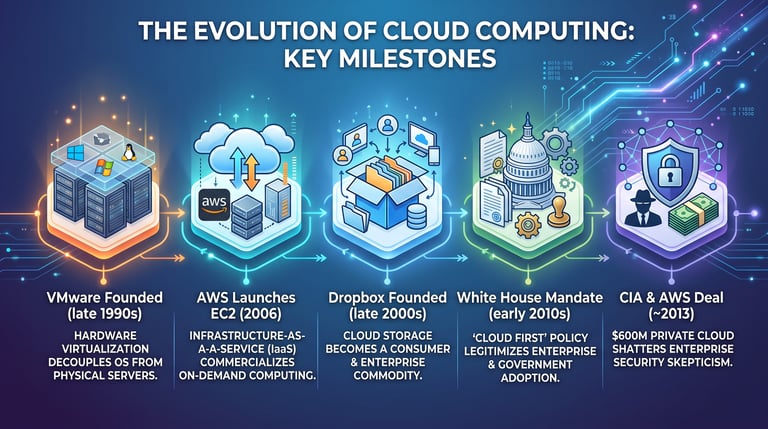
The historical trajectory of the cloud highlights a deliberate transition from solving localized hardware limitations to building globally interconnected business networks. This evolution began in the early 1980s with basic networking hardware, such as the first Ethernet adapter card for the IBM PC, which established the low-cost connectivity necessary for remote resource sharing. By the late 1990s, virtualization technology pioneered by companies like VMware allowed a single physical server to run multiple, isolated operating systems simultaneously, significantly improving hardware utilization. The landscape shifted fundamentally in 2006 when Amazon commercialized this concept on a massive scale by launching Elastic Compute Cloud, effectively introducing Infrastructure-as-a-Service to the market. As consumer-facing applications like Dropbox commoditized cloud storage, public and private sectors took notice. This culminated in significant institutional validation, including the United States federal government's "cloud first" mandate and the Central Intelligence Agency's landmark $600 million private cloud contract with Amazon Web Services, which effectively neutralized lingering corporate skepticism regarding cloud security.
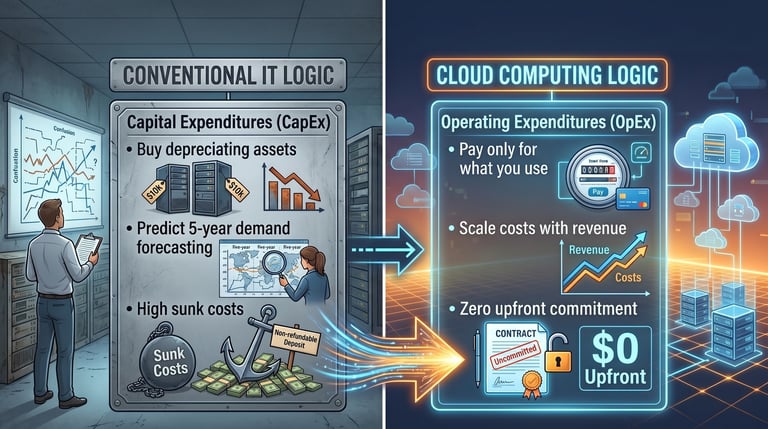
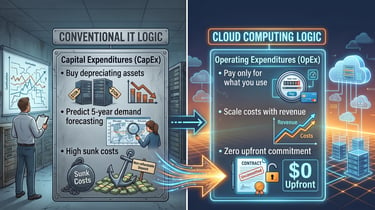
At its core, the business case for cloud migration centers on financial engineering and the reallocation of corporate risk. Traditional IT environments require substantial Capital Expenditures, forcing companies to invest heavily upfront in depreciating assets like physical data centers and hardware based on highly speculative five-year demand forecasts. These fixed costs quickly turn into sunk capital if business projections fall short. Conversely, cloud computing operates on an Operating Expenditures model. By transitioning infrastructure into a variable cost, businesses align their IT expenses directly with real-time utilization and operational revenue. This model eliminates the financial burden of idle capacity and frees up liquid capital to be deployed toward core business innovations and growth strategies rather than maintenance.
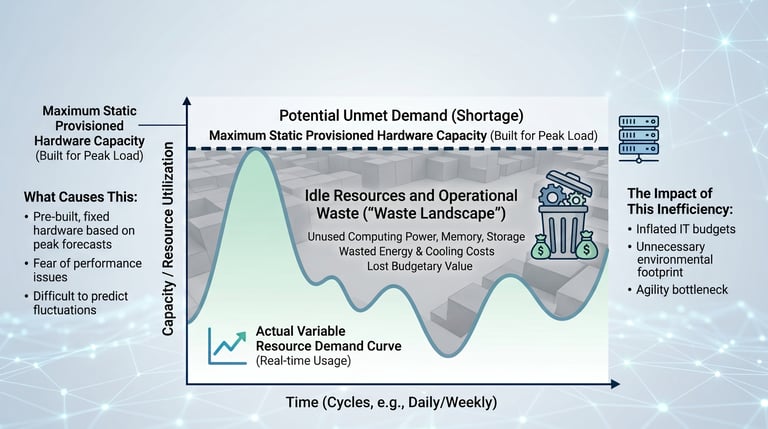
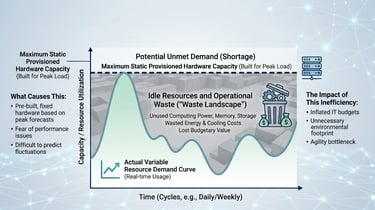
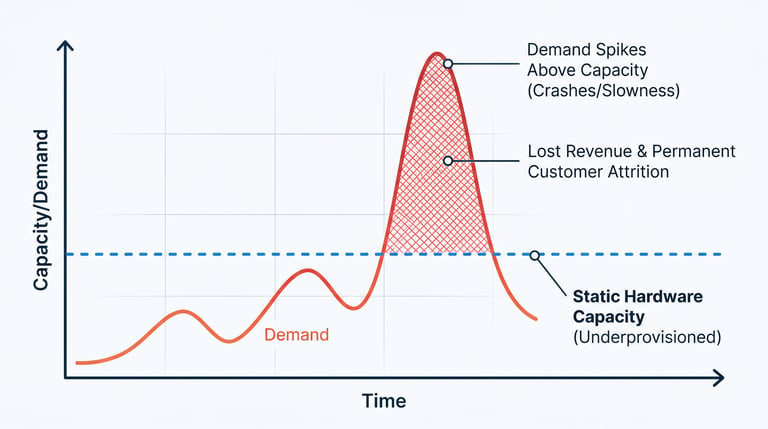
The financial hazards of traditional infrastructure become particularly evident when analyzing the capacity risk of static environments. In conventional computing, an enterprise must provision its data center to handle peak operational loads, such as holiday shopping spikes or end-of-month processing. When provisioning exclusively for these rare peak events, servers sit drastically underutilized during typical business hours, resulting in substantial resource waste and lost capital efficiency.
Conversely, if an organization attempts to contain costs by underprovisioning its infrastructure, it faces severe dual-layered risks. The immediate penalty is the direct sacrifice of revenue when customer demand exceeds system capacity, causing application latency, system time-outs, or complete website failures during critical sales windows. The more severe, long-term consequence is permanent customer attrition. Users who encounter broken interfaces or unreliable service frequently migrate to competitors, compounding immediate financial losses with lasting brand degradation and an eroded future revenue stream. Cloud computing resolves this dilemma through automated elasticity, dynamically scaling computing capacity to match demand perfectly without manual intervention.
To effectively govern these environments and manage vendor partnerships, executives utilize the structured Software, Platform, and Infrastructure framework to delineate operational responsibilities. Infrastructure-as-a-Service provides the raw baseline components, including virtual servers, networking capabilities, and storage, giving the corporate client maximum architectural control but requiring them to manage operating systems and software applications. Platform-as-a-Service abstracts the underlying hardware, providing developers with pre-configured environments to build and deploy applications quickly without managing server maintenance. Software-as-a-Service sits at the top of the stack, delivering fully managed, end-user applications directly over a web browser, such as enterprise resource planning software or collaboration tools. This framework clearly defines where corporate operational liability ends and where the cloud provider’s service-level agreement begins.


The underlying economic utility of these models generally manifests in three primary business use cases. The first involves highly variable demand patterns, where cyclical or time-dependent spikes make constant physical infrastructure maintenance financially non-viable. The second appears in early-stage ventures and digital startups where future traffic is fundamentally unknown; cloud elasticity acts as an operational safety net, protecting a viral product from crashing while shielding the business from financial ruin if user growth stalls. The third use case capitalizes on cost associativity, a pricing reality unique to cloud architectures where utilizing 1,000 computing instances for a single hour costs precisely the same as utilizing one instance for 1,000 hours. This enables organizations to execute high-intensity batch analytics and complex market simulations on demand, accelerating time-to-market without requiring a capital investment in supercomputing hardware.
As the corporate landscape matures, the focus of cloud strategy is pivoting away from basic storage efficiencies toward advanced data synthesis. The exponential proliferation of corporate data through enterprise workflows, industrial telemetry, and consumer analytics means the primary business challenge is no longer where to store data, but how rapidly to extract actionable intelligence from it. Contemporary enterprises use the cloud as a central engine for business intelligence, running integrated machine learning models and big data analytics directly over cloud data warehouses to optimize supply chains, predict consumer behaviors, and out-innovate fixed-capacity competitors. For future executives, the strategic mandate is clear: the cloud should not be managed as a mere technical migration project, but deployed as a catalyst for rapid business experimentation, financial agility, and competitive differentiation.
Contact
Questions? Reach out anytime.
© 2025 BizSphere. All rights reserved.