
The Strategic Network Architectural Mapping Across Sectors and Eras for Enterprise Longevity
by Divya
6/3/20264 min read


In professional development, an optimization paradox frequently occurs: ambitious professionals overinvest in their immediate peer cohorts. Whether inside corporate offices, startup accelerators, or top-tier MBA programs, individuals naturally default to networking with peers of identical seniority, industry focus, and career timelines.
While cohort-based relationships offer immediate psychological comfort and baseline solidarity, they rarely yield non-linear career breakthroughs. Long-term professional security and high-leverage opportunities require structural diversity. This master-level analysis deconstructs the architectural differences between horizontal and vertical networking, demonstrating why expanding your professional scope beyond your immediate cohort yields the highest dividends.
The Network Topography: Structural Hole Theory
To evaluate the mathematical utility of a professional network, we must look to computational sociology, specifically Ronald Burt’s Structural Hole Theory. Burt posits that individuals who bridge disconnected groups (structural holes) gain significant competitive advantages because they control the flow of unique information.
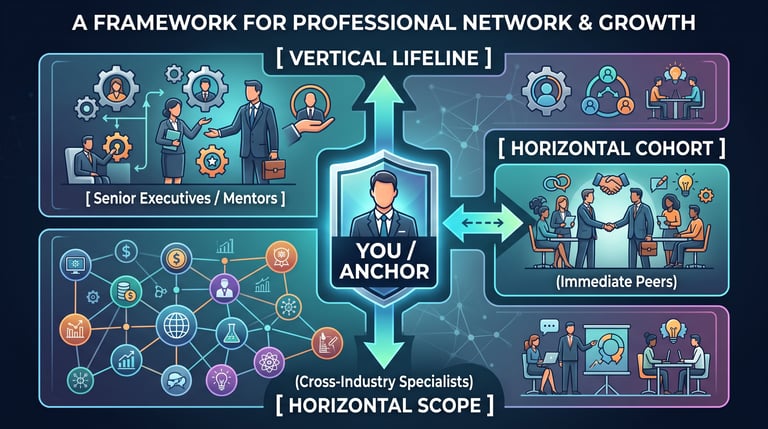

When you restrict your professional connections to your immediate cohort, you create a dense, redundant network cluster. Everyone in this group shares the same news feeds, encounters identical industry challenges, and competes for the exact same promotions. Information circulates inside a closed loop.
True career velocity happens when you build bridges out of this cluster, connecting horizontally into entirely different asset classes or vertically across disparate generations of seniority.
Structural Comparison: Scope vs. Cohort Allocation
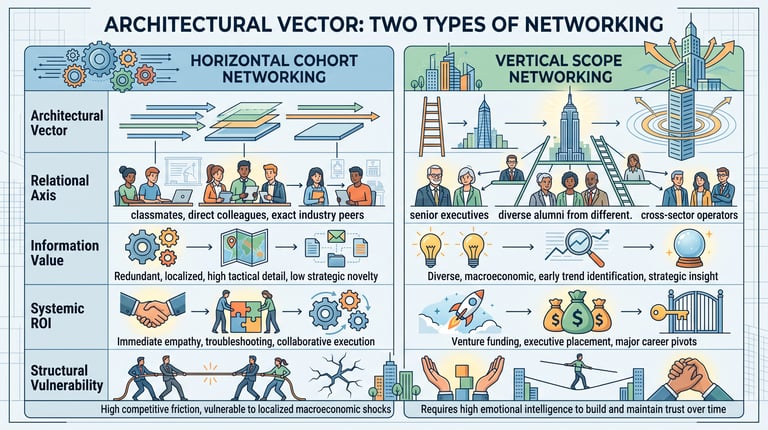
Maximizing your professional equity requires an intentional division of your relational capital. The matrix below contrasts the operational profiles of horizontal and vertical networking paradigms:
The Mechanics of Horizontal Scope Expansion
Horizontal networking beyond your immediate cohort means intentionally building ties with individuals who operate at your same structural level but within entirely different ecosystems. If you are a product manager in FinTech, your immediate impulse is to network with other FinTech product managers. A high-leverage strategy demands connecting with data scientists in biotech, supply chain directors in aerospace, or content strategists in media.
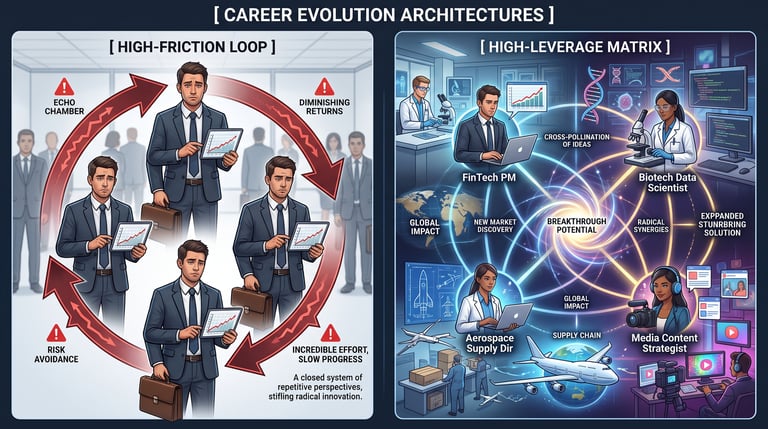

This matrix protects you from economic volatility. When an industry-specific downturn occurs, a cohort-locked network experiences systemic failure simultaneously—everyone is looking for a job at the exact same moment.
A cross-sector network provides immediate resilience. It allows you to transport innovative frameworks from a thriving industry into a stagnant one, making you a highly unique asset to future employers.
The Mechanics of Vertical Generational Sourcing
Vertical networking requires breaking through the boundaries of your graduation year or age bracket. This means engaging with two distinct demographics: Senior Pioneers (those 10 to 20 years ahead of you) and Emerging Innovators (those 5 to 10 years behind you).
1. Sourcing Upward: The Pull Strategy
Connecting with senior executives should not be viewed as an exercise in transactional mentorship. Senior leaders rarely respond to requests to "pick their brain." Instead, approach these relationships by positioning yourself as a fresh source of frontline information. Offer clear, real-time insights into consumer behavioral shifts, emerging tool adoption, or cultural changes within the lower tiers of the market. You supply tactical ground truth; they provide macro strategic direction and executive sponsorship.
2. Sourcing Downward: The Push Strategy
An underrated component of vertical networking is building deep connections with younger cohorts. Executives often fail because they lose touch with the operational realities of the frontline workforce. By anchoring relationships with junior professionals, you secure early access to the next wave of technical talent, emerging cultural trends, and disruptive startup methodologies. As these individuals rise, your influence expands alongside them.
Operational Blueprint for Network Rebalancing
To transition your network from a high-redundancy cluster to a high-leverage portfolio, implement this three-part structural execution plan:
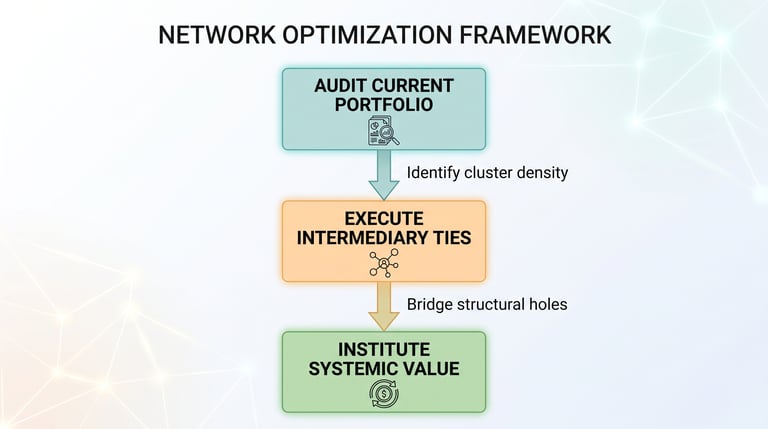
The 60/40 Portfolio Reset: Audit your current professional contacts. Intentionally allocate 40% of your networking time to your immediate cohort for execution support. Dedicate the remaining 60% to building cross-industry (horizontal) and multi-generational (vertical) connections.
The Alumnus Decadal Leap: When leveraging your university or corporate alumni network, skip the years immediately surrounding your tenure. Intentionally reach out to individuals who graduated exactly ten years before or ten years after you. This gap completely eliminates direct competitive friction while preserving a shared cultural baseline.
The Insight Exchange Protocol: When connecting across structural divides, always lead with zero-transaction value creation. Share relevant cross-industry data, offer technical troubleshooting to senior leaders, or provide interview preparation assistance to younger cohorts.
Architectural Equilibrium
Your immediate cohort provides the baseline foundation for your daily professional execution, but it should never define the boundaries of your long-term career capital. By systematically mapping your relationships across varied industries and structural generations, you insulate your career from economic shocks, capture elite macro insights, and build the expansive professional equity required for executive longevity.
Contact
Questions? Reach out anytime.
© 2025 BizSphere. All rights reserved.