
Turnaround Strategy for a Declining Retail Chain Modernizing Legacy Brick and Mortar Operations
by Divya
6/26/20262 min read


The core challenge focused on executing a delicate operational balancing act: aggressively cutting structural costs while simultaneously redefining the brand's core value proposition. Traditional cost-cutting maneuvers, such as closing stores or reducing frontline headcount, risked degrading the in-store customer experience and accelerating sales declines. Conversely, investing heavily in a digital overhaul required massive capital outlays that the company's stressed balance sheet could not easily support. The strategic management team had to find a way to extract immediate operational efficiencies and repurpose those savings into a modernized, omni-channel customer experience that online competitors could not replicate.
To evaluate its position accurately, the executive team performed a comprehensive SWOT Analysis, mapping its internal capabilities against a volatile macroeconomic environment.
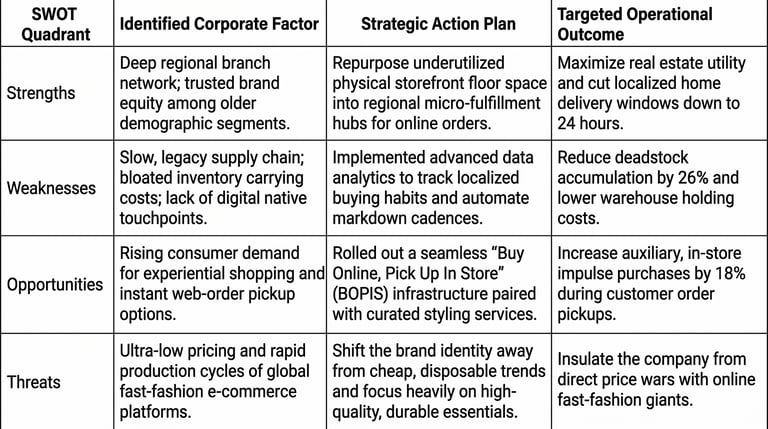
Simultaneously, management deployed the Ansoff Matrix to determine the most viable vector for long-term revenue growth. While diversification into completely new markets carried too much financial risk and simple market penetration was failing, the leadership team chose a aggressive path of Product Development and omni-channel integration. Instead of trying to match the endless, low-quality catalogs of online fast-fashion players, the retailer curated an exclusive line of sustainable, premium apparel tailored specifically for its core customer base. They backed this product launch with a synchronized digital ecosystem, allowing customers to easily check local store inventory online and book private, in-store styling appointments via a new mobile application.
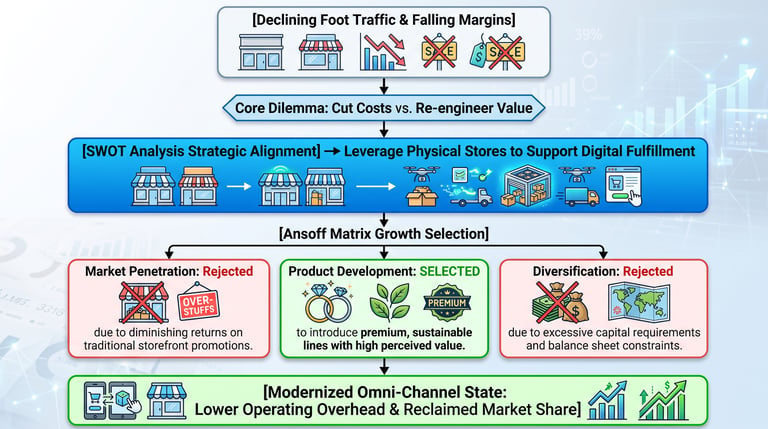
Within eighteen months of activating this multi-framework turnaround plan, the retail chain successfully stabilized its financial position and reversed its multi-year traffic decline. The company achieved a 14% reduction in overall retail operating costs by optimizing storefront footprints and streamlining logistics. These efficiency gains directly funded the digital transformation, which fueled a 42% increase in online sales volume. By converting its physical storefronts from an operational liability into a strategic fulfillment asset, the brand successfully protected its market presence, proved the enduring relevance of experiential retail, and established a scalable blueprint for brick-and-mortar survival.
The physical retail landscape is experiencing an intense structural disruption as legacy storefronts face rapid market share erosion from agile, pure-play e-commerce platforms. A prominent brick-and-mortar clothing retailer recently confronted this existential threat following consecutive quarters of declining foot traffic, shrinking operating margins, and a severe loss of younger consumer segments. For an organization tethered to long-term commercial real estate leases and high inventory overhead, the traditional retail model was rapidly becoming unsustainable. Executive leadership recognized that survival depended on a comprehensive operational turnaround that could defend the company's regional footprint while matching the digital velocity of online competitors.
Contact
Questions? Reach out anytime.
© 2025 BizSphere. All rights reserved.