
Value Innovation Strategic Positioning Blue Ocean Market Penetration
by Divya
5/7/20262 min read


When corporate strategists evaluate corporate growth vectors, they frequently face a fundamental choice between two distinct growth strategies: competing within traditional industry boundaries or trying to break out of them entirely. The traditional framework taught in business schools Market Penetration is an expansion strategy focused on capturing incremental market share within an existing, highly saturated industry. For organizations operating under this paradigm, the strategic imperatives are operational efficiency, marginal cost reductions, and aggressive customer acquisition Emerald. However, this relentless battle for market share often results in a "red ocean," where cutthroat competition and product commoditization erode profit margins, leaving firms highly vulnerable to price wars and shifting consumer preferences ResearchGate.
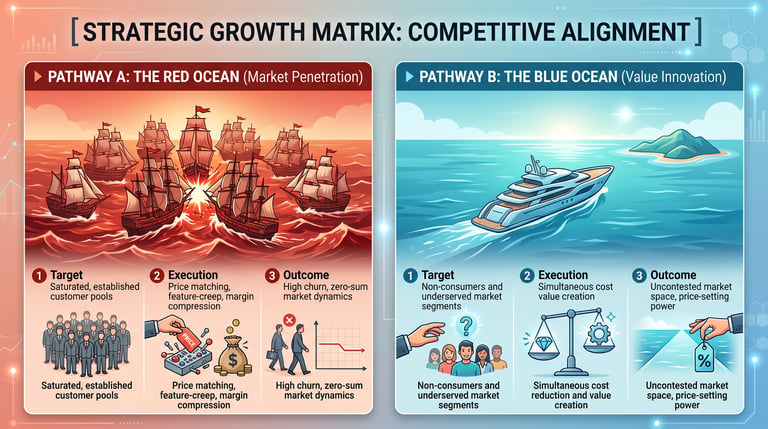
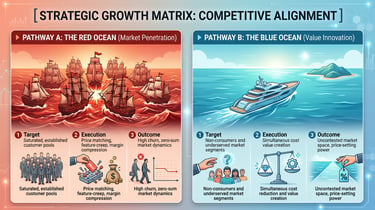
To escape this zero-sum competitive landscape, organizations must leverage the Blue Ocean Strategy, a framework centered on the concept of value innovation. Value innovation completely redefines traditional strategic positioning by rejecting the classic trade-off between low cost and high differentiation. Instead, it seeks to drive costs down while simultaneously driving value up for buyers ResearchGate. By eliminating and reducing factors that an industry has long competed on, and raising or creating entirely new elements that the industry has never offered, a firm can render the competition irrelevant and unlock uncontested market space ResearchGate.
Executing a true blue ocean pivot requires a profound shift in corporate mindset, moving the primary strategic focus from consumer optimization to non-consumer discovery. While a standard market penetration strategy relies heavily on data analytics to optimize features for current customers, value innovation demands a qualitative understanding of why certain demographics refuse to use the industry's products altogether. This approach allows an enterprise to reconstruct market boundaries, transforming latent demand into entirely new product categories and establishing a powerful first-mover advantage that insulates the firm from competitive pressure.
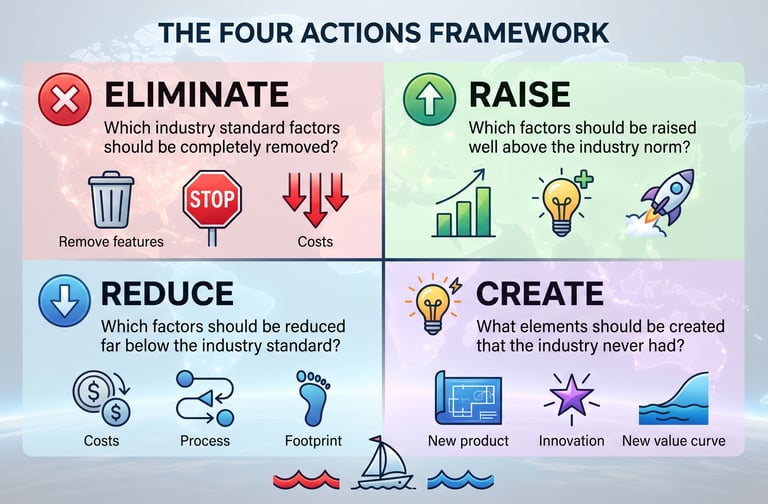
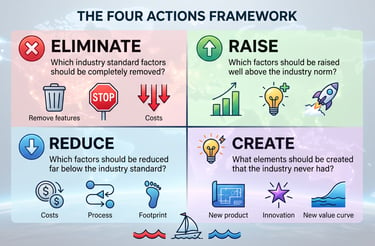
For future business leaders, managing this strategic choice requires balancing risk profiles against resource availability. A market penetration strategy carries high execution risk but low market uncertainty; the customer base is defined, and the execution playbook is well established. Conversely, a blue ocean strategy features low execution risk but high market and demand uncertainty. The challenge is not out-maneuvering a rival, but accurately predicting whether an entirely new market space will materialize and sustain long-term growth.
Ultimately, the choice between these strategies dictates an organization's long-term capital allocation and structural alignment. While market penetration remains an essential tactical lever for maximizing cash flow from legacy business units, long-term corporate renewal depends entirely on a firm's capacity for value innovation. The most resilient global enterprises are those that build an organizational architecture capable of executing a dual-strategy framework: leveraging the predictable revenue streams of their red ocean assets to fund the high-upside exploration of new blue ocean horizons.
Contact
Questions? Reach out anytime.
© 2025 BizSphere. All rights reserved.