
When and How to Safely Discuss Visa Sponsorship with US Recruiters
by Divya
6/11/20263 min read


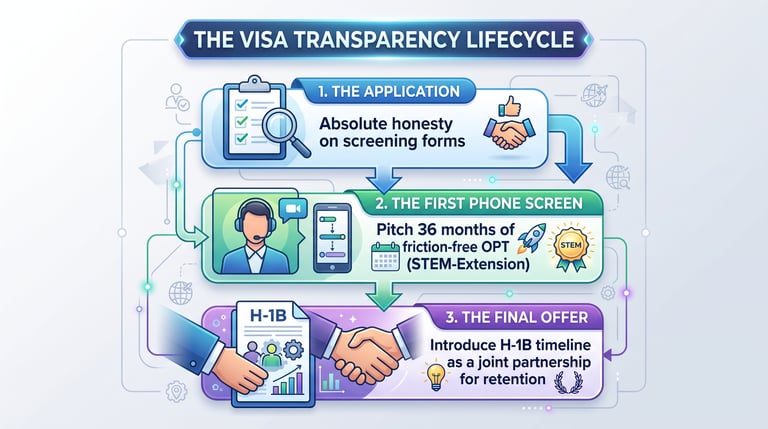
The question of visa sponsorship can feel like a ticking time bomb for international students navigating the US job market. Out of fear of immediate rejection, many highly qualified candidates make the critical mistake of hiding their status or delaying the conversation until the final round.
This approach often backfires, destroying trust with recruiters and wasting weeks of interview preparation.
Successfully navigating work authorization is not about hiding your status. It is about understanding the timing, managing the legal timelines, and framing your employment eligibility as an immediate, low-risk solution for the employer.
1. Demystifying the Online Screening Questions
The vast majority of US job applications feature two mandatory screening questions. You must understand exactly how corporate applicant tracking systems (ATS) handle your answers to remain both compliant and competitive.
Question 1: "Are you legally authorized to work in the United States?"
The Truth: If you hold an F-1 visa and qualify for Optional Practical Training (OPT), your answer is YES.
The Strategy: You do possess immediate legal authorization to work upon graduation. Marking "No" here can trigger an automatic, immediate rejection by the ATS before a human recruiter ever sees your resume.
Question 2: "Will you now or in the future require visa sponsorship?"
The Truth: Your answer must be YES.
The Strategy: Attempting to bypass this question by checking "No" is a severe strategic error. Even if you secure an interview, discovering a candidate lied on an initial application is a compliance red flag that almost always results in immediate disqualification later in the process.
2. Navigating the First Phone Screen: The 36-Month Value Pitch
The optimal window to clarify your work authorization is during the initial 15-minute phone screening with the recruiter. Your objective is to shift their perspective from viewing you as an immediate legal burden to recognizing you as a long-term, zero-cost talent solution.
Many recruiters do not fully understand immigration law. They often confuse an F-1 graduate with an immediate H-1B visa petition, assuming the company must pay thousands of dollars in legal fees on day one. You must educate them gently using a structured script.
The "Friction-Free OPT" Script
When the recruiter brings up work authorization, deploy this precise framing:
"I am fully authorized to work in the US for up to 36 months under my F-1 STEM Optional Practical Training (OPT) status. This means there is zero cost, zero paperwork, and zero legal sponsorship required from the company for the first three years of my employment.
During this time, I will be on the company payroll exactly like a domestic employee. If my performance drives measurable value, we can easily look at transitioning to long-term work authorization down the road, but for the next three years, my employment is completely seamless."
3. Comparing the Employer Risk Profile
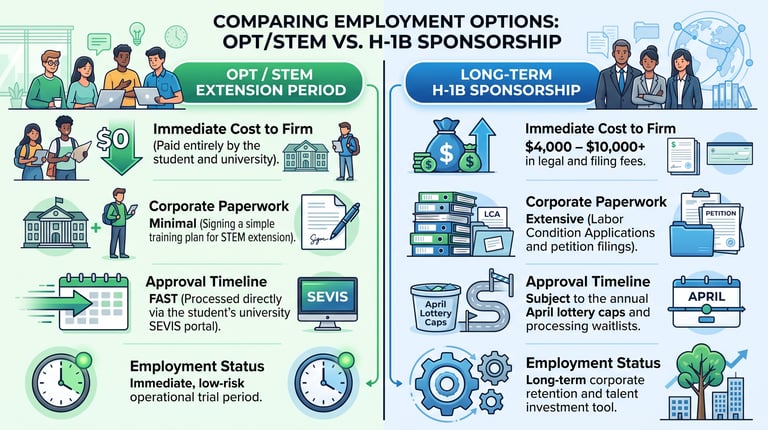
To confidently position your status, you must understand the operational difference between your immediate work authorization (OPT) and long-term sponsorship (H-1B). Use this breakdown to alleviate recruiter concerns during your discussions:
4. Closing the Loop at the Offer Stage
Once you pass the technical rounds and a team wants to hire you, your leverage increases significantly. This is the safe window to detail long-term retention goals. At this stage, you are no longer just an international applicant you are the chosen candidate who has proven they can solve the team's operational problems.
Framing the H-1B Lottery as a Retention Tool
When discussing the long-term plan with HR or your hiring manager, frame sponsorship as a talent retention strategy rather than a legal hurdle:
Emphasize Multiple Opportunities: "Because my STEM extension gives us three lottery cycles to apply for the H-1B cap, the mathematical probability of selection is highly favorable. It acts as an excellent, low-risk runway for us to build a long-term partnership."
Highlight Corporate Continuity: "Securing sponsorship allows me to continuity-proof the systems I will be building for your team over the next three years, ensuring your investment in my training stays within the firm."
By maintaining absolute transparency on your applications, pitching the zero-cost advantage of your OPT runway early, and addressing long-term sponsorship only after proving your strategic value, you strip the anxiety away from the visa conversation and position yourself as a highly calculated, low-risk asset.
Contact
Questions? Reach out anytime.
© 2025 BizSphere. All rights reserved.