
Why Traditional Internal Audit Frameworks Blind the Boardroom to Digital Disasters
by Divya
3/23/20263 min read


In modern enterprise governance, the Audit and Risk Committees of major corporations rely on a comforting illusion. Every quarter, they review beautifully formatted heat maps, compliance certificates, and internal audit sign-offs. These documents offer a definitive assurance: the organization's risks are under control.
Yet, year after year, multi-billion-dollar enterprises with pristine compliance records find their operations completely paralyzed overnight by sophisticated ransomware attacks, critical infrastructure failures, or systemic data breaches.
The hard truth facing corporate boards is that traditional risk assurance frameworks are fundamentally broken when applied to information security. While classic audit methodologies excel at verifying static financial records, they are dangerously blind to the dynamic, asymmetrical realities of modern technology risk.
This case study analyzes why traditional assurance fail-safes collapse during digital crises, breaks down the fatal flaw of "check-the-box" compliance, and outlines an advanced, operational framework for Continuous Risk Assurance.
1. The Core Framework Failure: The Inherent Blindness of "Point-in-Time" Auditing
The bedrock of traditional internal audit is the Point-in-Time assessment. An internal or external audit team spends three weeks examining control evidence from the previous fiscal quarter, verifies that proper authorization signatures exist, and issues an assurance report.
While this approach works perfectly for verifying that invoice approval policies are being followed, it is a catastrophic vulnerability in the digital space. A corporate network's security posture can shift completely in a single afternoon.
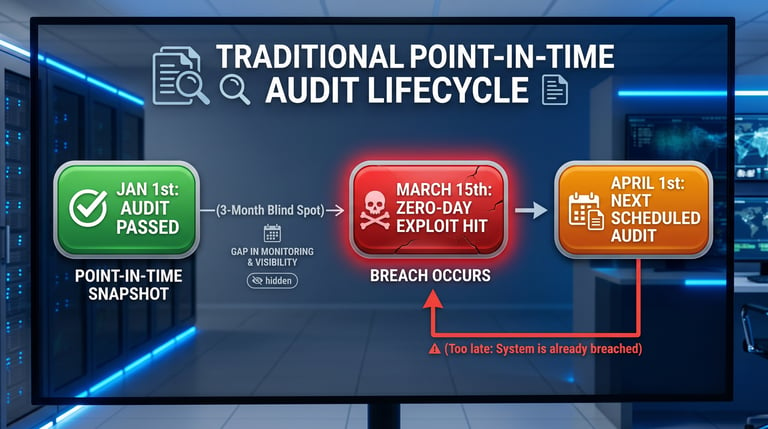
If an employee accidentally misconfigures a single cloud server storage bucket or a critical zero-day vulnerability is discovered on a random Tuesday, a company becomes immediately exposed to global threat actors. A quarterly compliance report cannot capture a live, rapidly evolving technical threat landscape.
2. The Danger of "Compliance Theater" vs. Operational Security
The most significant organizational threat to modern risk assurance is a psychological phenomenon known as Compliance Theater. This happens when an organization mistakes a passed compliance certification (such as SOC 2, ISO 27001, or PCI-DSS) for actual, hard-bitten security resilience.
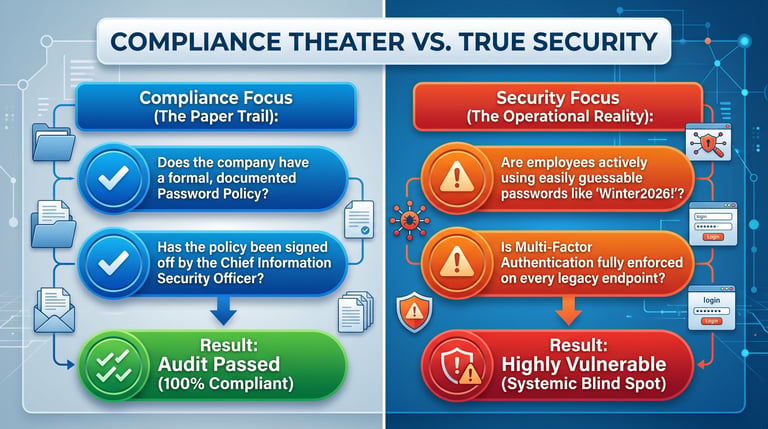
Compliance frameworks measure the existence of a control policy; they rarely evaluate its effectiveness against an active adversary. Threat actors do not care about your beautifully archived documentation or your certified audit reports; they exploit the unmonitored operational gaps between them.
3. Visualizing the Disconnect: Control Coverage vs. Attacking Vectors
To map out where traditional corporate assurance breaks down, look at the structural distribution of a typical audit budget. Traditional frameworks disproportionately channel resources into verifying high-visibility administrative controls while leaving complex technical and operational layers largely unverified.
As shown in the data breakdown, a profound misalignment exists in modern enterprise planning. Traditional audits exhaustively verify policies and administrative rules (where the actual threat vector is low), while virtually ignoring third-party supply chain software vectors and technical configurations (where modern adversaries strike hardest).
4. The Solution: Implementing Continuous Control Monitoring (CCM)
To fix this systemic failure, advanced internal audit and risk assurance teams are moving away from traditional checklists and adopting a data-driven framework known as Continuous Control Monitoring (CCM).
Instead of waiting for a quarterly or annual evaluation cycle, a CCM assurance architecture leverages automated software integrations to constantly query the organization's technical perimeter:
Automated Configuration Auditing: Scripted monitors continuously poll cloud configurations across platforms like AWS or Azure, raising immediate high-priority alerts the second an unauthorized open database or weak port is introduced.
Adversarial Emulation & Red Teaming: Rather than relying on simple automated scans, assurance teams hire external ethical hackers to perform continuous, unannounced simulated attacks against the company's human infrastructure (phishing) and technical barriers.
Data-Driven Dashboards for the Board: The Board of Directors drops static PowerPoint summary decks in favor of live executive risk dashboards. These platforms display verifiable, real-time metrics detailing patch deployment velocities and unmitigated security vulnerabilities.
Key Takeaways for Corporate Governance Directors
Stop Auditing Papers, Audit Systems: Instruct your internal audit teams to look past basic policy documentation. Demand raw, unfiltered technical data showing whether those policies are being actively enforced across production systems.
Decouple Compliance from Security: Treat compliance certifications strictly as a baseline legal requirement, never as proof of an effective security infrastructure. True assurance requires measuring real-world defense performance under duress.
Hold Third-Party Supply Chains Accountable: Your network is only as secure as the weakest software vendor connected to it. Extend your operational risk assurance protocols to continuously vet the code and access privileges of all external digital partners.
Contact
Questions? Reach out anytime.
© 2025 BizSphere. All rights reserved.