
Designing and Governing KPIs via the Balanced Scorecard
by Divya
4/13/20264 min read


A strategic vision is only as effective as the metrics used to enforce it. In corporate governance, poorly designed Key Performance Indicators (KPIs) create organizational friction, encourage bad behavior, and widen the Strategy Gap. For future executives, performance measurement is not a retrospective tracking exercise; it is an active alignment mechanism.
This practical guide provides an actionable framework to design, implement, and audit corporate KPIs by grounding them within Robert Kaplan and David Norton’s Balanced Scorecard (BSC) framework.
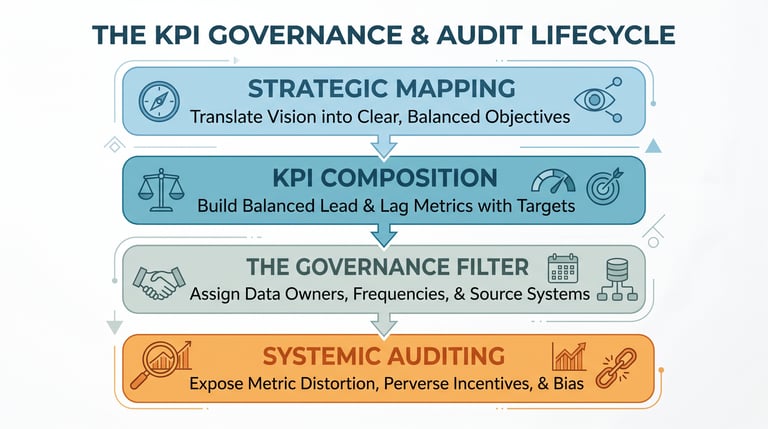
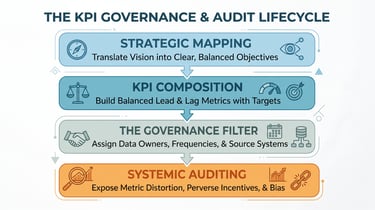
1. The Design Architecture: Translating Strategy into Balanced Metrics
An executive should never select KPIs from a generic template. Metrics must grow out of a firm’s unique strategic objectives. To prevent organizations from over-indexing on short-term financial returns, the Balanced Scorecard forces management to distribute KPIs across four distinct, cause-and-effect perspectives.
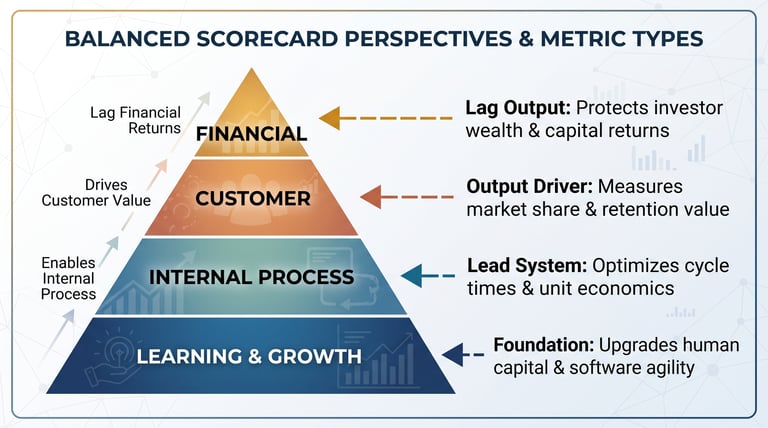
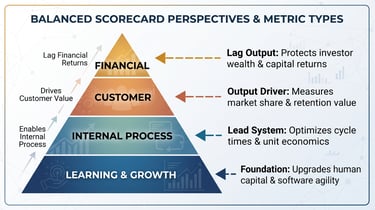
To build a robust dashboard, every chosen metric must fit into one of two operational categories:
Lagging Indicators (Output Metrics): These look backward to measure past performance (e.g., Net Profit Margin, Annual Customer Churn). They tell you what happened, but provide zero guidance on how to fix a down-trend in real time.
Leading Indicators (Predictive Metrics): These look forward to measure operational inputs that drive future success (e.g., Weekly Machine Downtime Hours, Employee Training Completion Rates). They serve as early warning signals, allowing management to intervene before financial damage occurs.
2. Practical Framework: The KPI Definition Matrix
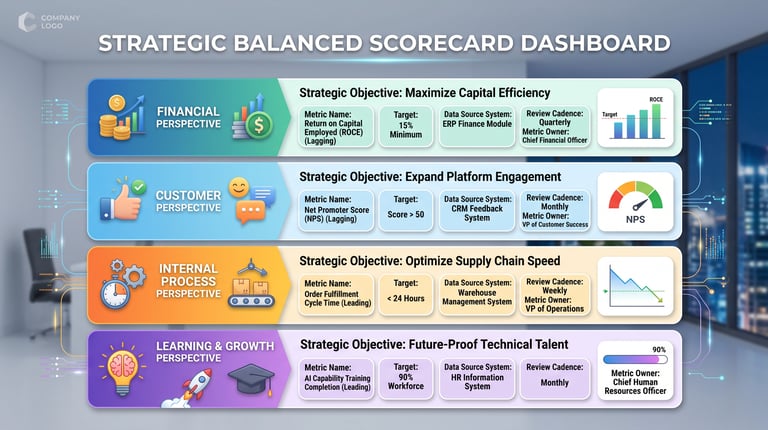
To move from abstract goals to measurable performance, every KPI must be rigorously defined using a standardized KPI Definition Matrix. This matrix eliminates ambiguity, identifies data sources, and establishes immediate accountability.


When implementing the matrix across your business units, ensure each metric defines the following operational dimensions:
3. The Blueprint: How to Audit Your Corporate KPIs
Even the most carefully designed metrics can degrade over time. Changes in technology, organizational structures, or market conditions can render once-useful KPIs completely irrelevant.
To prevent data distortion, executive boards must run a formal KPI Audit every 12 to 18 months, stress-testing each metric against three systemic failure modes:


Audit Vector A: Exposing Goodhart’s Law (The Gamification Risk)
Goodhart's Law states that when a measure becomes a target, it ceases to be a good measure. If employee bonuses are tied strictly to a single numeric metric, workers will naturally optimize their daily tasks to hit that target, even if doing so destroys broader corporate value.
The Audit Test: Look for places where teams hit their performance targets but overall business unit performance falls. For instance, if a customer service team hits its target for low "Average Call Duration" but customer retention rates drop, the metric has been gamified—agents are rushing clients off the phone to hit their speed target, destroying the customer experience.
Audit Vector B: Identifying Data Integrity and Silo Gaps
Many corporate KPIs fail because they rely on manual, unverified spreadsheet entries or siloed databases that do not talk to each other, leading to conflicting data.
The Audit Test: Run a data trace. Trace a KPI from the final board dashboard back to its raw origin point. If a metric requires manual manipulation, copy-pasting across systems, or subjective adjustments by a manager, its integrity is compromised. True strategic KPIs should pull data automatically from centralized core systems (like ERP, CRM, or HRIS platforms).
Audit Vector C: Balancing Lag and Lead Metrics
An organization that tracks only lagging financial metrics is like a captain steering a ship by looking exclusively at the wake behind it. Conversely, tracking only leading metrics can lead to high operational activity that fails to create bottom-line business value.
The Audit Test: Map your current KPI inventory. If more than 70% of your metrics look backward at financial and customer outcomes, your dashboard is unbalanced. You must introduce operational leading indicators to give frontline managers real-time levers to change future outcomes.
4. The Executive Audit Protocol: Keep, Evolve, or Exterminate
When the audit concludes, the corporate governance committee filters each performance metric through a final decision framework. This ensures the company's executive dashboard remains focused on a few highly critical KPIs rather than drowning in data noise. [1]
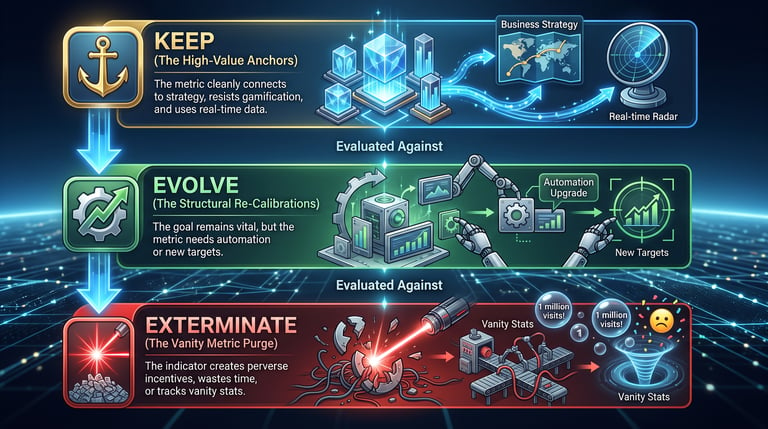

Keep: Retain metrics that show a clear cause-and-effect link to your strategic map, pull data from automated sources, and drive real value creation.
Evolve: Modify metrics that track a vital corporate goal but rely on outdated data collection or targets that no longer match current market realities.
Exterminate: Immediately cut metrics that encourage bad behavior, focus on vanity numbers (like total website hits or historical software downloads) that do not impact profitability, or cost more to track than the value they provide.
By enforcing this strict KPI design and audit framework, corporate leaders protect their organizations from metric paralysis. They transform their dashboards from simple corporate compliance tools into active, data-driven engines for rapid strategic execution.
Contact
Questions? Reach out anytime.
© 2025 BizSphere. All rights reserved.