
How International Students Can Conquer Cold Call Anxiety in US Business Schools
by Divya
6/8/20265 min read

The US business school classroom can feel like an intellectual battleground. For international students raised in lecture-based, "listening-first" cultures, the sudden shift to the US case method is often a shocking cultural pivot. The constant threat of the "cold call" where a professor calls on you without warning can trigger intense anxiety, especially when trying to translate complex business strategies into a second language under pressure.
However, speaking up in a case-based environment is not about flawless grammar or having the perfect answer. It is about strategic preparation and structured communication.
The lifecycle of a case discussion moves from individual preparation to real-time classroom tactics. By mastering each phase, you can turn cold call anxiety into a predictable, manageable routine.
1. The Strategy Shift: Contribution Over Perfection
In many global education systems, a student only speaks when they are 100% certain of the absolute correct answer. In a US case-method classroom, this mindset will keep you silent. US business education treats the classroom as a laboratory for management. Managers rarely have perfect information; they make decisions based on patterns, incomplete data, and calculated risks.
Shift your goal: Do not try to be the smartest person in the room. Aim to be the person who pushes the discussion forward.
Value your perspective: Your unique international background is an asset, not a barrier. A supply chain insight from your home country or a local market nuance adds massive value to a US-centric case.
Grammar doesn't dictate leadership: Business leaders care about clarity, logic, and structure, not whether you used the correct prepositions.
2. Advanced Case Prep: Engineering Your Comments
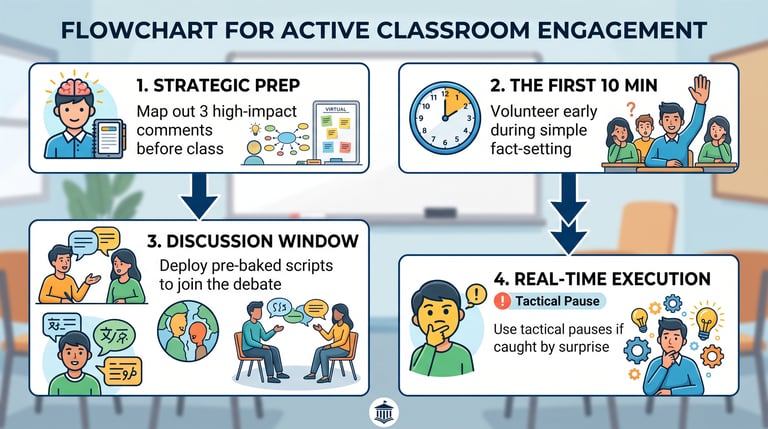
To reduce real-time anxiety, you must complete 80% of your talking prep before you ever step foot inside the lecture hall. When reading a case, do not just highlight text; actively engineer three high-impact comments you can deploy at different stages of the class.
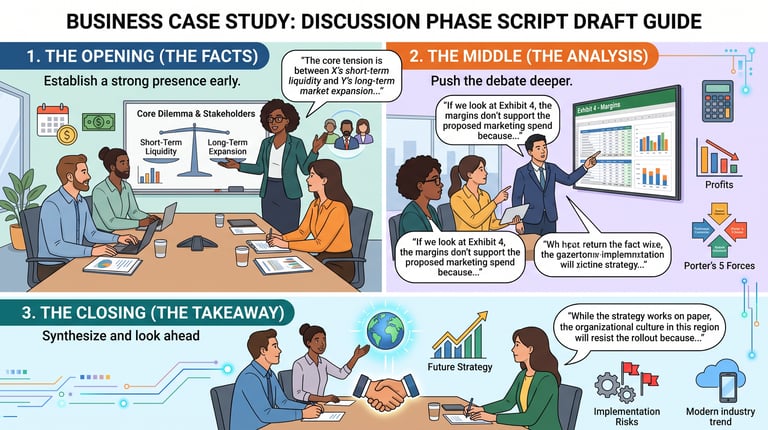
The Three-Tier Preparation Framework
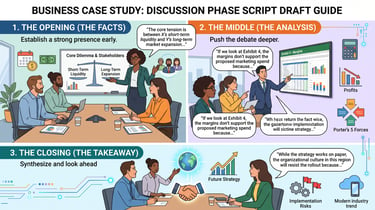
Use this structured matrix during your preparation to draft specific comments for different phases of the discussion:
3. Real-Time Tactics: The First 10 Minutes
The best way to neutralize cold call anxiety is to volunteer early. If you speak in the first ten minutes, you achieve three critical psychological and academic advantages:
You control the topic: You get to say what you prepared, rather than being forced to react to a complex tangent later in the hour.
You burn off adrenaline: Getting your voice into the room early breaks the psychological barrier and builds immediate confidence.
The bar is lower: Early questions usually focus on defining the problem or laying out basic case facts, which are much easier to state clearly than deep strategic trade-offs.
4. Actionable Scripts for Active Listening
A common fear among non-native speakers is that by the time they form a sentence in English, the class has already moved on. You can easily overcome this by using structural anchors—short, pre-baked phrases that buy your brain time to organize your core point while signaling to the professor that you are actively building on the debate.
When You Want to Agree and Expand
Do not just repeat what a classmate said. Validate their point, name them directly to show active listening, and add a fresh piece of data.
"I agree with [Name's] analysis of the financial risk, and I would add that Exhibit 3 shows a matching drop in consumer retention."
"Building on [Name’s] point about operations, we also need to consider how this impacts the frontline distributors."
When You Want to Disagree Politely
US classrooms value healthy, respectful disagreement. You do not need to be confrontational; frame your disagreement as an alternative hypothesis based on the data.
"I see [Name’s] point regarding expansion, but if we look at the regulatory barriers mentioned on page 6, a joint venture might be less risky."
"That is a compelling point, but I interpret the data in Exhibit 2 differently because..."
When You Want to Pivot the Discussion
If the class is stuck in a loop or hyper-focused on a minor detail, you can earn massive participation points by steering the room back to the big picture.
"We have spent a lot of time on the marketing budget, but I would like to pivot our attention back to the CEO's primary dilemma regarding leadership succession."
"To take a step back, how does this tactical decision align with the firm's long-term mission?"
5. Overcoming the "Brain Freeze" During a Cold Call
Even with perfect preparation, a professor might catch you off guard. If your name is called and your mind goes blank, do not panic, and do not stay silent. Use tactical pauses and structural frameworks to buy thinking time.
The Acknowledge & Repeat Strategy: Repeat the professor's question slowly to give your brain a few seconds to process.
“How would I handle the pricing strategy for Product X? Looking at the options presented in the case, I see two distinct paths we could take...”
The Framework Fallback: If you do not know the exact tactical answer, analyze the problem through a broad business lens. State your framework out loud.
“I am still evaluating the exact pricing number, but if we look at this through a competitive positioning framework, our primary concern has to be market share protection rather than immediate margin maximization.”
The Honest Pivot: If you genuinely did not calculate a specific metric, admit it quickly and pivot to an area where you have strong thoughts.
“I haven't calculated the exact net present value for that scenario yet, but looking at the qualitative risks of the expansion, the cultural mismatch seems to be the biggest threat.”
6. Building Relationships Outside the Lecture Hall
Your strategy to survive the case method should not start and end in the classroom. Use your time between classes to build structural support systems.
Leverage Your Study Group: Treat your small group as a safe sandbox. Practice pitching your ideas to your peers in English before class. Ask them for feedback on clarity.
Visit Office Hours: Meet your professors early in the semester. Be transparent about your background. Tell them: "I come from a lecture-based culture and am working hard to adapt to the case method. I might take an extra moment to raise my hand, but I am fully engaged." Professors appreciate this proactive approach and will often give you cleaner openings to speak during class.
The US case method is a learned skill, not an innate talent. By shifting your focus from linguistic perfection to strategic contribution, prepping predictable entry points, and leveraging structured scripts, you can confidently speak up, make an impact, and thrive in any business school environment.
Contact
Questions? Reach out anytime.
© 2025 BizSphere. All rights reserved.