
How to plan your week when you work full-time and study.
by Divya
5/25/20265 min read


Balancing a 40-hour workweek with a demanding Master of Business Administration (MBA) curriculum is one of the most intense professional challenges you will ever face. Without a systematic approach to your time, you run a high risk of experiencing severe burnout, missing critical academic deadlines, and seeing your professional performance suffer.
The secret weapon used by successful executive and part-time MBA students is the Sunday Reset. This is not a vague lifestyle trend. It is a highly structured, 30-to-60-minute executive planning ritual performed every Sunday afternoon or evening. It transforms you from a reactive participant in your week into a proactive manager of your time, resources, and mental energy.
This comprehensive, step-by-step guide provides a blueprint to build a customized, bulletproof weekly routine.
Why MBA Students Fail Without a Reset System
Most part-time students fail to find balance because they fall victim to the "Switching Cost" fallacy. In cognitive science, task-switching costs refer to the loss of time and mental energy when you constantly shift focus between unrelated tasks.
If you log off from work at 5:00 PM and spend an hour figuring out what you should study next, you waste precious executive function.
You risk procrastinating because your brain is exhausted.
You encounter decision fatigue before you even open a textbook.
Your study sessions become fragmented and highly inefficient.
The Sunday Reset solves this problem by separating planning from execution. By dedicating Sunday to making all your scheduling decisions, you can spend Monday through Saturday executing your plan with zero friction.
The Step-by-Step Sunday Reset Workflow
Set aside 45 minutes every Sunday. Turn off all phone notifications, open your preferred digital planning tools, and execute these four phases in order.
Step 1: The Executive Brain Dump
Clear your mental RAM. Take a blank sheet of paper or a digital canvas like Notion or Miro. Write down every single item currently competing for your attention. Do not try to organize, judge, or format them yet. Just list them out.
Your list should include:
Professional items: Deliverables, client meetings, performance reviews, presentation prep, and administrative tasks.
Academic items: Case study readings, group project meetings, data analysis assignments, discussion board posts, and upcoming exams.
Personal items: Grocery shopping, meal prep, workouts, social obligations, bills, and family commitments.
Step 2: The Time Audit & Fixed Calendar Mapping
Before you can schedule your tasks, you must identify your non-negotiable constraints. Open a digital calendar, such as Google Calendar or Microsoft Outlook, and block out your fixed, non-negotiable time blocks for the upcoming week.
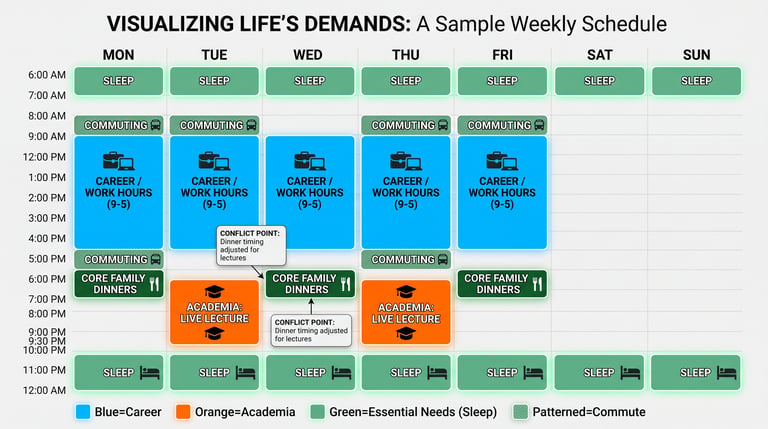
Once these blocks are placed on your calendar, calculate your remaining "White Space" the true number of discretionary hours you have available for independent study, group collaboration, and personal rest.
Step 3: Strategic Triaging (The MBA Eisenhower Matrix)
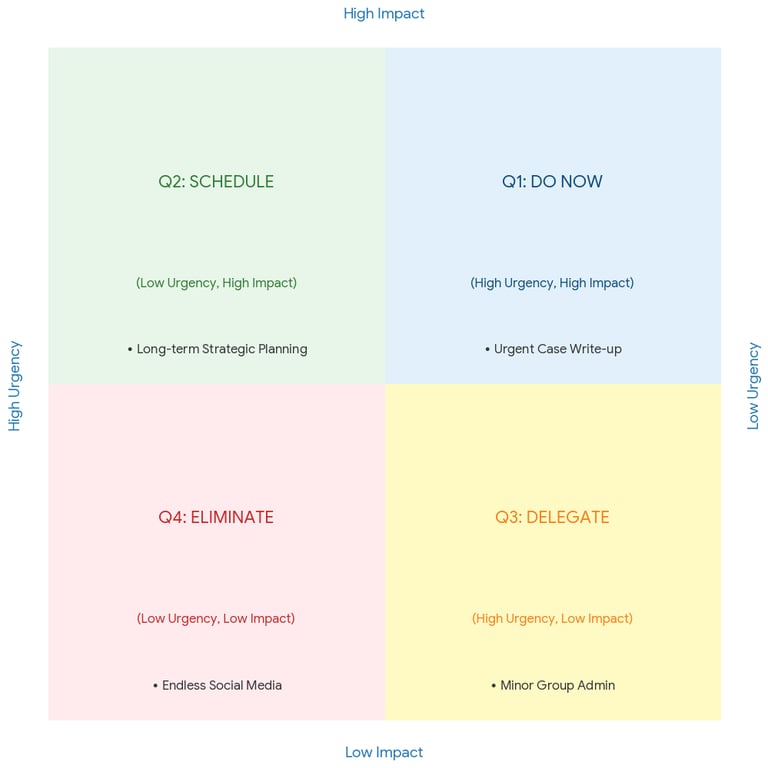
Take your raw brain dump from Step One and filter it through a modified Eisenhower Matrix. This matrix forces you to evaluate tasks based on two metrics: Impact and Urgency.



Step 4: High-Yield Time Blocking & Buffer Insertion
Now, match your high-value Quadrant 2 tasks with your available calendar white space. Apply these three rules to ensure your time blocks are realistic:
The 90-Minute Rule: Academic research and deep financial modeling require significant cognitive setup time. Create study blocks that are at least 90 minutes long to help you reach a state of deep focus.
Energy-Task Alignment: If you are a morning person, block out hard academic tasks (like microeconomics or statistics) from 6:00 AM to 7:30 AM before work. If you are an evening person, reserve 8:00 PM to 9:30 PM. Never schedule your most difficult readings for your lowest energy period of the day.
The 15% Buffer Rule: Unexpected events will happen. A work crisis will run late, or a case study will take longer than expected. Leave at least 15% of your weekly white space completely blank. This acts as a buffer zone to help you catch up without derailing your entire week.
A Realistic Weekly Master Schedule
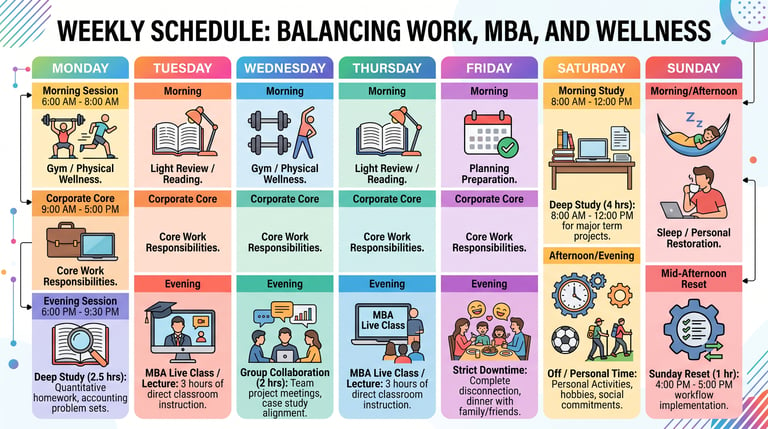
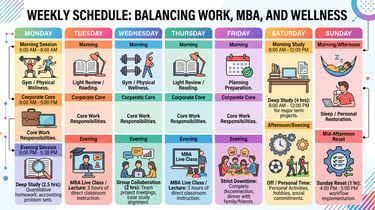
Below is a master schedule template for a part-time MBA student who works a standard 9-to-5 corporate job. It shows how to balance professional responsibilities with an optimal 20-hour weekly study plan.
Advanced Frameworks to Optimize Execution
The 80/20 Rule for MBA Readings - Business school professors assign massive amounts of reading material. Trying to read every single word of every case study line-by-line while working full-time is an ineffective strategy. Instead, apply the Pareto Principle (80% of the insights come from 20% of the text):
Read the Executive Summary and Conclusion first. Understand the core business problem and the final outcome.
Review the charts, tables, and financial exhibits. Data tells the story faster than paragraphs of text.
Skim the body text. Look for section headers and bold terms that directly support the conclusion.
Professional Boundaries and the "No" Inventory. To protect your study time, you must manage expectations at your job.
Refuse non-essential corporate projects that do not align with your core career goals.
Avoid volunteering for extra committees during your academic quarters or semesters.
Create a list of polite responses to guard your schedule (e.g., "I cannot take the lead on this new initiative right now due to existing project commitments, but I can review the final draft next week.").
Actionable Sunday Reset Checklist
Keep this checklist handy every Sunday afternoon to guide your planning session:
Empty your email inboxes (both corporate and university accounts) to ensure no hidden tasks are lingering.
Review your university syllabus for the next 14 days to prevent upcoming exams or paper deadlines from surprising you.
Complete the 15-minute executive brain dump on paper or a digital notebook.
Update your calendar constraints, including work travel, doctor appointments, and family events.
Categorize your tasks using the 4-quadrant matrix.
Block out your 90-minute study sessions directly into your calendar.
Meal prep or organize your clothing for the week to save time during busy weekday mornings.
Explore More Business Articles
Contact
Questions? Reach out anytime.
© 2025 BizSphere. All rights reserved.