
How to Use Machine Learning Data to Test New Markets Before Launching Products
by Divya
6/29/20263 min read


AI-driven market entry allows modern enterprises to minimize launch risks by using predictive analytics instead of relying solely on historical, retrospective data. Traditional market validation often takes months of manual surveying, but machine learning models can instantly process millions of unstructured data points like real-time consumer sentiment, localized search trends, and supply chain bottlenecks to simulate consumer demand before a physical product ever launches. By analyzing these data points simultaneously, companies can identify hidden consumer segments and predict exact purchase intent with unprecedented accuracy.
To execute this strategy successfully, companies generally follow a sequential four-step pipeline to transform raw regional data into a highly precise launch plan.
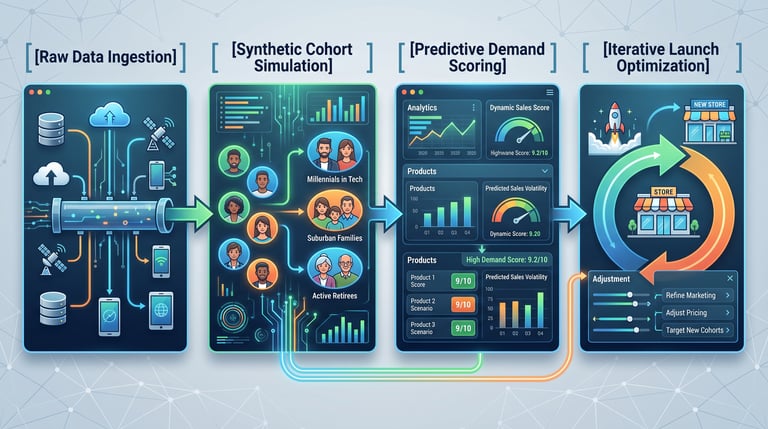
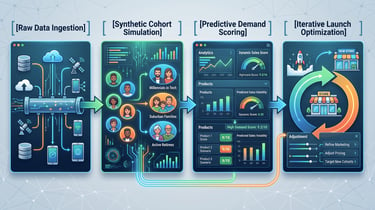
First, data engineering teams aggregate localized web scraping inputs, macroeconomic indicators, and competitor pricing variables into a centralized model. Second, the machine learning system creates synthetic consumer personas to simulate how different demographics will respond to pricing changes or marketing messages. Third, the model outputs a predictive demand score, ranking potential geographic regions by their immediate conversion potential. Finally, the business uses these scores to optimize supply chain logistics and marketing spend, ensuring resources are only deployed to high-probability markets.
When evaluating which machine learning framework to deploy for this validation process, teams typically choose between three core modeling methodologies based on their specific data constraints.
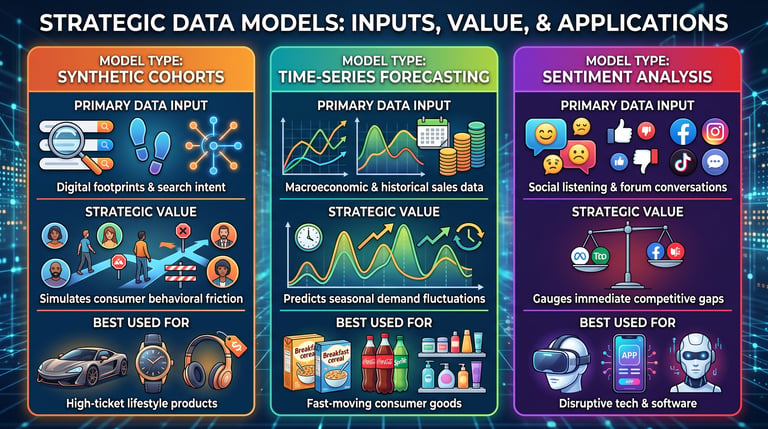
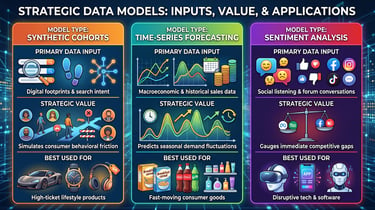
While these models provide immense clarity, advanced operators must watch for data drift, where rapid real-time cultural shifts cause the model's accuracy to degrade over time. To counter this, data pipelines must refresh continuously with live API feeds to prevent the machine learning algorithm from making predictions based on stale, outdated consumer patterns. Organizations that master this continuous loop can confidently scale their footprint, turning market entry from a high-stakes gamble into a highly predictable, data-backed science.
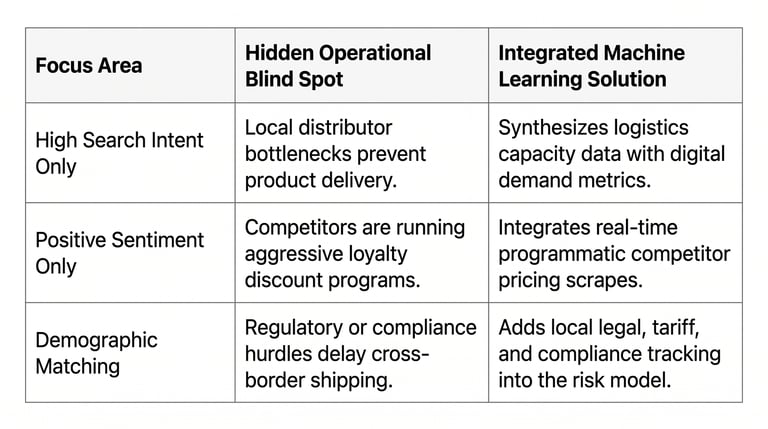
However, an incomplete data model or a fragmented pipeline is the primary reason AI-driven market entry strategies fail during the pre-launch validation phase. When machine learning models operate on siloed datasets such as analyzing consumer sentiment while ignoring localized supply chain constraints they create an inaccurate picture of market readiness. To prevent these blind spots, data engineering teams must build an end-to-end framework that continuously syncs consumer behavior metrics with operational realities before making a final go-to-market decision.
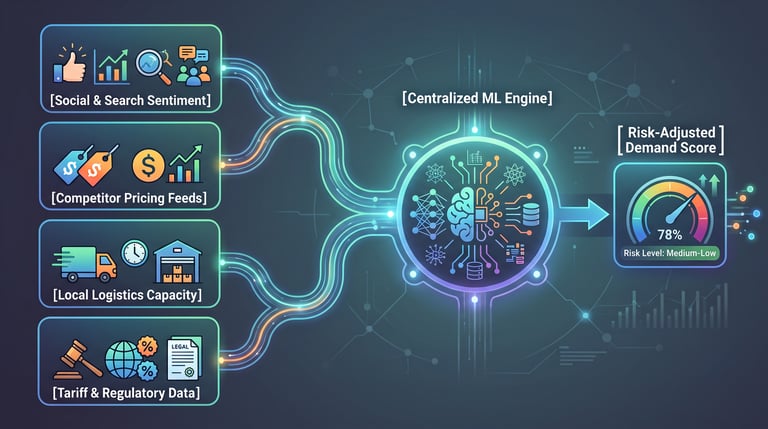

To bridge these gaps, organizations use a unified data infrastructure where disparate inputs feed a singular, centralized machine learning engine to output a risk-adjusted demand score. The table below outlines how specific operational blind spots distort predictive accuracy and how a fully integrated data pipeline corrects them.
Once these variables are unified, executive teams can move away from binary "go or no-go" decisions and instead utilize dynamic, phased rollouts based on real-time data thresholds. If the machine learning model flags a sudden drop in sentiment or a spike in shipping costs, the deployment pipeline automatically scales back ad spend and redirects inventory to a more stable micro-market. Ultimately, this continuous, self-correcting feedback loop ensures that the market entry strategy remains resilient, profitable, and fully aligned with shifting real-world conditions.
Contact
Questions? Reach out anytime.
© 2025 BizSphere. All rights reserved.