
Intel Strategic Supply Chain Cost Management Case Study
by Divya
5/19/20263 min read


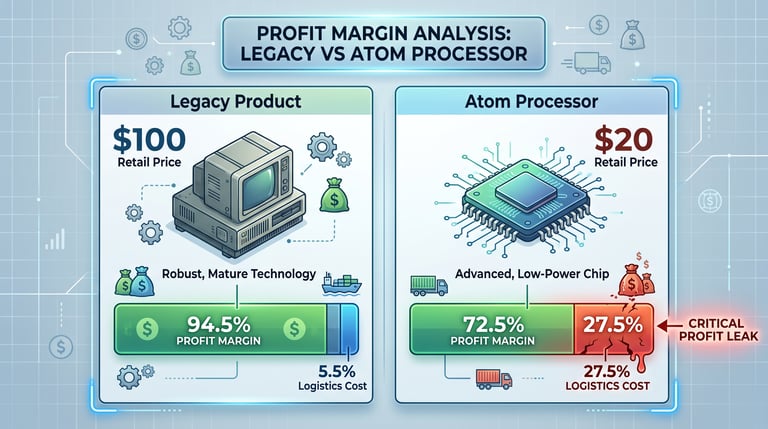
This case study evaluates how Intel Corporation resolved a severe product-process misalignment during the launch of its low-cost Atom processor. Historically optimized for premium, high-margin microprocessors retailing at approximately $100, Intel’s supply chain carried an unviable fixed overhead of $5.50 per unit. When the $20 Atom chip debuted, this logistics burden swallowed an unacceptable 27.5% of gross product revenue.
Bound by strict product performance standards and lean physical packaging, Intel could not reduce manufacturing quality, duty tariffs, or baseline freight rates. This left inventory holding levels as the sole lever for optimization. By pivoting from a traditional semiconductor Make-to-Stock (MTS) push framework to an agile, demand-driven Make-to-Order (MTO) pull ecosystem, Intel compressed its order cycle time from nine weeks to just two weeks, driving down per-unit supply chain costs by over $4.00.
Intel's legacy logistics infrastructure was designed to prioritize product availability over asset turnover. Premium chips could easily absorb high inventory expenses. However, the low-cost Atom chip completely disrupted this cost structure.
The Cost Structure Trap
High-Margin Benchmark: A $5.50 fulfillment cost represents a manageable 5.5% drag on a $100 processor.
Low-Cost Disruptor: For a $20 unit, that same $5.50 cost represents an unsustainable 27.5% supply chain tax, eroding the product's profit margin.
Constraint Matrix
To solve the cost issue, Intel's management team had to work within a highly restricted operational boundary:
Zero Quality Trade-offs: Chip performance parameters could not be lowered to save money; components required absolute reliability.
Inelastic Customs Duties: The Atom chip was packaged as a single-component SKU, leaving no room to restructure tariff classifications.
Optimized Physical Dimensions: Packaging footprints and high value-to-weight ratios were already streamlined, eliminating any further gains in basic freight cube utilization.
The Long-Cycle Vulnerability: The primary driver of high inventory costs was a rigid nine-week customer order cycle time, which forced the company to maintain massive safety stock buffers.
Intel tackled this challenge by launching an iterative pilot program with an assembly and test contractor in Malaysia. The goal was to systematically identify and eliminate process waste.
Transitioning to a Lean Pull Network
The team shifted the manufacturing paradigm from an inventory-heavy push configuration to an agile, demand-driven Make-to-Order (MTO) model. To achieve this without hurting order fulfillment rates, Intel deployed three interconnected tactical changes:
Assembly and Test Window Compression: The factory testing and validation cycle was compressed from a slow, rolling 5-day schedule into a highly focused, bi-weekly 2-day sprint. This cleared production floor bottlenecks.
Sales and Operations Planning (S&OP) Integration: Intel implemented a cross-functional S&OP framework. This system aligned real-time market demand directly with factory floor capacity, smoothing out production spikes.
Vendor-Managed Inventory (VMI): Upstream component supply chains were converted to a VMI model wherever possible. This pushed ownership and storage costs back to suppliers until the materials were actually pulled into production.
The structural overhaul significantly altered Intel's primary operational and financial metrics.


Little’s Law and Working Capital Acceleration
From an operations management perspective, Intel's turnaround is a textbook application of Little's Law, which governs inventory dynamics:
By holding throughput requirements constant to meet market demand, Intel focused on aggressively cutting Flow Time (T) from 9 weeks down to 2 weeks. This mathematical reduction cut the volume of work-in-process and finished goods sitting idle in the supply chain pipeline. Less trapped inventory meant lower holding costs, which directly reduced the per-unit fulfillment expense.
Product-Process Alignment Matrix
In supply chain theory, low-cost commodities with predictable demand require an efficient supply chain layout. High-cost, variable items require a responsive configuration.
Intel's legacy network treated the Atom chip like a highly responsive product. By reducing the order cycle time down to two weeks, they aligned a low-cost commodity with a highly efficient, lean distribution network. This fixed the strategic mismatch and protected the product's profitability.
Takeaways
Intel's restructuring of the Atom processor supply chain provides key lessons for modern operations managers:
Inventory Explains Cost Inefficiencies: When freight, packaging, and tariffs cannot be changed, reducing process cycle times is the most effective way to cut logistics costs.
Challenge Industry Assumptions: While the semiconductor industry typically relies on large production batches and Make-to-Stock models, a lean Make-to-Order framework can work for low-cost, high-volume products if process waste is eliminated.
Continuous, Iterative Improvements Lower Risk: Rather than attempting a risky, overnight global overhaul, Intel tested and refined its new strategy in a regional Malaysian pilot program before scaling it across the organization.
Contact
Questions? Reach out anytime.
© 2025 BizSphere. All rights reserved.