
John Deere Strategic Supply Chain Cost Management Case Study
by Divya
5/18/20264 min read
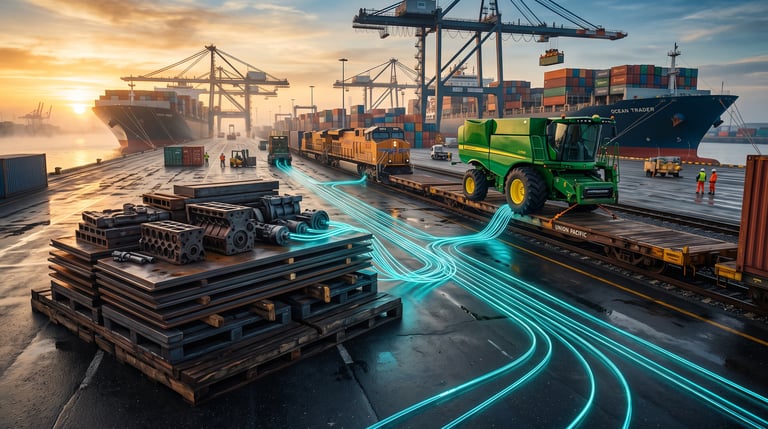
This case study examines how Deere & Company (John Deere), a global leader in agricultural, construction, and forestry machinery, transformed its complex logistics operations. Historically plagued by high inventory holding costs, extreme seasonal demand, and rigid weekly shipping cycles, the company executed a multi-year strategic sourcing and network optimization redesign. By transitioning from a rigid push-based model to a flexible pull-based network utilizing intermediate merge centers and third-party logistics (3PL) providers, John Deere realized a $1 billion reduction in excess inventory, sliced customer delivery lead times in half, and generated an annual transportation cost savings of approximately 5%.
Founded in 1837, Deere & Company has grown into an industrial heavyweight. In 2014, the company secured the 80th position on the Fortune 500 list and stood at 307th in the Fortune Global 500 standings. The manufacturer operates via a complex product architecture divided broadly into:
Standardized, high-volume equipment for the mass consumer market.
Highly customized, engineer-to-order (ETO) machinery built explicitly for industrial, agricultural, and forestry enterprises.
Managing this massive catalog introduces significant operational friction. The business is heavily constrained by extreme seasonality, with up to 70% of retail sales clustered tightly between March and July.
At the turn of the millennium, John Deere’s Commercial and Consumer Equipment division faced an unsustainable operational crisis. The legacy fulfillment network was structured around a rigid, factory-to-dealer push model. Dealers were replenished strictly on a weekly cycle. Heavy machinery was loaded onto cargo ships or long-haul trucks and dispatched directly from manufacturing warehouses to individual dealerships.
This operational architecture triggered severe performance challenges:
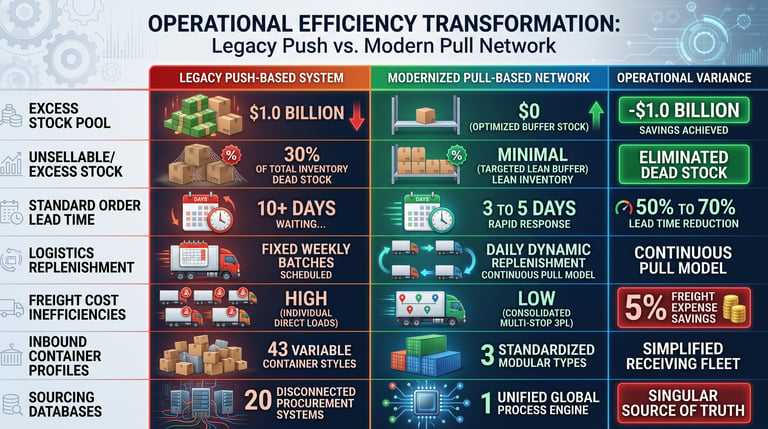
The $1 Billion Excess Inventory Trap: Due to massive demand spikes during the spring agricultural season, the division carried $1 billion in excess inventory to buffer against stockouts. Up to 30% of total warehouse stock was classified as slow-moving or completely unsellable.
Extreme Procurement Leverage: External purchasing accounted for 70% of total product costs, rendering the company highly vulnerable to minor supply shocks and variable vendor prices.
Inbound Packaging Chaos: The manufacturing facilities were receiving components across 43 distinct types of shipping containers, creating friction at offloading bays, slowing down cross-docking operations, and inflating material handling labor costs.
Bloated Fulfillment Cycles: Standard dealer order fulfillment dragged on for 10 or more business days, causing frustrated customers to seek alternative competitors during tight farming windows.
Faced with these compounding variables, corporate leadership established a strict performance mandate: reduce global supply chain operational costs by 10% over a four-year horizon.
To overcome these barriers, management transitioned from localized, tactical purchasing to an enterprise-wide strategic sourcing framework. The core metrics table below outlines the operational shift:
John Deere achieved its turnaround by deploying a series of supply chain restructuring projects.
Category Spend Architecture and Process Integration
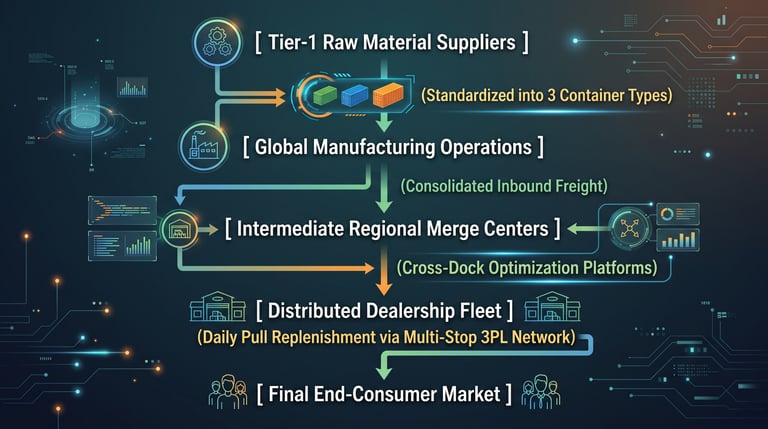
Instead of attempting to negotiate aggressive price cuts from individual vendors, the procurement team systematically mapped out 100% of external material spending. They collapsed 20 independent regional ordering networks into one global process engine. This enabled raw component aggregation and massive volume-purchasing discounts. To optimize warehouse receipt speeds, they standardized inbound logistics by compressing the 43 erratic container types into just 3 uniform styles. This allowed material handlers to leverage predictable cross-dock schedules.
Implementation of Intermediate Merge Centers
Rather than shipping equipment directly from factories to remote end-dealers, John Deere built a multi-stage distribution architecture using strategically positioned intermediate merge centers.
High-volume consumer goods and fast-moving components are stored at these regional hubs, situated close to major dealer clusters and shipping ports. This network design decoupled erratic factory production queues from market demand.
Transition to Dynamic Daily Replenishment via 3PL
By holding safety stock at centralized merge centers, John Deere abandoned weekly direct shipments. They shifted to a rapid daily replenishment cycle. To control the added overhead of daily shipments, the manufacturer outsourced outbound freight management to specialized third-party logistics (3PL) providers. These 3PL firms consolidated scattered, low-volume orders into unified, multi-stop truckloads. This tactical system maxed out container capacity and slashed empty backhaul miles.
The optimization program yielded major operational dividends across John Deere’s business units:
Balance Sheet Optimization: Streamlining the distribution pipeline slashed $1 billion in excess inventory costs, driving working capital efficiency and elevating free cash flow.
Transportation Savings: Consolidating shipments through 3PL channels cut annual freight and transportation expenses by 5%.
Agile Customer Fulfillment: Standard product delivery timelines were squeezed from 10 days down to 5 days during baseline windows, and plummeted to just 3 days during intense peak agricultural seasons.
Resiliency and Nearshoring Strategy: This restructuring built a foundation for future agility. For example, John Deere expanded its domestic industrial footprint by shifting premium excavator manufacturing from overseas facilities back to its core North American hubs, such as Kernersville, North Carolina, thereby minimizing international trade exposure.
John Deere’s turnaround highlights a core truth in modern operations: long-term cost reduction is not achieved by squeeze-tactics or demanding lower prices from vendors. Instead, organizations must eliminate structural waste, standardize infrastructure, and deploy data-driven distribution models to build long-term value.
Contact
Questions? Reach out anytime.
© 2025 BizSphere. All rights reserved.