
SpaceX Surges Past Microsoft And Amazon In Trillion Dollar Market Cap Flipping
by Divya
6/16/20262 min read


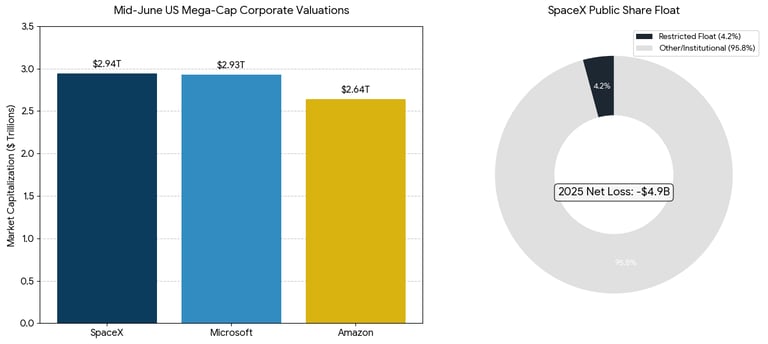
A spectacular 13 percent intraday surge propelled SpaceX to a brief market capitalization of $2.94 trillion, engineering a historic shakeup in the corporate hierarchy. Following its record-shattering initial public offering, the aerospace and artificial intelligence conglomerate temporarily leapfrogged tech titans Microsoft and Amazon. This rapid escalation briefly established Elon Musk’s firm as the fourth-largest public company in the United States, demonstrating how speculative fervor and strategic cross-sector positioning can rapidly reshape modern equity markets.
From an investment banking and corporate valuation perspective, this unprecedented growth presents an extreme decoupling of traditional fundamental metrics from forward-looking growth premiums. Financial data shows that SpaceX achieved its near-$3 trillion status despite recording a steep $4.9 billion net loss for the 2025 fiscal year. MBA students of financial analysis should note that the market chose to heavily discount these current operational deficits, choosing instead to price in aggressive multi-industry growth curves stemming from the integration of the Starlink satellite constellation, SpaceX launch infrastructure, and the newly absorbed xAI capabilities.
The structural mechanics of this equity surge also offer a compelling lesson in capital structure and market liquidity. Only about 4.2 percent of total SpaceX shares were floated on the open market at the debut, causing a severe supply-side constraint that amplified buy-side order pressure during intraday trading. This thin public float, combined with massive institutional demand and aggressive momentum trading, triggered standard short-squeeze dynamics in derivative markets. The resulting price volatility underscores how supply elasticity in mega-cap equities can introduce rapid, distorted spikes in corporate valuation.
Strategic expansion played a definitive role in convincing the market to value SpaceX like an enterprise software or cloud compute platform rather than a traditional hardware contractor. Coinciding with the trading surge, the company finalized a massive $60 billion acquisition of Anysphere, the developer of the artificial intelligence coding application Cursor. This aggressive move, alongside plans to rent terrestrial Nvidia GPU data infrastructure at premium rates, signaled a diversification strategy aimed at capturing high-margin tech revenue. For students of strategic management, this case highlights how a firm can leverage its core infrastructure advantage to pivot into adjacent, highly valued technology ecosystems.
Contact
Questions? Reach out anytime.
© 2025 BizSphere. All rights reserved.