
Strategic Integration of Sustainability into Corporate Strategy and Value Chains
by Divya
4/1/20263 min read


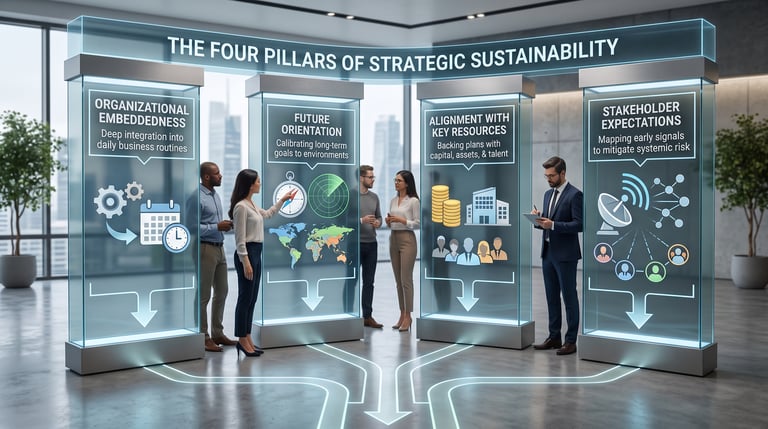
Modern corporate strategy, historically defined as a set of goal-directed actions taken to gain and sustain competitive advantage, is undergoing a fundamental paradigm shift. Future business leaders can no longer separate a firm’s internal and external market focus from its broader socio-ecological footprint. True strategy determines not just financial objectives, but defines the range of business a company pursues, the nature of its economic and non-economic contributions, and its responsibilities to shareholders, employees, customers, and communities alike. To move beyond superficial corporate social responsibility, executives must anchor sustainability within a core strategic framework built upon four foundational pillars: organizational embeddedness, future orientation, alignment with key resources, and the proactive consideration of stakeholder expectations.
Operationalizing these pillars requires an analytical understanding of how strategy and sustainability intersect, which occurs through two primary architectural directions: outside-in and inside-out approaches. The outside-in perspective recognizes that a firm's competitive context both enables and restricts its strategic choices. By mapping the external landscape, executives identify sustainability issues that can be leveraged to shape their competitive context in favorable ways. This involves optimizing factor conditions through resource preservation, aligning with shifting demand conditions, securing the resilience of supporting industries and suppliers, and shaping the competitive context by establishing progressive rules and incentives. Conversely, the inside-out perspective relies on a resource-oriented view, analyzing the firm’s routine business operations through its value chain to redesign internal activities so they simultaneously support environmental stewardship and corporate profitability.
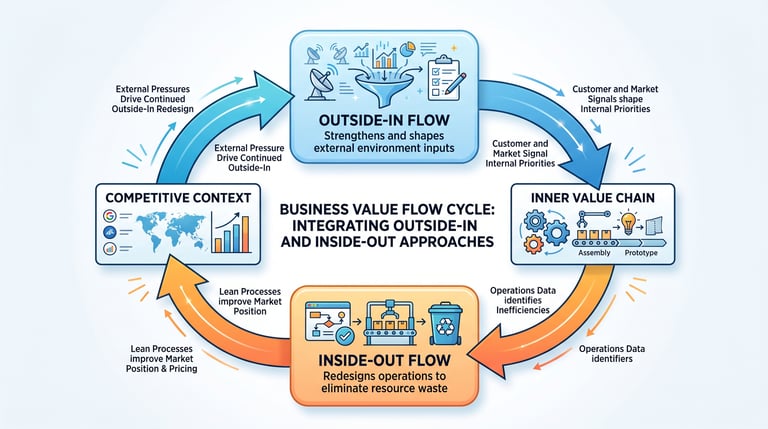
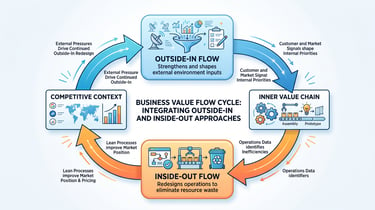
When executing an inside-out transformation, the value chain serves as the primary diagnostic tool for corporate alignment. Primary and support activities are re-engineered to eliminate systemic waste and capture new efficiencies. In inbound and outbound logistics, this manifests as switching to low-emission modes of transportation. In operations and product design, companies reduce packaging materials to lower distribution costs, design products to optimize resource efficiency such as minimizing water usage during manufacturing and incentivize customers to repair products rather than replace them, extending the product lifecycle. On the structural side, supply chain managers work collaboratively with vendors to improve supplier productivity, while human resource teams integrate sustainability-related key performance indicators directly into executive compensation models, cementing accountability at the governance level.
Organizations progress through distinct maturity stages as they attempt to align their commercial strategies with these sustainability realities. This evolution generally moves along a continuum from total denial, to isolated initiatives, to defensive posturing, before finally reaching embedded and transformative states. Within executive leadership, this transformation dictates the shifting level of strategic ambition, moving from simple value protection to active value creation.
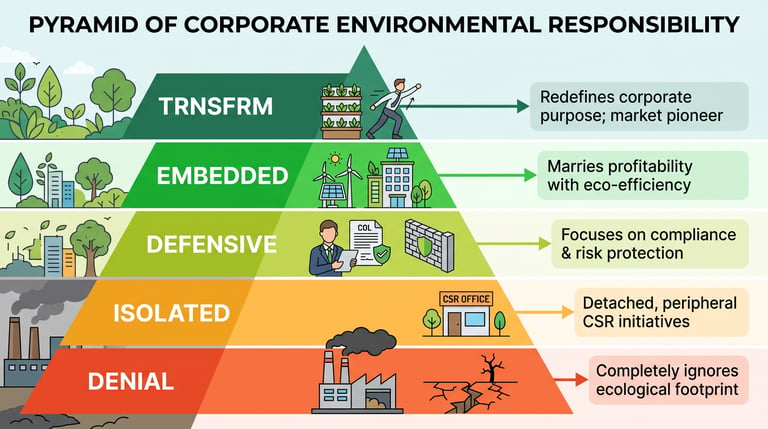
The baseline phase of this ambition matrix focuses strictly on value protection, establishing a corporate license to operate. This is a defensive, risk-minimization approach driven by compliance with tightening international sustainability accounting standards and local environmental regulations. The secondary phase elevates the strategy to value enhancement, where sustainability initiatives are explicitly designed to raise profitability, either through internal operational cost savings or customer-facing market differentiators. The ultimate corporate phase centers on true value creation. Here, a company completely redefines its corporate purpose, accepting technological risks and return-on-investment uncertainties to build new industrial ecosystems, drive net-zero supply chain alignment, and generate long-term value for both society and shareholders.
Ultimately, the business case for strategic sustainability is balanced on a dual framework of risk mitigation and opportunity capture. From a risk perspective, aggressive sustainability management insulates a corporation from legal and political interventions, guards assets against the physical impacts of extreme weather, protects the brand from reputational scandals, and neutralizes competitive vulnerabilities. From an opportunity perspective, a progressive sustainability posture drives revenue generation by capturing expanding consumer segments, attracts and retains high-tier talent whose values align with the firm, and enhances long-term operational effectiveness. For the modern executive, sustainability is no longer an auxiliary cost center; it is an indispensable framework for managing corporate risk, optimizing resource productivity, and maintaining market relevance in a resource-constrained global economy.
Explore More Business Articles
Contact
Questions? Reach out anytime.
© 2025 BizSphere. All rights reserved.