
Strategic Operational Protocols for Corporate Governance During Global Liquidity Emergencies
by Divya
4/10/20264 min read


A sudden, systemic cash flow freeze is an existential threat requiring immediate, decisive corporate intervention. When a macroeconomic shock, credit market contraction, or rapid operational failure cuts off an enterprise's liquidity, the executive leadership team enters a high-stakes scenario. Survival depends on moving past routine accounting practices and shifting to a central, defensive cash-preservation framework. This playbook outlines the critical governance steps, liquidity-preservation models, and stakeholder management frameworks required to keep a corporation solvent during a sudden liquidity crisis.
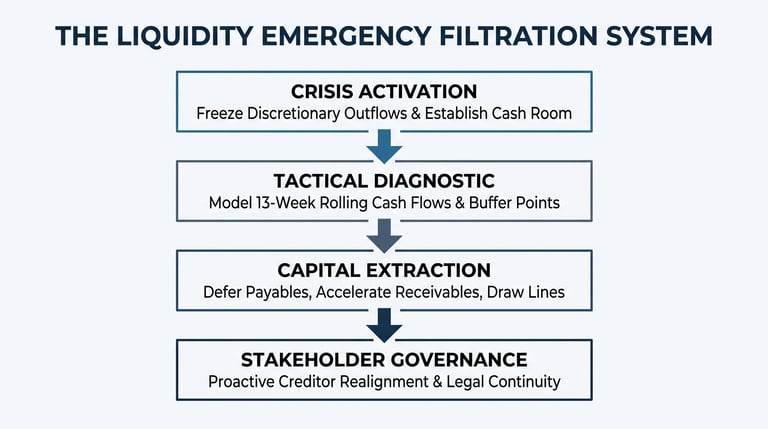
1. Immediate Stabilization: Activating the Cash Command Center
Within the first 48 hours of a systemic cash flow freeze, the Chief Executive Officer and Chief Financial Officer must halt all non-essential outflows and centralize corporate spending authority.
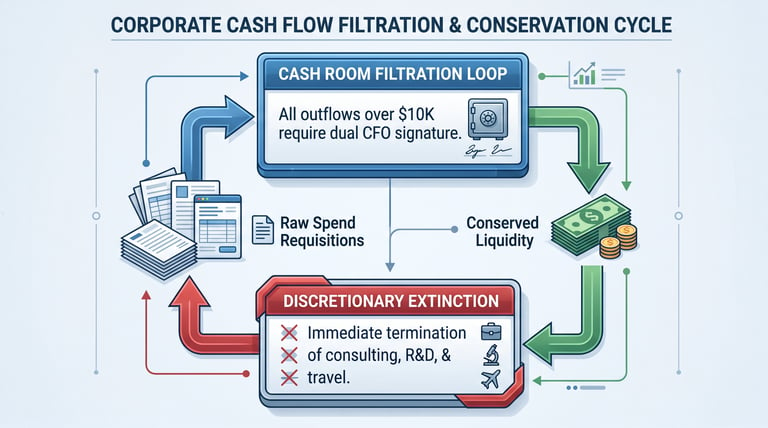
To establish absolute control over corporate liquidity, leadership must immediately deploy three stabilization rules:
The Cash Room Mandate: Establish a dedicated cash command center. All business unit spending authority is suspended. Every single cash outflow above a minimal threshold (e.g., $10,000) must be manually reviewed and approved by the CFO and a designated restructuring officer.
Immediate Discretionary Freeze: Suspend all non-essential corporate spending. This includes freezing marketing campaigns, halting internal research and development, stopping active hiring pipelines, and canceling all corporate travel. Existing consulting contracts and non-operational vendor agreements should be suspended pending review.
Capital Expenditure Moratorium: Immediately halt all uncommitted capital expenditure projects. Active construction, software rollouts, or equipment acquisitions must be paused and secured to prevent further cash leakages.
2. Tactical Financial Diagnostics: The 13-Week Cash Flow Engine
During a liquidity crisis, traditional accounting metrics like net income, EBITDA, and monthly balance sheets are useless. Leadership must transition entirely to an active 13-Week Rolling Cash Flow Model to map out precisely when the firm's cash reserves will hit zero.
This diagnostic engine requires corporate finance teams to track cash movements on a purely cash-in, cash-out basis:
Cash Receipts Modeling: Project incoming cash based on historical collection speeds, adjusted for potential client delays during a wider market crunch. Do not rely on uncollected accounts receivable or expected new contract wins.
Cash Disbursements Modeling: Map out critical cash outlays required to maintain baseline operations. This includes mapping payroll cycles, rent, taxes, essential utility payments, and core supplier invoices.
Identifying the Buffer Point: Calculate the net cash position at the end of each weekly cycle. By identifying the exact week where cash dipping below operational thresholds creates a risk of insolvency, management gains a clear timeline to execute more aggressive financial restructuring maneuvers.
3. Capital Optimization: Squeezing the Working Capital Belt
To push the firm's cash buffer point further out, management must execute aggressive working capital adjustments to extract every dollar of trapped liquidity from internal operations.
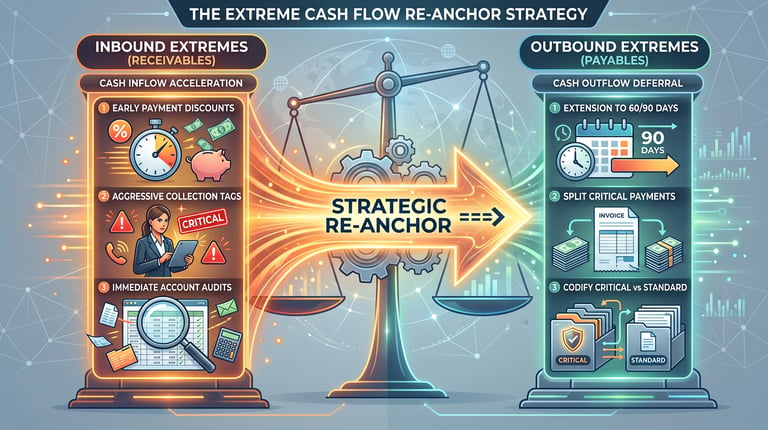
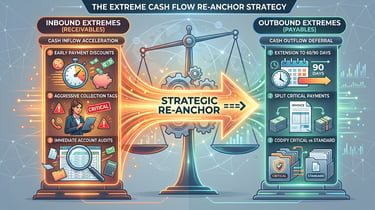
Working capital optimization requires taking extreme, coordinated action across both sides of the ledger:
Accelerating Cash Inflows: Review the accounts receivable ledger. Offer immediate financial discounts (e.g., 2% cash discounts) to corporate clients who settle outstanding balances within 72 hours. Transition sales teams to cash-on-delivery terms for new transactions, and deploy senior managers to personally pursue high-value, overdue accounts.
Stretching Cash Outflows: Systematically extend accounts payable cycles. Shift standard vendors to 60-day or 90-day payment terms, explaining the temporary liquidity situation transparently to long-term partners. Prioritize payments to "critical suppliers" those vendors whose products or services are absolutely necessary to keep the business open while holding back payments to secondary service providers.
Defensive Liquidity Extraction: Draw down the maximum allowable limits on all existing revolving credit facilities and bank lines of credit immediately, before lenders attempt to freeze access. If necessary, consider selling non-core business assets or factoring high-quality accounts receivable to specialist financial institutions to generate immediate cash.
4. Stakeholder Governance and Strategic Alignment Frameworks
Surviving a deep liquidity crisis requires proactive, highly structured communication with external stakeholders to prevent them from taking legal action that could force the company into bankruptcy.
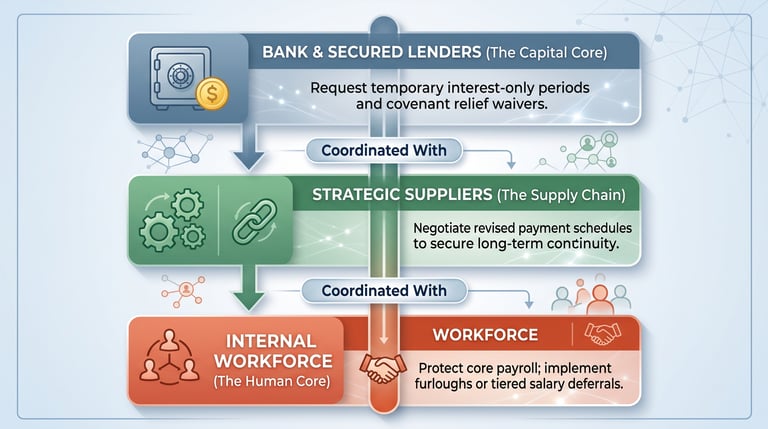
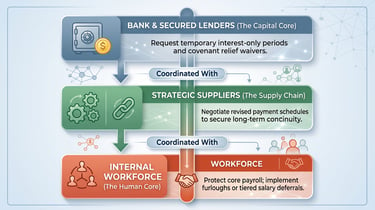
Management must maintain parallel negotiation tracks across three primary stakeholder groups:
Managing Bank and Debt Partners: Do not hide financial distress from lenders. Arrange immediate meetings with secured creditors and banking syndicates to present the 13-week cash model and operational stabilization plan. Request temporary interest-only payment periods, relief from debt-covenant compliance violations, or bridge-financing facilities to support the company through the stabilization window.
Managing the Core Supply Chain: Maintain transparent communication with critical vendors. Explain the steps the firm is taking to secure new funding, and present structured, realistic payment plans to settle outstanding debts over time. Securing supply chain continuity prevents a total operational shutdown that would erase any chance of recovery.
Protecting the Workforce: Prioritize employee payroll above all other unsecured obligations to prevent a mass loss of talent and legal penalties. If payroll costs are structurally unsustainable relative to incoming cash flows, management must quickly implement tiered temporary salary deferrals, freeze bonuses, or execute structured furloughs to protect the company's core survival.
Contact
Questions? Reach out anytime.
© 2025 BizSphere. All rights reserved.