The Executive Talent Matrix Balancing Technical Expertise and Emotional Intelligence in Modern Hiring
by Divya
6/1/20264 min read


The corporate recruitment landscape is undergoing a profound structural shift. For decades, the rulebook for securing a high-paying corporate role was clear-cut: master a highly technical, quantifiable skill set, display it prominently on your resume, and let your execution drive your advancement.
Today, that linear equation has completely broken down.
As automated platforms, cloud computing, and advanced generative AI systems commoditize standard technical tasks, the value premium has shifted radically. Corporate recruiters are no longer merely looking for technical specialists who operate in a vacuum. Instead, they are actively hunting for cross-functional orchestrators who can synthesize data, align teams, and manage emotional friction. This analysis breaks down exactly how today's hiring market balances hard technical skills with soft leadership competencies.
Redefining Competency in a Tech-Driven Economy
To understand how contemporary recruiters evaluate talent, we must first examine how the lifespan of a skill has changed.
Hard Skills: Quantifiable, rule-governed capabilities easily verified via technical testing, certifications, or direct portfolios (e.g., Python scripting, SQL architecture, predictive data modeling).
Soft Skills: Behavioral, relational traits that dictate how an individual manages interpersonal dynamics, navigates stress, and steers organizational culture (e.g., emotional intelligence, active listening, psychological safety curation).
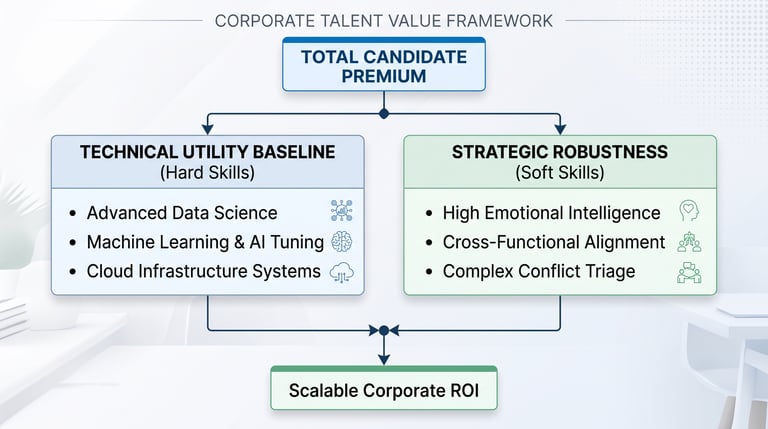
The underlying catalyst for this shifting dynamic is obsolescence velocity. The half-life of a technical hard skill has contracted to an historical low of four to five years. In fast-evolving fields like artificial intelligence and cloud engineering, that number drops to less than three years.
Because hard skills decay rapidly, recruiters view them as short-term operational tools. Conversely, core soft skills act as permanent capital assets. They determine a candidate’s learning agility the critical ability to absorb, discard, and refresh technical frameworks as the market demands.
The Recruiter’s Valuation Matrix Across Corporate Tiers
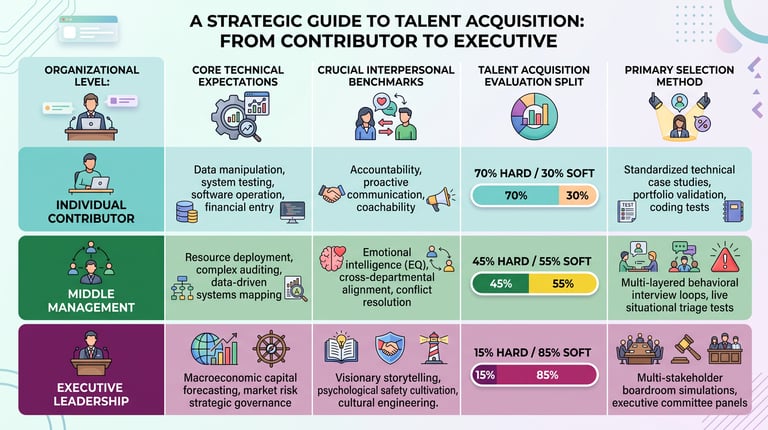
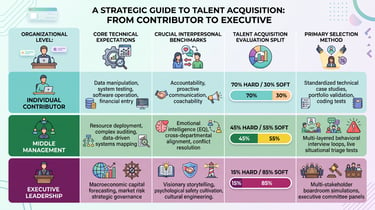
Corporate talent acquisition teams do not value skills uniformly. Evaluation priorities alter drastically based on the seniority of the role and the level of systemic influence required.
The matrix below illustrates the balancing act performed by modern recruiters when evaluating candidates at different career milestones:
Macroeconomic Factors Driving the Evolution
Several structural market forces have elevated soft skills from secondary "interpersonal pluses" to primary survival mechanisms for modern organizations.
1. The Democratization of Technical Execution
Enterprise AI and low-code/no-code platforms have thoroughly democratized foundational technical work. Tasks that once required junior analysts to spend dozens of hours querying databases or formatting complex financial models are now completed in seconds. The human value-add has moved upstream. Recruiters now pass over rigid technicians in favor of professionals who can critically analyze automated data and communicate its strategic implications to non-technical stakeholders.
2. The Nuances of Distributed and Hybrid Workplaces
Leading a hybrid or fully remote workforce demands an exceptionally high degree of emotional intelligence. Managers can no longer gauge team morale or detect burnout through passive hallway interactions. They must be intentional, communicative, and highly perceptive. Modern recruiters systematically screen out command-and-control managers, seeking leaders who build trust through clear asynchronous workflows and active empathy.
3. Hyper-Agile Organizational Shifts
The modern enterprise operates in a state of perpetual transformation. Due to sudden market shifts, an organization may completely overhaul its tech stack, product suite, or client delivery model within a single fiscal year. Companies cannot afford to hire professionals who lock themselves into static technical domains. They look for high cognitive flexibility and systemic resilience traits that ensure a worker can help guide a team through corporate turbulence without suffering a drop in operational output.
The Interview Infrastructure: Isolating Behavioral Realities
Because soft skills were historically difficult to measure objectively, corporate recruitment pipelines default-indexed on easily verifiable credentials like university tiers or technical certificates. Modern recruitment infrastructure avoids this pitfall by using highly calibrated, behavior-focused evaluation loops.
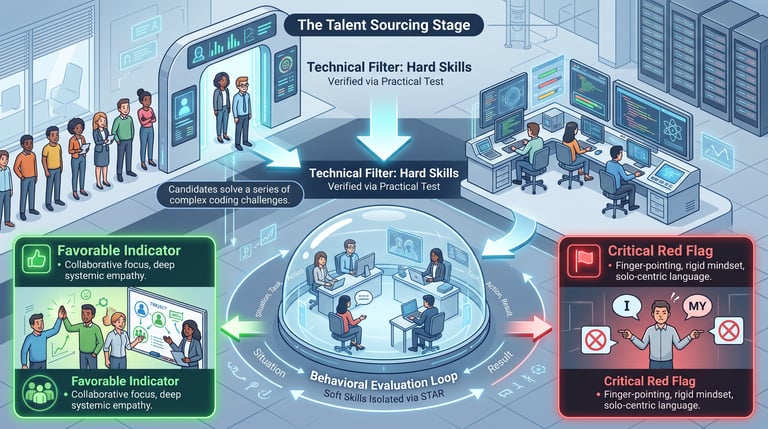
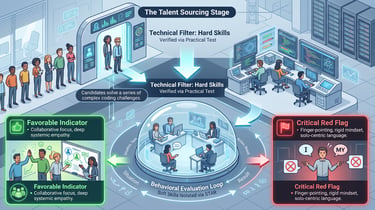
The engine of modern behavioral screening is a rigorous adaptation of the STAR Method (Situation, Task, Action, Result). Recruiters skip past the technical "Result" to meticulously dissect the "Action" phase, scanning for key markers:
The Pronoun Audit: Talent acquisition specialists note a candidate's language choices. A candidate who relies heavily on "I" when describing a massive, cross-functional project flags poor teamwork habits. Balanced use of "we," "our team," and "collaborative partners" signals strong operational integration.
The Psychological Friction Test: Candidates are asked to recount a high-stakes project that failed due to a breakdown in communication. Recruiters look for cognitive empathy the candidate's ability to clearly and objectively explain their counterpart’s position without sounding dismissive or defensive.
The Ambiguity Threshold: Recruiters present hypothetical scenarios containing incomplete data and conflicting priorities. The goal isn’t to find a perfect technical solution, but to observe how well the candidate manages the emotional anxiety of making decisions under systemic pressure.
Navigating the Future of Corporate Talent
The ultimate goal of modern enterprise recruitment is to secure the T-Shaped Professional. This framework represents a perfect blend of hard and soft capabilities.
The horizontal top bar represents the breadth of a professional's soft skills their ability to connect disparate business units, lead with emotional intelligence, and adapt to cultural shifts. The vertical stem represents the depth of their technical competence within a specific functional area (like advanced data analytics or cloud architecture).
Contact
Questions? Reach out anytime.
© 2025 BizSphere. All rights reserved.