
Turning Accent Fears into a Competitive Advantage in Business School Group Projects
by Divya
6/9/20263 min read


The business school team room can feel much more intimidating than a large lecture hall. For international students, high-stakes group projects often trigger a specific type of imposter syndrome rooted in accent fears and the terror of being misunderstood by domestic peers. This anxiety frequently leads brilliant students to stay silent, pull back from leadership roles, or stick strictly to quantitative "back-room" analysis.
However, an accent is not a communication deficit; it is the literal footprint of a multilingual brain. In a globalized business environment, your international perspective is a massive project asset, not a liability. By combining targeted psychological shifts with structured team-communication protocols, you can overcome self-doubt and claim your rightful authority in any group setting.
The roadmap to building this authority can be broken down into a continuous, self-reinforcing process:
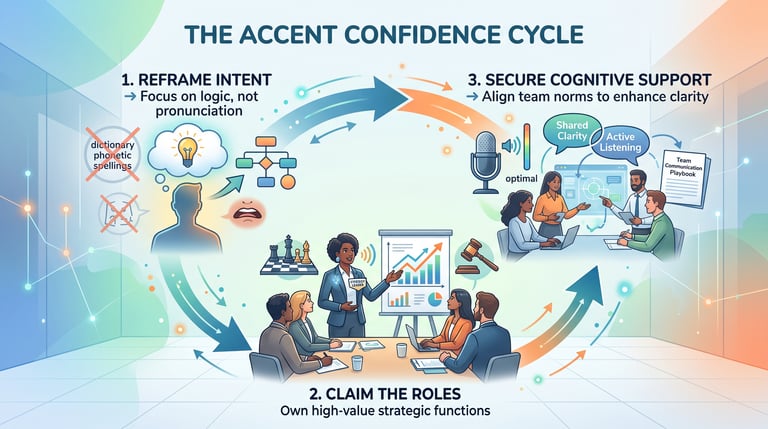
1. The Psychological Shift: Redefining "Perfect English"
Imposter syndrome thrives on the false assumption that domestic students possess a superior business intuition purely because they speak English without a foreign accent. To break this mental trap, you must reframe how you view communication in a professional environment.
Prioritize clarity over native pronunciation: Global business leaders do not care about a flawless American or British accent. They care about structured logic, data-driven insights, and actionable solutions.
Recognize the listener's job: Communication is a two-way street. It is not your sole responsibility to adapt to a specific dialect. A diverse team means everyone adjusts their listening habits to understand global variations.
Stop over-monitoring your speech: When you spend your mental energy tracking your grammar mistakes mid-sentence, you lose focus on the strategic value of your ideas. Speak with conviction and let the data carry your point.
2. Direct Team Communication Strategies
Instead of hiding your accent fears, address the team dynamic proactively during your very first group meeting. Setting explicit communication boundaries eliminates awkwardness and builds mutual trust early on.
The "Day One" Transparency Script
When your team forms, establish a norm of mutual support. This positions your language development as a shared operational goal rather than a personal weakness:
"I bring deep experience in [your industry/country market], but because English is my second language, I sometimes think through complex frameworks in my native script first. If I ever say something that isn't clear, please stop me and ask for clarification. I won't take it personally at all—it helps me ensure we are completely aligned on the project goals."
Reclaiming the Floor During Brainstorming
If fast-talking domestic peers dominate the conversation, use structural entry phrases to pause the discussion and introduce your framework:
"Let's take a step back and look at how this decision impacts our global supply chain compliance."
"I want to add an international perspective to this market entry model based on what I’ve seen succeed in emerging markets."
"Before we finalize the financial projections, we need to stress-test our assumptions against regional regulatory risks."
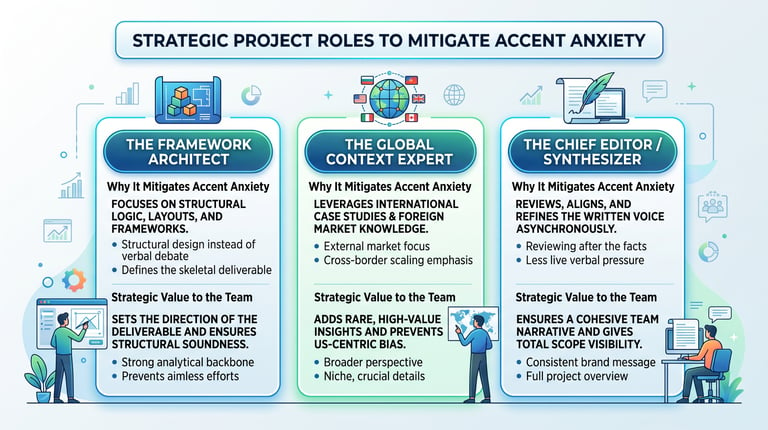
3. High-Impact Strategic Team Roles
Do not let accent fears relegate you to hidden spreadsheet data entry. Reclaim your leadership presence by volunteering for high-value strategic functions that play directly to your strengths.
4. Building Cognitive Support Systems
Reduce real-time presentation or meeting anxiety by integrating asynchronous tools and written prep routines into your workflow.
The Shared Workspace Strategy: Utilize digital collaboration platforms like Google Workspace or Microsoft Teams to document your ideas visually before meetings. When your team can see your diagrams or bullet points in a shared doc, the pressure to deliver a flawless spontaneous speech disappears.
Pre-Baked Slide Ownership: When preparing for a final presentation, claim specific slides early. Practice the exact transition phrases and core takeaways for those slides until they become second nature.
The "Two-Pass" Review: If you are nervous about writing grammar in final deliverables, do a structural data pass first. Focus entirely on getting your business insights down on paper, then ask a peer or use institutional writing centers to do a quick secondary proofread.
Your accent is a testament to your adaptability, international mobility, and intellectual stamina. By asserting your perspective early, building supportive team norms, and focusing entirely on strategic contribution, you can turn your global background into your team's greatest competitive advantage.
Contact
Questions? Reach out anytime.
© 2025 BizSphere. All rights reserved.